China (setting)
Showing posts with label China (setting). Show all posts

The historic, horrific lives that the Forest built and destroyed {Barkskins by Annie Proulx}


Barkskins by Annie Proulx*: From Annie Proulx—the Pulitzer Prize-­ and National Book Award-­winning author of The Shipping News and “Brokeback Mountain,” comes her masterwork: an epic, dazzling, violent, magnificently dramatic novel about the taking down of the world’s forests.

In the late seventeenth century two penniless young Frenchmen, René Sel and Charles Duquet, arrive in New France. Bound to a feudal lord, a “seigneur,” for three years in exchange for land, they become wood-cutters—barkskins. René suffers extraordinary hardship, oppressed by the forest he is charged with clearing. He is forced to marry a Mi’kmaw woman and their descendants live trapped between two inimical cultures. But Duquet, crafty and ruthless, runs away from the seigneur, becomes a fur trader, then sets up a timber business. Proulx tells the stories of the descendants of Sel and Duquet over three hundred years—their travels across North America, to Europe, China, and New Zealand, under stunningly brutal conditions—the revenge of rivals, accidents, pestilence, Indian attacks, and cultural annihilation. Over and over again, they seize what they can of a presumed infinite resource, leaving the modern-day characters face to face with possible ecological collapse.

Proulx’s inimitable genius is her creation of characters who are so vivid—in their greed, lust, vengefulness, or their simple compassion and hope—that we follow them with fierce attention. Annie Proulx is one of the most formidable and compelling American writers, and Barkskins is her greatest novel, a magnificent marriage of history and imagination.

My two cents
An ambitious novel spanning over 300 years, Barkskins presents the history of logging and the deterioration of the world's forests -- from widespread unapologetic clearcutting to today's alarm over global warming -- through the family histories of two men.

Barkskins were servants brought in to clear vast tracts of land in New France (now Canada) during the late 17th century. The politicized history of the world's forests is told through the family histories of barkskins,  René Sel and Charles Duquet.

Sel took on the backbreaking work. Despite his loyalty, he is forced to marry an older Mi'kmaq, Mari, the mistress of his signeur. Over generations, the Sel's lives tell of great hardship and toil, exacerbated by the fact that Native Americans bore the brunt in a white man's world. There is a continuous battle to hold on to their lifeways but were marginalized and moreso impoverished in the process.

Duquet, ambitious yet unused to hard work, runs away. Duquet makes a fortune, mostly on furs and lumber, but mainly through unscrupulous means. He marries the daughter of his rich Dutch business partner. Anglicizing the family name to Duke, he builds the Duke and Sons timber empire who wreaks havoc on the untouched forests in other countries over the next century.

*** 

I've not read any of Annie Proulx's work but she looms large in the literary world. So can you really blame me for wanting to read this ... and love it? I had built this up in my mind but I ended up getting a mixed bag. I loved the beginning up until about three fourths of it, before I started to feel I was slogging through. The tone changed to preachy and everything suddenly felt rushed.

Let's not overlook the fact that this is a chunkster (700+ pages). Prepare yourself for the experience. And don't dare rush this one if you're keen on getting something from this, because Proulx has a lot to offer.

The heart of this book is humanity's ever-conflicted relationship with nature. There are two contrasting views about resource utilization: the "to hell with it" extract as much as possible, profit to the hilt and move on, or the more measured (and informed) way where extraction is based on need and allowing the resource regenerate naturally. Today's return to sustainable resource utilization is borne out of the realization that resources are not limitless and is, too, a return to the holistic views of many indigenous cultures.

This is about the politics of forests. I can't help but applaud at Proulx's decision to write this highly politicized and polarizing book. It is seemingly inevitable as white man conquered and colonized and took lands for their own leaving native American tribe of the Mi'kmaq severely marginalized, poor, and socially and culturally unmoored.

Delving into the politics of the extraction of natural resources, only confirms an age old modus operandi -- there will be the moneyed and powerful who will get as much as they can from from the earth and take advantage of people to succeed. Capitalism can be greedy, rapacious, ruthless. At stake are indigenous cultures and their harmonious relationship with nature. But Proulx attempts to bring this story full circle, a conscientization of her readers: what have we done, and what shall we do about it?

This was very well researched, rich in the detail not only of the history and cultures, but more importantly of the science behind the story. Foresters, ecologists, historians, sociologists, I know you will delight in the details! However, the devil is in the details: it's easy to get lost and distracted in them (good or bad, that is totally up to you).

The earlier portion of the book made the characters feel real with horrific descriptions of the mental anguish and physical hardships they had to endure. But character upon character came into the cast and with the varying lengths by which they appear in the story, the sense of time was easily lost on me. Despite having the family tree, it did little to ease how I followed along in the characters' lives.

Verdict:
I can't help but applaud at Proulx's decision to write this highly politicized and polarizing book. Well researched and rich in detail, this was a mixed bag for me in terms of the reading experience. I loved the beginning but Proulx lost me towards the end. However, I still recommend this book and suggest reading in short bursts lest 700+ pages intimidates you!

History has a way of repeating itself. {The Incarnations by Susan Barker}


History has a way of repeating itself.

About The Incarnations by Susan Barker: Hailed as “China’s Midnight’s Children” (The Independent) this “brilliant, mind-expanding, and wildly original novel” (Chris Cleave) about a Beijing taxi driver whose past incarnations over one thousand years haunt him through searing letters sent by his mysterious soulmate.

Who are you? you must be wondering. I am your soulmate, your old friend, and I have come back to this city of sixteen million in search of you.

So begins the first letter that falls into Wang’s lap as he flips down the visor in his taxi. The letters that follow are filled with the stories of Wang’s previous lives—from escaping a marriage to a spirit bride, to being a slave on the run from Genghis Khan, to living as a fisherman during the Opium Wars, and being a teenager on the Red Guard during the cultural revolution—bound to his mysterious “soulmate,” spanning one thousand years of betrayal and intrigue. As the letters continue to appear seemingly out of thin air, Wang becomes convinced that someone is watching him—someone who claims to have known him for over one thousand years. And with each letter, Wang feels the watcher growing closer and closer…

Seamlessly weaving Chinese folklore, history, and literary classics, The Incarnations is a taut and gripping novel that sheds light on the cyclical nature of history as it hints that the past is never truly settled.

My two cents

Wang's middle-aged humdrum life takes a turn when an anonymous letter is left in his taxi. It claims to be from his "soulmate" and eerily describes his movements ... and Wang's past lives. As more letters follow, each detailing Wang's incarnations, one wonders: should Wang accept this as truth, or more sensibly, chalk this up as the rantings of a lunatic stalker?

The novel alternates between Wang's life story and the letters depicting his past lives.

Snapshots of Wang's life today: A taxi driver's struggle to make ends meet. Time spent with wife Yida and daughter Echo. A strained relationship with his father and his second wife. Revelations of the impacts of the death of his biological mother on his childhood, and finally, an unravelling of family life and the revelation of Wang's relationship with a lover spurned.

Meanwhile, with each letter—told in the voice of someone very close to each incarnation—Wang's five incarnations take the reader on a journey through China's history, and Wang's present and potential future.

***

I was blown away by this novel. I already had high expectations from the onset because of the blurb (how many books can be compared to Midnight's Children?). I also found the author blurb fascinating since Barker is British and Malaysian-Chinese. This novel delivered on so many levels that I'm still in a bit of a daze as I write this.

Intriguing story structure
With a beginning so intriguing, I wondered vaguely where Wang's present-day story would pan out. But what really excited me was when each of the letters came around. What I initially thought would be simply alternating present-day story with incarnation story was turned on its head as the arc of this story played itself out! I found the structure surprising and unpredictable, and definitely befitting of the overall theme of reincarnation.

I loved the mysteriousness of who the letter writer is and I had my ideas about who it could be. I am sure that you'll have a hunch and make some good guesses but it won't take away from the exposition.

Tight short stories within a story, diverse characters
Each letter is a short story in itself, a vignette of a life during a particular time period in China's history. The incarnations include a woman pledged to become a Spirit Bride, a male slave during the rule of Genghis Khan, a fisherman during the Opium Wars, a concubine in The Forbidden City, and a teenage revolutionary during the Cultural Revolution. These incarnations span over a thousand years! There is a lot to learn if you have just a cursory knowledge of China's history and her people.

What is particularly fascinating to me is that despite the individual stories being able to stand alone, they all play a part in the overall story arc, masterfully done!

Uh-ohs

Wang's incarnations had rather wretched existences and were often in oppressive circumstances. Sex and the politics of sex is a recurring theme. Oh, this can be brutal, graphic reading including sexual violence and physical abuse. There were sections of this that made me feel sick and I had to skim the overtly graphic descriptions of a castration and sadistic sex.

Verdict: A masterful story build around the theme of reincarnation, highlighting the fascinating people of and the brutal history of China. I dare not give too much information about this book as a first time reading of this truly an experience. Highly recommended.

I received and Advance Reader Copy from the publisher for honest review consideration.


The Beauty Experiment by Phoebe Baker Hyde


I can have my cake and eat too, i.e. I can have my red lipstick and love myself. 

About The Beauty Experiment by Phoebe Baker Hyde: I looked at my reflection and despaired. As an exhausted young mother I felt ugly and saw that a new dress or face cream would never help. I was at risk of passing on a habit of feeling miserable about my looks to my baby girl—if nothing changed.

Soon afterward Phoebe Baker Hyde made a vow: to give up new clothes, makeup, haircuts, and jewelry in hopes of revealing something she had always paid lip service to but never quite believed in—her inner beauty. The Beauty Experiment chronicles Hyde’s quest for self-acceptance in nothing but her own skin. In thoughtful, exquisite prose, Hyde holds up a mirror to all women and shows how perfectionism can keep us from achieving what we really want: happiness, confidence, and serenity.


My two cents

What if we forgot all the trappings of womanhood and focused on what really matters—inner beauty? Can you "survive" without your perfect red lipstick, or your power heels, your layered mane, or the perfect girly blouse? That's what the author did in The Beauty Experiment. As she navigates the expat life in Hong Kong, with an overly busy husband and headache-inducing demands of her children, she abandons all these things in an attempt to get to the crux of the matter ... and love herself.

While this is a fun and funny read, it will prod you into thinking about how society has shaped our ideals of beauty and much we place value in looking good, including the different superficial things that can become "crutches." This book breaks it all down from hair, cosmetics, how we and society judge a woman's appearance over history, clothing, appearance "professionals." And in the end, one can use the Beauty Wealth Calculator and see what percentage of ones' net worth goes into wardrobe and beauty products.

***

I have bad (horrible) hair days. I felt fat and ugly after pregnancy. I have had a love-hate relationship with my wardrobe. I can relate in so many ways to the feelings of insecurity experienced in different phases in her life throughout this book.

What I can't relate to is how the author equates her self-acceptance to these externals (which all seem to be quite skewed to the high-end spectrum, by the way). What was running through my mind was: Ahhh, First World problems! Why is ditching the lipstick or a salon haircut such a big deal in the first place? Really, how many cosmetics does one need (for example, going through her list of things to toss (p. 28) made me laugh -- I have never used anti-brassiness hair glosser or a microdermabrasion kit in my life!)? Why does she place so much value in buying the new designer dress for potentially just one-time use?

This is the list on page 28 ... how many of these do you have?
For a person like myself, who is pretty low maintenance and is all into moderation, this is mind-boggling because I feel that having these external trappings and inner beauty aren't mutually exclusive concepts. I'm a bit of a cynic and it's difficult for me to wrap my head around totally buying into what media says. I also think that I can have my cake and eat it too, i.e. I can indulge in my favourite red lipstick and love myself at the same time.

Props to her for her honesty, though. She doesn't sugarcoat anything (let's face it, who wants to admit that they don't shave their armpits?)

The "beauty" crisis that the author goes through seems more a function of her low self-esteem and the major life changes she was going through. The fact that she was also in an alien culture with its own set of views about appearances didn't exactly help her already fragile ego.

This book is a memoir, and as such, there is a lot of information about the personal circumstances of the author (albeit a little bit whiny for my taste). This is not a cut-and-dried experiment as the title led me to believe. However it is a valuable documented experience of one woman, informed by her own research and gaining more info from woman surveyed.

Verdict: This book has the potential to resonate with any woman with its lesson of self-love and self-acceptance, whether one loves their beauty products or not! While I found the experiment a bit extreme, I can relate to the author's struggle to understand herself better and find her happy balance.

***

As part of this review, I decided to try one of the suggested activities provided by the author. You may want to try one of these yourself!

I chose no. 2 under the Experiment Activities because I did a variation of it several years after my pregnancy.

My wardrobe was littered with clothes that simply did not fit, lots of faddish pre-pregnancy pieces, and lots of things on sale which I bought because they were on sale and not necessarily because I liked them. It was all a function of impulse buys, of sentimental clothing, and a (rather futile) hope that I'd fit into all my clothes again. My wardrobe stressed me out.

I decided to de-stress myself. I decided that I would only buy what I needed (say, I need a new pair of dress slacks and not: "I'll go shopping to feel better"), and only what I loved (no more: "I guess it looks ok on me, and it's cheap" ...).  I took my time window shopping. I would try the piece on. I often went home empty-handed (sales can no longer pressure me!) After often having slept on it, I would go back to the store if, and only if, I was absolutely sure I wanted to buy the piece. This is how I shop for clothes to this day.


Experiment Activities: 

1. Identify your major cosmetic crutch and go without it for two weeks, noticing any changes. I think it takes about two weeks to really start feeling positive results, whereas negative ones start in one week!

2. When in need of a new garment, go shopping without money and enjoy the "costume box approach" to the world's malls. Then go back to the same stores a second time and purchase any items you still want/remember. Gauge how your habits and shopping experience shifted.

3. Cover all but a small section of the bathroom mirror in your house for a week. Take notes on any changes, particularly interruptions of mental flow.


***
Inner Voice Activities:

1. Transcribe a recent inner conflict you've had as if it were two separate people arguing in dialogue. Label these voices "Me" and "Argumentative Inner Voice." Then, write out a monologue featuring the AIV riffing on the problem, as if or she could hold forth without limit. Afterward answer a few questions about that inner voice: What is it afraid of? What are it's survival strategies? What does it want to protect you from?

2. Draw a timeline chronicling the development of this inner voice, adding all the influences that have combined to form it over the years. Start as a tiny girl and go all the way to now. What "injuries" or setbacks has this inner voice suffered?

3. Write a love letter to your inner voice, explaining that you find him or her useful and appreciate the help, but would like to reframe your relationship. Explain how.

Check out the rest of the tour here. 
I received a copy of this book from the publisher via TLC Book Tours in exchange for an honest review.

Phoebe Baker HydeAbout Phoebe Baker Hyde

Phoebe Baker Hyde has written on self, place and culture for The New York Times, The Los Angeles Times, Salon.com, and The Wall Street Journal. She holds degrees in Anthropology and English from the University of Pennsylvania and Master of Fine Arts in writing from University of California at Irvine. She currently lectures and teaches in Boston.

Find out more about Phoebe at her website, connect with her on Facebook, and follow her on Twitter.

Paperback: 248 pages 
Publisher: Da Capo Lifelong Books; 1 edition (December 23, 2012)

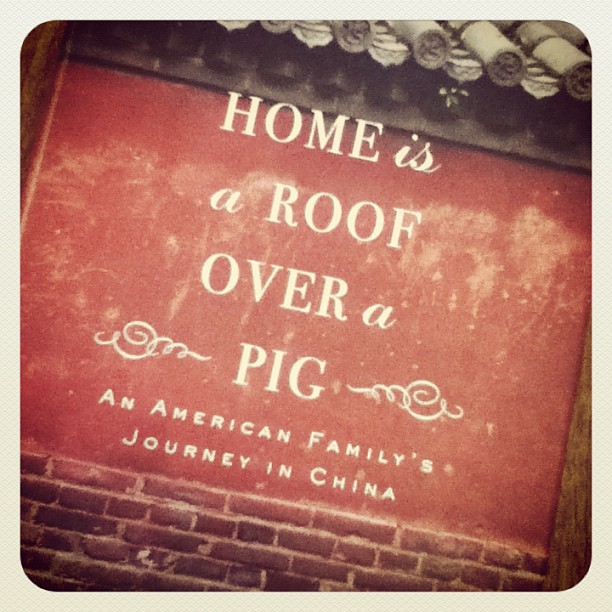
Home is a Roof Over a Pig by Aminta Arrington


Synopsis of Home is a Roof Over a Pig by Aminta ArringtonWhen all-American Aminta Arrington moves from suburban Georgia to a small town in China, she doesn't go alone. Her army husband and three young children, including an adopted Chinese daughter, uproot themselves too. Aminta hopes to understand the country with its long civilization, ancient philosophy, and complex language. She is also determined that her daughter Grace, born in China, regain some of the culture she lost when the Arringtons brought her to America as a baby. In the university town of Tai'an, a small city where pigs' hooves are available at the local supermarket, donkeys share the road with cars, and the warm-hearted locals welcome this strange looking foreign family, the Arringtons settle in . . . but not at first. Aminta teaches at the university, not realizing she is countering the propaganda the students had memorized for years. Her creative, independent (and loud) American children chafe in their classrooms, the first rung in society's effort to ensure conformity. The family is bewildered by the seemingly endless cultural differences they face, but they find their way.

My two cents

Wonderful memoir! I really enjoyed it -- it's a mixture travelogue, family diary and history lesson. Arrington's strong point is the charming way in which she recounts her experiences. It's personal, it's funny, and at times heartbreaking. If you like to travel, it's extremely interesting to view China from another's eyes. And I learned quite a bit about Chinese culture, history, and the educational system. 


Aminta Arrington is an American who has always been fascinated with China. When her husband, Chris, retires from the army, they decide to live out her dream of living in China. Having adopted a Chinese baby girl, Grace, is the other reason for their move. They want Grace to identify not only with her Western upbringing, but also her roots. They pack up their family and take the leap into an unknown culture ... and have a grand (if rather culturally shocking) adventure until years later, they eventually become accepted in the small university town of Tai'an where Aminta finds a teaching post. 
One major device that Arrington used throughout the book, and in fact the title of the book is derived from the Chinese symbol for home, and each chapter has an equivalent in Chinese script.  I came away with a better appreciation and understanding of how unwittingly the pictorial representation of the words gives us a glimpse of ancient Chinese life. She likewise injects her own observations or opinions, giving us a bit more depth of how she interprets the meaning behind these words.

For example, the word "population" is pictured literally as "people mouths" and knowing that China is a over a billion strong, Arrington explains: "... they austerely, yet uniquely express the challenge China has long faced: a large population means more mouths to feed."(p. 41). 

The book focuses on a Western experience in China -- from university town, to a rural countryside, to a modern metropolis. It was interesting to read a Western viewpoint when I come from a very Asian viewpoint.The culture shock they experience is where I could totally relate to. (I am an immigrant to Canada from Asia) -- the shock of unfamiliarity of everything, the language barrier, and the agony of learning how to do even the simplest of things (like buying something, or taking public transport). I found the "second culture shock" they experience when they go back to the US and return as fascinating -- it's the first time I have ever heard of it.

This book is also as much about family life and rearing kids in an alien culture. I had a few moments of quiet heartbreak as she recounts how they learn of Grace's origins. I laughed a little as they struggled to make sense of themselves as a family within a strange country. I cheered on the kids as they became more proficient in the local language and made friends. I turned sober as I see the desire of Aminta and Chris to retain their American-ess while embracing some of the China that they had so desired for Grace and for themselves as a family. And I smiled when a small gesture of Mr. Jia, their super, reveals to Aminta that they are finally accepted as part of the little community.

There are many other diversions. Some interesting points that I appreciated were the pressures that Chinese students face in a China that is fast modernizing, the peek into how steeped in tradition China still is, and finally the subtle commentary about the one-child policy which has resulted in a generation of girls being adopted by other countries. The book is a rich source for many potentially controversial discussions.   

Uh-ohs:

Arrington seems to be quite open to the cultural differences she experiences. Obviously, this has a strongly Western-centric viewpoint of the world but hey, it's a memoir, and being biased is the stuff that memoirs are made of. I admit that I am both intrigued and wary about these books as the "holier than thou" attitude of many Western writers writing about Asia always seems to revolve around them. (Think Eat Pray Love.) I flag this as an "uh-oh" because someone coming from the opposite perspective may do a few eye rolls at the obvious, or find offense in her blatant and unapologetic American-ness. 

Right off the bat, I was slightly irked by her continual whining about wanting to experience the "real China"... how romanticized a phrase is that? She talks about "modern China" (a China opening to the West and its influences) and she talks about "traditional China" (rural China as if they were two separate things and if one were real and the other less real. But isn't the real China just China ... modern and traditional all rolled into one?

I was also a little annoyed with how she -- whether knowingly or not -- seemed to be foisting her opinions on her students. I tsk-tsked a bit when she got worked up about the idea her students not understanding the concept of independence, individuality and individual freedom. Cultural relativism of what is considered right and wrong is an emotionally laden topic; I applaud her for her honesty because it has also made me more conscious of my own stereotypes and my own cultural lens.

One thing that I thought was missing in the book: photos. I wanted to know what her little hole in the wall looked like, the descriptions of the beautiful mountains and the countryside. If you want to take a peek, she put up a few photos on her website, so go check them out if you're as curious as me.

Verdict: A charming and fascinating look into China and Chinese culture in this travelogue memoir. Definitely worth the read! 

First line: The Chinese writer Zhang Ailing said that every butterfly is a dead flower flying back to look for her lost life.

Last line: We've realized that we left behind a community that opened to allow us a place; and that was what made it home.

Find out more at Aminta Arrington's website.

I won this book at GoodReads First Reads.

·
OLDER


© guiltless readingMaira Gall