immigrant stories
Showing posts with label immigrant stories. Show all posts

The Buddha in the Attic by Julie Otsuka


Poetic justice for picture brides. 

Synopsis of The Buddha in the Attic by Julie Otsuka: Julie Otsuka’s long-awaited follow-up to When the Emperor Was Divine is a tour de force of economy and precision, a novel that tells the story of a group of young women brought from Japan to San Francisco as “picture brides” nearly a century ago.

In eight incantatory sections, The Buddha in the Attic traces the picture brides’ extraordinary lives, from their arduous journey by boat, where they exchange photographs of their husbands, imagining uncertain futures in an unknown land; to their arrival in San Francisco and their tremulous first nights as new wives; to their backbreaking work picking fruit in the fields and scrubbing the floors of white women; to their struggles to master a new language and a new culture; to their experiences in childbirth, and then as mothers, raising children who will ultimately reject their heritage and their history; to the deracinating arrival of war.


My two cents

I have now read this book twice. The first time, I was in too much of a daze to write a coherent review. The second time merely confirmed what I knew about this book the first read: this one is special.

Told in the collective voice of Japanese picture brides as they recount the unfolding of their new lives in the US during the early 20th century, the melding of history in an almost poetic treatment is both unusual and enlightening.

I don't know too much about picture brides so I decided to look it up. Picture brides were so named because Japanese and Korean men who had immigrated to the US during the late 1900s decided to take wives and did so by choosing them based on pictures or photos provided by matchmakers. It was a modified practice of the traditional matchmaking wherein family members also had their say. It was basically the then-equivalent of the mail-order bride (source).

The book can be broken down into eight sections, which trace the lives of Japanese picture brides from their arrival up to the war, and hints of the impact on next generations to come:
  • Come, Japanese!
  • First Night
  • Whites
  • Babies
  • The Children
  • Traitors
  • Last Day
  • A Disappearance
In the author's notes in the back, there is an exhaustive list of references from which Otsuka drew these stories, which when collectively told provide a comprehensive and nuanced account of the struggles and challenges that these women faced and endured.

What I found surprising is that while told in collective, the voice is startlingly personal and intimate.

This entire book is a remembrance of an important piece of Japanese immigration in US history and of acknowledging the horrors of war and racial segregation.

Verdict: This book acknowledges the need to dust off the proverbial Buddha that has been put away in the attic. A remembrance of Japanese immigration to the US in the 1900s, this is the voice of the picture bride. Poetic justice indeed.

Uh oh 

The use of the collective "we" throughout has an almost hypnotic effect on the reader; I personally felt it was an interesting treatment. However, it does have a tedium to it and can potentially bore.

Extra

My love for the cover can't be expressed properly - it's such a beautiful cover for a beautifully written homage.

Interesting reading:


#TopTenTuesdays: Ten (12!) Books about Immigrants


And so Top Ten Tuesday rolls around once again! The theme is:

April 28: Top Ten Books Which Feature Characters Who _____ (are musically inclined, have lost someone, have depression, who grow up poor, etc.)

This week, I decided to highlight books that feature immigrant stories. I've intentionally been trying to get more of this into my TBR because one, I can relate on some level because I myself am an immigrant, and two, I think it's a fascinating process to uproot then acculturate. It's not without its struggles and challenges and it is always inspiring to hear how people eventually . These stories are a peek into some historic immigrant movements, from past to present.

I've linked up to my reviews, so I hope you click if a title catches your eye. In no particular order:


Tiger Babies Strike Back by Kim Wong Keltner (non- fiction - bonus, because I wanted to get another non-fiction title in here)

Buddha in the Attic by Julie Otsuka (a bonus, because it's unreviewed!) 


Have you read any of these? Which one/s catch your eye?

If you have any recommendations for books featuring immigrant stories, I'd love to hear about it!


More Top Ten Tuesday:
Ten Authors I Adore
Top Ten Characters I'd Like to Check in With
Ten Books I Recently Added to my TBR
Top Ten Books that Blew My Mind in 2014


Obasan by Joy Kagawa


A shattered silence.
 
Synopsis of Obasan by Joy Kagawa: A powerful and passionate novel, Obasan tells, through the eyes of a child, the moving story of Japanese Canadians during the Second World War. Naomi is a sheltered and beloved five-year-old when Pearl Harbor changes her life. Separated from her mother, she watches bewildered as she and her family become enemy aliens, persecuted and despised in their own land. Surrounded by hardship and pain, Naomi is protected by the resolute endurance of her aunt Obasan and the silence of those around her. Only after Naomi grows up does she return to question the haunting silence.

My two cents

Obviously drawing from real-life experiences, this is a heartbreaking novel that breaks the silence of the horrors faced by Canadian citizens of Japanese ancestry during the second World War.

I picked a copy of this up with the intent of adding some Canadian reading into my TBR. I wasn't quite sure what to expect when a friend pointed out that she (or someone she knew?) had heard the author speak in Vancouver ... and was quite blown away by the unassuming yet powerful woman she is. Kind of like this book ... it seems like a slim novel, it's even a little "quiet," but it packs quite the punch.

Canada is known for its open arms to immigrants, the value it puts on the cultural diversity of its population, and its pride in upholding human rights. It's interesting to think that this book is written by a Canadian national who had suffered through a time that Canada would not be proud of.

Told from the viewpoint of a young girl, this is observational, non-judgmental, yet extremely telling and insightful. There is little histrionics, no blaming (probably because the narrator is a child), just a narrative that tells how this sad history unfolded. I enjoyed the writing and the contemplative mood it put me in.

This is a story of family and how one can never divorce one's identity from culture or history, no matter how horrific, no matter how one wants to forget. It is also a story of how a country can make amends for the wrongs in its past.

Verdict: A novelized child's recounting of the evacuation, relocation, and dispersal of Canadian citizens of Japanese descent during the  Second World War in Canada. This is a powerful commentary of how war lead a country to commit heartbreaking horrors to its beloved citizens.

Buy This Book from Book Depository, Free Delivery World Wide

Eat Now; Talk Later by James Vescovi


Laugh, cry, eat (but don't talk while eating) with the Vescovi family.

Synopsis of Eat Now; Talk Later by James Vescovi: Prepare yourself for a feast consumed in delicious bites. This collection of stories can be read before bed, on a lunch hour, or waiting in line. They can even be shared with friends who complain they have enough to read. Together they ask the question, "How do you make modern life run smoothly for parents or grandparents who grew up in an era when oxen were used for plowing, children left school after third grade to tend chickens, and meat was eaten only twice a year?

When Tony and Desolina Vescovi arrived in America, they collided with the 20th century. Born around 1900, they were stumped by telephones, banks, fast food, TV wrestling, and supermarkets. It was up to their only child, a son, to serve as their shepherd, and it wasn't easy For example, how to explain that his job was taking him and his family 700 miles away when, in their day, sons stayed put to work the family farm? Or that it wasn't wise to hide $10,000 in the bedroom? Or that the ice cream they just tried and enjoyed is called 'Chubby Hubby'?

This collection of 52 bite-size stories offers a twist on the American immigrant tale and is a testament to love, loyalty, and frequent half-truths.

My two cents

With heartwarming humour and an overwhelming love for his family members, James Vescovi tells his family history in 52 vignettes. Hailing from rural Italy, his grandparents immigrated to America and what an interesting clash values-wise, culturally, and technologically it is! Get to know three generations of the Vescovi family, Antonio (Tony) and Desolina, their only son Selvi and his family, and the family of grandson and author, James Vescovi.

***

I have to say this right off: I am jealous of what James Vescovi has accomplished in his family memoir. I have had my own aspirations of compiling family memories into something concrete, maybe not as ambitious as a book, but something tangible to capture all those monumental stories as well as those wonderful little moments that define families. The desire is always rekindled at family reunions or when we have one of those long after dinner conversations just reminiscing. This memoir has certainly inspired me to maybe try again ...

Vescovi's little tales brought a smile to my face, but then he has also broken my heart. This book's compilation brings into sharp focus the circle of life: from the young and hopeful Tony and Desolina immigrating to America in search of a better life, establishing and assimilating themselves in a foreign land, growing their family, and the inevitable aging and their passing away. But the journey is filled with the stuff that makes their lives unique: lots of humour, spunky remonstrances from Desolina, a get-it-done attitude from industrious Tony, mad money floating around the house, oh, and lots of good food and eating!

This is an excellent memoir that many people will undoubtedly see themselves in, in some way, in the people or the circumstances described. Obviously, the immigrant experience is a highlight of this book. However, it also shows us the challenges of aging parents and how families cope to provide the care and support. But what struck me most were the values that the Vescovi family hold dear: hard work, honesty, familial love, and valuing their Italian roots.

The stories are short and sometimes without resolution. But such is life - sometimes things just are.

Vescovi has an engaging way of telling his stories. This book felt intimate, like sitting down with him for a visit -- all I needed was some limoncello (ok, maybe some coffee) with my book! The photos also lent an air of flipping through an old photo album -- everything felt real because I could imagine each of the Vescovis in my mind's eye. While Vescovi argues that his family lives "quiet, anonymous lives," this memoir has shown what special people they are. 

A special treat is how the Vescovis have compiled some of their family's recipes at the back of the book, a testament to how they value their food and the memories surrounding eating. After all, that's where the title came from!
 
Verdict: I loved this memoir! This is special -- read it! It will make you realize just how precious our family members are, with all their quirks and their faults. It will make you realize how fleeting and forgetful we can be of our family histories if we fail to capture the stories told orally.

I highly recommend this memoir to anyone who has an interest in family histories and of documenting them. With three generations documented here, this has a multi-generational appeal.

Links:

I received a manuscript from the author in exchange for an honest review. 


Foodies Read 2014

The Frangipani Hotel: Stories by Violet Kupersmith (+Giveaway!)

Ghosts explore immigration, tradition and self-identity.

Synopsis of The Frangipani Hotel: Stories by Violet Kupersmith: A self-assured and stunning collection by an astonishingly gifted new writer, these stories—based on traditional Vietnamese tales—are sure to appeal to fans of Karen Russell, Jennifer Egan, Colson Whitehead, George Saunders, and Téa Obrecht. The Frangipani Hotel blends the old world and the new with fantastical, chilling, and original explorations of the ghosts that continue to haunt us: those of the Vietnam War.

My two cents

I have a soft spot for immigrant stories! Short stories, yes, I love those, too. Ghost stories, yes, yes! And then the genesis of this collection, intriguing: I loved that the author, who is of mixed heritage, found inspiration for these stories from her Vietnamese grandmother's traditional ghost stories and her own life experiences. Read Violet Kupersmith's guest post about her chats with here grandmother here.

This collection of nine creepy ghost stories, all with a Vietnamese element to them, make a wonderfully macabre and uncomfortable read.

What I liked

Creepy but not cheesy scary. I grew up in an Asian culture where superstition, the supernatural and folklore are so much a part of everyday life. I think because of that, these Vietnamese scary tales naturally resonated with me: they seemed eerily familiar, as if they were Vietnamese versions of folk tales or urban legends I've known and heard since from childhood.

These are not scary in a typical "boo" way. As Asian ghost stories go, they are subtle in their scariness. They have a magical realism to them, with a slight chill factor, a menacing undertone, and unexpected twist at the end. Think Twilight Zone.

The "ghosts" aren't always scary but they make their appearance often as real life people or in tangible forms, to impart some chilling life lesson or be a harbinger of some great realization.

The themes. What I found quite profound about this collection was the exploration of the themes of immigration, cultural identity, and ultimately of self-identity.

Vietnamese culture is interwoven in the fabric of these stories, providing us with a glimpse into its traditions and history. The Vietnamese War is pivotal moment as it impels the characters to migrate from Vietnam to the US, allowing the characters to explore the pain and loss brought about by war, and the ensuring tug-of-war involved in forcibly melding two cultures both in mind an in body.

I offer you these quick summaries without giving too much away:

Boat Story opens this collection, with a young girl needling her grandmother to tell her about their family history for a school assignment but instead gets a stomach full of papaya and a ghost story that her grandmother and grandfather lived through.


Reception is one of the longer stories and is about a beautiful ghost who haunts the Frangipani Hotel.

Skin and Bones is among my favourites because it uses the lure of food to explore rootlessness, cultural affinity and family relationships. Young US-based sisters are sent to visit with grandma in Vietnam to reconnect ... but there is something wrong. Do you like bánh mì? Read on.

Little Brother is a truck driver's close encounter with a ghost.

The Red Veil is a ghost story told by a nun to a nun-in-training while making egg rolls.

Guests, the only non-ghost story, explores how Mia struggles to make sense of straddling two cultures.

Turning Back is how a young Vietnamese girl who works the night shift at the corner convenience store has an encounter with a man cursed as a shape-shifter, and how his life and future impacts on the girl.

One-Finger seems to be a folk tale which brings together a band of old geezers who are haunted by their past.

Descending Dragon closes the collection, highlighting how one learns to make amends with one's past.
The prose. The language is atmospheric and lyrical yet straightforward. There is unexpected humour in some places, which I found oddly appropriate!

Verdict: I enjoyed this collection thoroughly. I look forward to more from this debut author, as this collection promises that she has some great stories begging to be told.

A chilling collection of ghost stories which is an unusual treatment to drive home the themes of immigration, grappling with the past and tradition, and discovering one's identity. This is an unsettling read that I recommend this to those who enjoy immigrant stories, short stories, and those who'd like to experience a different type of scary.

IMG_1160[1]

About Violet Kupersmith

Violet Kupersmith was born in rural Pennsylvania in 1989 and grew up outside of Philadelphia. Her father is American and her mother is a former boat refugee from Vietnam. After graduating from Mount Holyoke College she received a yearlong Fulbright Fellowship to teach and research in the Mekong Delta. She is currently at work on her first novel.


GIVEAWAY!
Thanks to the publishers, I have
1 paperback of The Frangipani Hotel up for grabs! (US only)
Please use Promosimple form below.


Check out the rest of the tour here.
I received copy of this book from the publisher via TLC Book Tours in exchange for an honest review.

Hardcover: 256 pages
Publisher: Spiegel and Grau (April 1, 2014)

The Isolation Door by Anish Majumdar {+Literary Blog Hop Giveaway!}


Kicks the isolation door wide open.

Synopsis of The Isolation Door by Anish Majumdar: Neil Kapoor, 23, finds the fragile threads of a new life threatened by a mother's descent into schizophrenia.

The debut novel of acclaimed journalist Anish Majumdar examines the inner world of the mentally ill and those within their gravitational pull. A mother's delusions of Bollywood stardom become a son's raw materials for finding happiness beyond her shadow. Enlisting the aid of an Aunt with means and questionable motives, Neil finds love and forms crucial friendships. But when the life he's kept secret begins to crumble, a choice must be made: family or freedom? Intimate in approach and devastating in impact, The Isolation Door marks the arrival of a unique talent in American letters.

A portion of the proceeds from the sale of this book will be donated towards schizophrenia research and treatment.

My two cents

This post is part of the The Literary Blog Hop Giveaway because I thought it was a beautiful piece to share with you all! There is a giveaway for 3 paperback copies (US/Can), courtesy of the publisher through TLC Book Tours.  

Make-up, a beautiful sari, and non-stop prattling about her adoring fans. Neil is helping his mother get ready for her big acting gig. But in a blink of an eye, this innocuous scene turns ugly when I realised that Neil was humouring his delusional mother to get her ready for readmission to the hospital. It's tough love .. unfortunately with roles reversed.

The opening scene sets the tone for a young man's personal journey from isolation, fear, and frustration to compassion, understanding and reconciliation.

***
This book did not disappoint and exceeded all my expectations in a wonderful way. It has an atmospheric quality to it but it is a brutal read. It is an intimate look into a young man's life that is impacted by his mother's schizophrenia. It is emotional, a little shocking in spots, painfully tragic in many instances, and searingly honest. 

There is so much to learn from this fictionalized experience: Neil's uncertainties and frustrations, his mother's confused struggle to make sense of things, a worried father and husband who does everything for the woman he loves, and the community from which they turn to for support. 

There were a few touches that I found really compelling:
1. I found really touching the loyalty of the relationship portrayed between husband and wife. One event just about broke my heart (no spoilers).

2. The parallels between Neil's relationship with his mother and girlfriend Emily. While his initial attraction to Emily - who was vulnerable and "damaged"- probably sprung naturally from having to deal with his mother's problems, the way he came to care for Emily probably wouldn't have been possible if not for his life experience.

3. The ending. I loved it.

Backing up a bit, when I saw this book up for review, I jumped on it. Coming from an Asian country where there is a continuing stigma on mental illness, I was curious to read another cultural take on this issue. The author is Bengali-Canadian-American and his strong ties to his own culture and the Bengali community played into the storyline. Always shrouded in secrecy, I felt an empathy to Neil's odd powerplay of relationship with his moneyed aunt (who didn't know how to handle her sister's mental illness) and moreso with his father who drew heavily from his friends and community for moral support and legal advice.  

This is a compelling read that sheds light on the personal struggles of families dealing with mental illness of a family member. This does a beautiful job of humanizing the impacts of mental illness, not only spreading awareness but, more importantly, encouraging us to be empathetic and compassionate. 

***

Uh-oh: This is written by a male. If you've read a lot of Murakami or Garcia Marquez, you'll know they love to punctuate their stories with some sexual scenes, which while not absolutely necessary to the storyline are there because, well, that's part of life. This is similar. 

Verdict: An affecting, empathetic portrayal of a young life forced to cope with the devastation of mental illness in the family. Incisive, brutal, raw and honest. Kicks the door wide open on the travails of families dealing with mental illness so that people not only understand this issue but even lend a helping hand. A dark yet empowering read! I highly recommend it and look forward to more of Majumdar's work. 

Interesting line:
I knew what it was to flounder in the service of a loved one. To know you were doing the right thing even as every instinct for self-preservation claimed otherwise. I've witnessed my father do it for most of his life. Far from discouraging or depressing me, I felt bolstered by the realization. - p. 74  


About Anish Majumdar

AnishAuthorPicAs a child growing up in Montreal, Canada, Anish Majumdar’s first creative writing lessons came courtesy of his mother, a former English teacher. Witnessing her struggle with schizophrenia had a profound impact and inspired The Isolation Door, his first novel.

His non-fiction work, appearing in many publications, has garnered Independent Press Association Awards for Feature Writing and Investigative Journalism. His short fiction has been nominated for the Pushcart Prize. He lives with his wife, son, and a growing menagerie of pets in Rochester, NY.

Connect with Anish Majumdar: Website | Twitter | Google + | Facebook


Check out the rest of the tour here.
I received copy of this book from the publisher via TLC Book Tours in exchange for an honest review.

Book Depository
Paperback: 304 pages
Publisher: Ravana Press (February 4, 2014)

Giveaway!
This post is part of the The Literary Blog Hop Giveaway. 
3 paperback copies (US/Can), courtesy of the publisher through TLC Book Tours
Please use PromoSimple form below, and don't forget to check out the other stops! 


Linky List:
  1. Leeswammes
  2. Seaside Book Nook
  3. Booklover Book Reviews
  4. Biblionomad
  5. Laurie Here
  6. The Well-Read Redhead (US/CA)
  7. River City Reading
  8. GirlVsBookshelf
  9. Ciska's Book Chest
  10. The Book Stop
  11. Ragdoll Books Blog
  12. Nishita's Rants and Raves
  13. Lucybird's Book Blog
  14. Reading World (N-America)
  15. Journey Through Books
  16. Readerbuzz
  17. Always With a Book (US)
  18. 52 Books or Bust (N.Am./UK)
  19. Guiltless Reading (US/CA)
  20. Book-alicious Mama (US)
  21. Wensend
  22. Books Speak Volumes
  23. Words for Worms
  24. The Relentless Reader
  25. A Lovely Bookshelf on the Wall (US)
  1. Fourth Street Review
  2. Vailia's Page Turner
  3. The Little Reader Library
  4. Lost Generation Reader
  5. Heavenali
  6. Roof Beam Reader
  7. Mythical Books
  8. Word by Word
  9. The Misfortune of Knowing
  10. Aymaran Shadow > Behind The Scenes
  11. The Things You Can Read (US)
  12. Bay State Reader's Advisory
  13. Curiosity Killed the Bookworm
  14. Lizzy's Literary Life
  15. Books Can Save a Life (N. America)
  16. Words And Peace (US)
  17. The Book Club Blog

Ru by Kim Thúy


Stripped, stark, unapologetic.


Synopsis of Ru by Kim Thuy: Ru. In Vietnamese it means lullaby; in French it is a small stream, but also signifies a flow--of tears, blood, money. Kim Thúy's Ru is literature at its most crystalline: the flow of a life on the tides of unrest and on to more peaceful water.

In vignettes of exquisite clarity, sharp observation and sly wit, we are carried along on an unforgettable journey from a palatial residence in Saigon to a crowded and muddy Malaysian refugee camp, and onward to a new life in Quebec. There, the young girl feels the embrace of a new community, and revels in the chance to be part of the American Dream. As an adult, the waters become rough again: now a mother of two sons, she must learn to shape her love around the younger boy's autism.

Moving seamlessly from past to present, from history to memory and back again, Ru is a book that celebrates life in all its wonder: its moments of beauty and sensuality, brutality and sorrow, comfort and comedy.

My two cents

In short snapshots, we piece together the life of Ru: living a wealthy life in Saigon, struggling to survive in an overcrowded and squalid Malaysian refugee camp, transplanted in the strange world of Quebec. It is a story of hope and possibility, of remaking and rebuilding oneself . An immigrant story that is short, non-verbose, honest and hard hitting.

***
I am guilty of letting this review languish in my drafts as I don't quite know how to verbalize how this resonated with my own immigrant experience. While I never faced the extreme conditions that Ru did, I can definitely relate to the feelings of displacement, alienation, and the need to be "can do" in a new culture and environment. How else can one rebuild their life? How else can one move on? She her retrospective so succinctly:
"...after only thirty years I already recognize our old selves only through fragments, through scars, through glimmers of light."
In very stark stripped, even poetic writing, Thúy shares a fictionalized version of her true-to-life story through the character of Ru. Much of what is recounted is quite horrific -- the horrors of war and what one must do to survive, the squalid conditions that had to be endured, the life left behind, and the uncertainty of a new life in a foreign county. But it is surprisingly unsentimental, a recounting of what is, without passing judgement on what can be labelled as unethical or immoral.

Uh-oh
I was at times struggling to make sense of the series of events in Ru's life -- she jumps around from present to past and back again, from country to country, that it constantly left me confused. However, I think while this is an uh-oh for a time, the fluid structure of these streams of consciousness grew on me. That's how memories are -- there doesn't need to a structure to it, they strike at the most innocuous times. However I can see this being a problem are for those who are more inclined to a structured reading experience.

I wonder why Thúy decided to make this a fictional version of her life as I would've welcomed a memoir in this format too. I guess she has taken some artistic liberties or maybe wanted to protect the identities of certain people. Your guess is as good as mine.

Verdict: AVietnamese immigrant's life story told in poetic snapshots. A story that I will keep close to me to remind myself that I too had a different life and have a world of possibility in this new life I've chosen. This makes my favourites list for this year!

I recommend it to those who like immigrant stories, experimental books, and minimalist writing.


Buy This Book from Book Depository, Free Delivery World Wide 
 

Lotería by Mario Alberto Zambrano


When the next Lotería  card opens, I will find out more about dear Luz. 

Synopsis of Lotería by Mario Alberto Zambrano: Prepare to be enthralled by this lyrical, achingly human debut novel about a young girl’s remarkable resilience in the face of loss. Struggling to cope as her family falls apart, eleven-year-old Luz María Castillo retreats into her beloved set of Lotería cards—a Mexican game featuring riddles and vibrant images. Each card represents a different memory, and as Luz shuffles through the deck, she weaves her recollections into a compelling story of love, loyalty, tragedy, and hope.

By turns affecting and inspiring, Lotería is a powerful novel that heralds the arrival of an outstanding new writer, one who reminds us of the importance of remembering, even when we are trying to forget.

My two cents

I found this story so powerfully raw and real that upon finishing it, I felt the compulsion to shout out my feelings to the world! I did the next best thing and shared the story with my husband over brunch, then I went on Goodreads and Twitter to attach my five stars to it. I can't recommend it enough.

***
Luz is eleven years old and is being held in the custody of social services; her father is in jail and her sister is fighting for her life in the ICU. She is beseeched by Julia, the counselor, to tell the truth to save her father from a lifetime in jail. But Luz in her youth refuses to speak: suspicious, she doesn't seem to grasp what she should tell Julia nor does she know if she will even be believed.

Loteria cards
Loteria cards
Her aunt, Tencha, encourages her to use her beloved deck of Lotería cards -- the Mexican equivalent of bingo with colourful images -- to spark her memory and tell her story. As Luz turns over each card in the deck -- and literally you see the back of the card and when you turn the page to reveal the face -- it triggers a recollection of her family life ranging from the simple and mundane, to the fun and happy, to the more disturbing picture of domestic and sexual abuse and alcoholism.

The cards aid in piecing together the tragic events that lead to the sad situation that Luz is in. There is a pivotal scene with a jawdropping revelation where I couldn't help but  scream "Nooooooo....!" in my mind. The ending is unresolved which sits very well with me, making it open to possibilities and moreso hopeful in this sometimes overwhelmingly dark novel.

***

This is a strong commentary about domestic abuse and its inevitable effects upon the household, particularly the emotional and physical scars that it can leave on the children.

It paints a very real picture, which within a very macho culture, makes for an even more twisted powerplay between husband and wife. Trying to cope with the disappointments of a difficult immigrant life, both parents try to shield their children as much as they can. But the abuse escalates with an increasingly frustrated father, egged on alcohol. Their mother suffers in silence, often fearing for her life. Luz's parents have fallen into a vicious and unnerving cycle.

Luz's observations are heartbreaking. She and Estrella cope in their own ways by hiding out when her father is on a rampage. She tries to act "normal" when she sees dark bruises on her mother. She reminds herself that her father is a good man and that it is all the fault of Don Pedro (the brand of the alcoholic drink). This childish justification is perpetuated by Tencha who forbids her nieces from speaking ill of their father; she continues to turn a blind eye to the abuse happening right under her nose. Their mother escapes further abuse by disappearing one day.

Inevitably, Luz is drawn into the very violence that she and her sister were spared from by their mother. This was spurred on by an encounter when Luz was just seven years old, which Luz dimly recalls as a  seemingly innocent incident at the hands of a lascivious uncle. Her father unleashes his temper and his violence upon her, leading to an injury that maims Luz.

***

What I felt was very powerful in this novel:
The use of the cards as memory triggers, similar to writing prompts. I found this a creative and original way of letting the story unfold and I never felt it gimmicky. As a reader, you can delve deeper into these cards and meanings, riddles and answers, of the chances of what card is drawn. In fact, the book opens with a saying which I found the translation to, which may get you ruminating more about the themes of this novel: El que es buen gallo, en cualquier gallinero canta. (A good rooster crows in any chicken coop.)

It touches on many issues prevalent today and themes woven into the storyline that make for a rich context and which resonated profoundly with me.

The power of this novel is its brevity. Only 270 pages with many of them pictures of the Loteria cards, each of which lend to storyline in some way.

This is all told in the voice of an eleven-year-old girl. Disturbing and tragic, the story has stayed with me and it makes me feel heavy of heart. Since it is told from the Luz's perspective, she passes no judgment and has no malice whatsoever, making for even more painful reading for an adult. Throughout the book, I wanted to just reach out and protect her; I felt for her and I feel for many other children like her.

One is the inside view into the immigrant life. People leave the comfort of their own countries and cultures in search of a better life. But a richer material life, sadly, does not always translate to a better life. Luz's father nurtured a dream for his family but kept running into one hurdle after the other: difficulty in finding a job, the need to work backbreaking jobs, not getting the promotion. His own personal dreams take a backseat to the pressures of providing for his family.

Another is the cultural context within which this story takes place. The Hispanic culture is very male dominated. Women are expected to accept their place and be subservient to the male will. Even if domestic abuse is apparent, no one should stick their nose into what is deemed should stay between husband and wife. Even how Luz is conditioned to accept her father as a "good man" and how she consequently is torn between her loyalty to him and her very own well-being speaks volumes about the power of culture to shape our attitudes in life.

Uh-oh: A warning for those who dislike having their story cut up with dialogue or words in another language: You may be irked by the constant use of Spanish in this novel. I don't speak Spanish but was not especially bothered by it as I read through context (plus my native language, Filipino, has a lot of Spanish in it so I suspect that helped me along). I then followed it up by running a few things through Google Translate.

There are also many Hispanic cultural references which may get lost on those who have no idea about the strong religious (Roman Catholic) influences, of superstition, and of the communal/community nature of families.

Verdict: Deserves five estrellas! As the young Luz turns her Lotería cards, she tells me the unthinkable for someone so young: a profound, tragic story of how an immigrant Mexican family slowly unravels and is torn apart by domestic violence, alcoholism, and misplaced family loyalty. A memorable debut novel that made me go "wow" and will definitely get me looking for more of Zambrano's work.


About Mario Alberto Zambrano

Mario Alberto Zambrano

Mario Alberto Zambrano was a Riggio Honors Fellow at the New School and recently completed his MFA at the Iowa Writers’ Workshop as an Iowa Arts Fellow. He is a recipient of the John C. Schupes Fellowship for Excellence in Fiction. Lotería is his first novel.

Find out more about Mario at his website and connect with him on Facebook.
Visit the rest of the tour here.
I received an Advance Reader Copy through TLC Book Tours in exchange for an honest review.


Lotería by Mario Alberto Zambrano
Book Depository: Hardcover | Audible

Hardcover: 288 pages
Publisher: Harper (July 2, 2013)

A Whisper in the Jungle by Robert Mwangi


Amazon.com: Paperback | Kindle Edition

A love story - about Kenyan culture. 

Synopsis of A Whisper in the Jungle by Robert Mwangi: Deep in the African jungle where even the bravest are afraid to venture, lies a truth that will propel James through his improbable American journey, if he can come out alive. James a village boy in Africa receives a scholarship to go and study in America and he becomes the envy of the whole village. His girlfriend Janny is however skeptical of what a long distance relationship can do to love. But when Janny vanishes from the village, James and his dog Simba plunge into the belligerent forest at the risk of his life and his American dream. Love transcends all. A Whisper In The Jungle is a suspense story full of love, humor, adventure and mystery.

My two cents: 

I am always keen to read immigrant stories probably because I am an immigrant myself. I find it fascinating to hear how people enter into new cultures and come to terms with the new while combining it with the "old," resulting in a combining of both worlds. Everyone makes sense of it in their own way.

A Whisper In The Jungle speaks to this quite strongly but not in the way I expected it to. Robert Mwangi, in this semi-autobiographical book, shares the experience of being Kenyan and thrust into an American culture as a soccer player. I was prepared for a story along this premise so I was a little disconcerted when the soccer playing in America was just a diversion.

The stronger plot lies in the small Kenyan village where James was born, grew up and lives. Although he has gotten the taste of playing soccer abroad and is just about to start living his dream of leaving his village and make his mark in the world, James is compelled to return his childhood sweetheart, Janny, mysteriously disappears. This brings back horrible memories of the disappearance of his older brother.

Determined to find Janny, James sets out to into the dangerous jungle and unwittingly stumbles upon a secret that is difficult for him to fathom -- a secret in the jungle that tests James's loyalties and reveals truths about himself, his family and his culture.

***


I liked:

  • The originality of the story. I don't want to put in any spoilers in this review but the turning point lies in James's discovery in the forest.  
  • Mwangi's obvious love for African culture is the backbone of the storyline. The stories about James's village, his time with his family, alongside the descriptions of age-old traditions,  important figures in African history, and of his homeland are a peek into the Kenyan culture that he so loves. This book is indeed a wonderful ambassador for the Kenyan culture! 
  • For those who have always wanted to see what it's like to be a foreigner in America, Mwangi's observations may be quite an eye-opener! James ponders upon American culture which he loves with an equal fervor as his Kenyan roots. 

Uh-ohs:

The storyline can be tightened up a bit. The beginning of the story sets up expectations for the plot to carry through with the soccer storyline so it is a bit confusing to be thrust back into the jungle. However, I thoroughly enjoyed how the story played out.


As with many books written by authors whose first language isn't English, I found this having some small niggling things that distract, and uneasiness in the flow of the language. This would have benefitted from having a good English editor so that thoughts could be tightened up. Some of things I picked up on were strange use of idioms, incorrect spellings (loose for lose, p. 31), some awkward wording (e.g. "In the next few moments of his life, he went through extreme forms of emotions ..." p. 63), and a general formality in the the use of English (especially towards the end).


First cover art
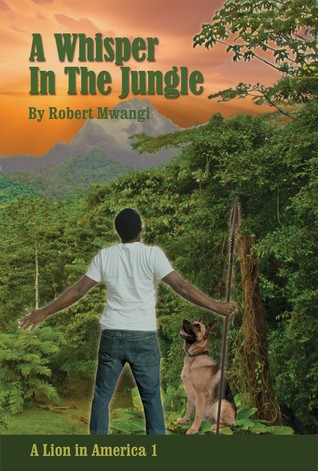
When I was first putting together Robert's guest post and giveaway, I actually wasn't sure what the title was. Is it Whisper in the Jungle or A Lion in America? Go check Amazon and Goodreads and the primary title is A Lion in America 1. Confusing much. Yes, I understand this is a series but without a clear title, it risks people not finding the book in the first place.

When I first was approached with this book, the cover was very different (see right). The cover honestly didn't appeal to me but then it does capture a sense of the immigrant story I was expecting. When I heard back from the author, the cover had changed to something similar to that in the cover art featured below. I think that cover art is an extremely important first impression, and while the current cover better captures the story, I'm not a huge fan of the Photoshop job.


    Verdict: A young man's love story turned love story for Kenya. Read this if you'd like to learn something new about another country and culture.

    A Whisper in the Jungle by Robert Mwangi
    Amazon.com: Paperback | Kindle Edition
    I received a copy of this book in exchange for an honest review.

    American Dervish by Ayad Akhtar


    The paradoxes of life, culture and religion.

    Synopsis of American Dervish by Ayad Akhtar: Hayat Shah is a young American in love for the first time. His normal life of school, baseball, and video games had previously been distinguished only by his Pakistani heritage and by the frequent chill between his parents, who fight over things he is too young to understand. Then Mina arrives, and everything changes.

    Mina is Hayat's mother's oldest friend from Pakistan. She is independent, beautiful and intelligent, and arrives on the Shah's doorstep when her disastrous marriage in Pakistan disintegrates. Even Hayat's skeptical father can't deny the liveliness and happiness that accompanies Mina into their home. Her deep spirituality brings the family's Muslim faith to life in a way that resonates with Hayat as nothing has before. Studying the Quran by Mina's side and basking in the glow of her attention, he feels an entirely new purpose mingled with a growing infatuation for his teacher.

    When Mina meets and begins dating a man, Hayat is confused by his feelings of betrayal. His growing passions, both spiritual and romantic, force him to question all that he has come to believe is true. Just as Mina finds happiness, Hayat is compelled to act -- with devastating consequences for all those he loves most.

    American Dervish is a brilliantly written, nuanced, and emotionally forceful look inside the interplay of religion and modern life. Ayad Akhtar was raised in the Midwest himself, and through Hayat Shah he shows readers vividly the powerful forces at work on young men and women growing up Muslim in America. This is an intimate, personal first novel that will stay with readers long after they turn the last page.

    My two cents

    The book in one sentence: A young Muslim boy finds himself in the middle of a religiously fueled love story.

    ***

    I don't know what it is about this book, but when I first saw it and read the synopsis, I knew I wanted to read it! Do you ever get that type of book "hunch"? This hunch paid off once again and I came away with yet another favourite read for this year.

    Do you know the feeling of being an outsider getting a peek into something people aren't normally privy to? Do you know that feeling where you wanted to speak but couldn't for fear of being politically incorrect? This is how this book made me feel. Reading this book felt a little uncomfortable and I didn't quite know whether I would really like this. Surprisingly, I enjoyed the discomfort because it challenged me to open my mind and not pass judgement on this no-holds barred account of another culture and another religion.

    This is quite the provoking read. I can see it becoming quite polarizing as it delves into, among other things:
    • religion
    • the place of women as prescribed by religion 
    • interfaith relationships
    • immigration, the immigrant life, and the melding of two cultures
    (Can I breathe now?) 

    To say it deals with some very tough issues is an understatement. But don't underestimate the power of Ayad's storytelling! I was so engrossed that I actually managed to read it in a few days, staying up quite late both nights.

    The book opens with Hayat as a young man who, coming into his first serious relationship and spurred on by an academic discussion on Islamic history, recounts the circumstances of his life. The book is a flashback.

    Thus we enter the ten-year-old Hayat's world: a young Pakistani boy living with his immigrated family in modern America. We become witness to the dynamic within his family -- his loving and rather doting mother, his strict rather secular father,  and an inexplicable coldness between his parents. His mother doesn't mask her discontent with her husband, often bad mouthing him to Hayat. His father secretly drinks - but Hayat knows all about it.

    Things become complicated when his mother's best friend, Mina, comes to live with them. Coming from a conservative Muslim family and recently divorced, she is also beautiful, charismatic, well-read and highly spiritual woman. When Mina takes Hayat under her wing to further his studies of the Quran, Hayat cannot help but become totally infatuated with her.

    But this isn't merely a coming-of--age love story. This is also Mina's love story. Things start to go haywire when Mina falls in love with Hayat's father's business partner -- a Jew. The story spins into a complicated, messy and emotional disaster which not only involves the two lovers but Hayat's entire family, Mina's entire family, and even the entire Muslim community in their town. Religious conflict boils over, enmeshed in two cultures.

    Hayat, in his utter innocence, unwittingly plays a role in the ensuing drama. I am reminded of Atonement by Ewan McGregor when Hayat looks back on his past and thinks about what he could've done otherwise to spare people the anguish of his actions.

    ***

    This is a story of paradoxes, a confluence of spirituality, religion, relationships. There is the paradox of spirituality versus organized religion. Whether we like it or not, we are living paradoxes. In this book, there are many examples. There is the paradox of Hayat's teenage friend being known as being a spiritual prodigy ... yet acts upon his very male urges. There is his father, who Hayat fears will be severely punished ... because of his love for alcohol, a sin in Islam. There is his Auntie Mina, a devout Muslim ... in love with the Muslim-loathed Jew. There is the  relationship between man and woman ... which is known by many to be abusive yet is not challenged because it is shrouded and even condoned within the propriety of religion. There is his religious community, which preaches of love and respect, yet shows disdain and even hate for someone of another religion.

    Hayat cannot wrap his head around these paradoxes as his world is still in black and white, absolutes and he has yet to learn the subtleties of gray. It is the raw honesty of how these paradoxes are described and come into play that really struck a chord in me. Substitute any other religion for Jew or Muslim and this story could be anyone's life -- prejudice and intolerance rear its ugly head in insidious ways in our everyday lives.

    When Hayat grows older, he comes to some surprising realizations and he is able to make sense and make peace with himself, his family, his religion, and most of all, his beloved Auntie Mina. I was touched by the ending. This is one of those rare books that I felt was truly honest and I appreciate Akhtar's ability to write in a sensitive, caring and respectful manner.

    Verdict: A beautifully sensitive story of a Muslim boy's life and love in today's America. Highlights that the message of tolerance and respect for humanity cuts across the boundaries of religion, gender or age. I highly recommend this for those who want to learn more about Islam, immigrant life, and the complexities of relationships.  

    Random quotes:
    "I keep telling her the fact that Nathan's Jewish is a good thing. They understand how to respect women, behta. They understand how to let a woman be a woman, to let her take care of them. They understand how to give a woman attention. I told Mina-Auntie that he will give her a life she can never dream of with a Muslim man. Muslim men are terrified of women ... all of them." She leaned in, kissing me on the nose, her face just inches from mine, her soulful eyes swollen with abounding love. "That's why I'm bringing you up differently, so that you learn how to respect a woman. That's the truth, kurban: I'm bringing you up like a little Jew." - p. 117

    "'To be a Sufi,'" she continued, "'means to give up the world and everything in it. To be a Sufi means to depend on nothing, to want nothing, to be nothing.'" [..] She sobbed quietly into another tissue. "This is what life does to us, behta. It grinds us, grinds us to dust. The Sufi is just someone who doesn't fight it. He knows that being ground to nothing is not bad. It's the way to God." - p. 274


    I won a copy of this book in a giveaway.

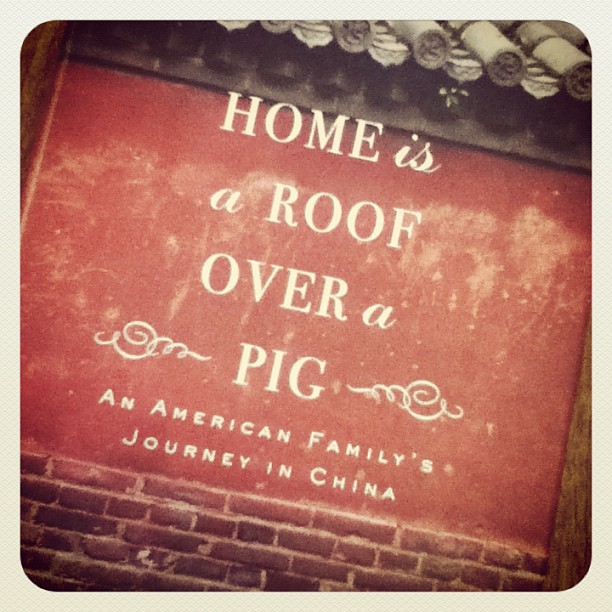
    Home is a Roof Over a Pig by Aminta Arrington


    Synopsis of Home is a Roof Over a Pig by Aminta Arrington: When all-American Aminta Arrington moves from suburban Georgia to a small town in China, she doesn't go alone. Her army husband and three young children, including an adopted Chinese daughter, uproot themselves too. Aminta hopes to understand the country with its long civilization, ancient philosophy, and complex language. She is also determined that her daughter Grace, born in China, regain some of the culture she lost when the Arringtons brought her to America as a baby. In the university town of Tai'an, a small city where pigs' hooves are available at the local supermarket, donkeys share the road with cars, and the warm-hearted locals welcome this strange looking foreign family, the Arringtons settle in . . . but not at first. Aminta teaches at the university, not realizing she is countering the propaganda the students had memorized for years. Her creative, independent (and loud) American children chafe in their classrooms, the first rung in society's effort to ensure conformity. The family is bewildered by the seemingly endless cultural differences they face, but they find their way.

    My two cents

    Wonderful memoir! I really enjoyed it -- it's a mixture travelogue, family diary and history lesson. Arrington's strong point is the charming way in which she recounts her experiences. It's personal, it's funny, and at times heartbreaking. If you like to travel, it's extremely interesting to view China from another's eyes. And I learned quite a bit about Chinese culture, history, and the educational system. 


    Aminta Arrington is an American who has always been fascinated with China. When her husband, Chris, retires from the army, they decide to live out her dream of living in China. Having adopted a Chinese baby girl, Grace, is the other reason for their move. They want Grace to identify not only with her Western upbringing, but also her roots. They pack up their family and take the leap into an unknown culture ... and have a grand (if rather culturally shocking) adventure until years later, they eventually become accepted in the small university town of Tai'an where Aminta finds a teaching post. 
    One major device that Arrington used throughout the book, and in fact the title of the book is derived from the Chinese symbol for home, and each chapter has an equivalent in Chinese script.  I came away with a better appreciation and understanding of how unwittingly the pictorial representation of the words gives us a glimpse of ancient Chinese life. She likewise injects her own observations or opinions, giving us a bit more depth of how she interprets the meaning behind these words.

    For example, the word "population" is pictured literally as "people mouths" and knowing that China is a over a billion strong, Arrington explains: "... they austerely, yet uniquely express the challenge China has long faced: a large population means more mouths to feed."(p. 41). 

    The book focuses on a Western experience in China -- from university town, to a rural countryside, to a modern metropolis. It was interesting to read a Western viewpoint when I come from a very Asian viewpoint.The culture shock they experience is where I could totally relate to. (I am an immigrant to Canada from Asia) -- the shock of unfamiliarity of everything, the language barrier, and the agony of learning how to do even the simplest of things (like buying something, or taking public transport). I found the "second culture shock" they experience when they go back to the US and return as fascinating -- it's the first time I have ever heard of it.

    This book is also as much about family life and rearing kids in an alien culture. I had a few moments of quiet heartbreak as she recounts how they learn of Grace's origins. I laughed a little as they struggled to make sense of themselves as a family within a strange country. I cheered on the kids as they became more proficient in the local language and made friends. I turned sober as I see the desire of Aminta and Chris to retain their American-ess while embracing some of the China that they had so desired for Grace and for themselves as a family. And I smiled when a small gesture of Mr. Jia, their super, reveals to Aminta that they are finally accepted as part of the little community.

    There are many other diversions. Some interesting points that I appreciated were the pressures that Chinese students face in a China that is fast modernizing, the peek into how steeped in tradition China still is, and finally the subtle commentary about the one-child policy which has resulted in a generation of girls being adopted by other countries. The book is a rich source for many potentially controversial discussions.   

    Uh-ohs:

    Arrington seems to be quite open to the cultural differences she experiences. Obviously, this has a strongly Western-centric viewpoint of the world but hey, it's a memoir, and being biased is the stuff that memoirs are made of. I admit that I am both intrigued and wary about these books as the "holier than thou" attitude of many Western writers writing about Asia always seems to revolve around them. (Think Eat Pray Love.) I flag this as an "uh-oh" because someone coming from the opposite perspective may do a few eye rolls at the obvious, or find offense in her blatant and unapologetic American-ness. 

    Right off the bat, I was slightly irked by her continual whining about wanting to experience the "real China"... how romanticized a phrase is that? She talks about "modern China" (a China opening to the West and its influences) and she talks about "traditional China" (rural China as if they were two separate things and if one were real and the other less real. But isn't the real China just China ... modern and traditional all rolled into one?

    I was also a little annoyed with how she -- whether knowingly or not -- seemed to be foisting her opinions on her students. I tsk-tsked a bit when she got worked up about the idea her students not understanding the concept of independence, individuality and individual freedom. Cultural relativism of what is considered right and wrong is an emotionally laden topic; I applaud her for her honesty because it has also made me more conscious of my own stereotypes and my own cultural lens.

    One thing that I thought was missing in the book: photos. I wanted to know what her little hole in the wall looked like, the descriptions of the beautiful mountains and the countryside. If you want to take a peek, she put up a few photos on her website, so go check them out if you're as curious as me.

    Verdict: A charming and fascinating look into China and Chinese culture in this travelogue memoir. Definitely worth the read! 

    First line: The Chinese writer Zhang Ailing said that every butterfly is a dead flower flying back to look for her lost life.

    Last line: We've realized that we left behind a community that opened to allow us a place; and that was what made it home.

    Find out more at Aminta Arrington's website.

    I won this book at GoodReads First Reads.

    ·
    OLDER


    © guiltless readingMaira Gall