book reviews
Showing posts with label book reviews. Show all posts

Just breathe {The Selfless Act of Breathing by JJ Bola)


When a story needs some breathing room.

About The Selfless Act of Breathing by JJ Bola: Michael Kabongo is a British Congolese teacher living in London and living the dream: he’s beloved by his students, popular with his coworkers, and adored by his proud mother who emigrated from the Congo to the UK in search of a better life. But when he suffers a devastating loss, his life is thrown into a tailspin. As he struggles to find a way forward, memories of his fathers’ violent death, the weight of refugeehood, and an increasing sense of dread threaten everything he’s worked so hard to achieve. Longing to start over, Michael decides to spontaneously pack up and go to America, the mythical “land of the free,” where he imagines everything will be better and easier. On this transformative journey, Michael travels everywhere from New York City to San Francisco, partying with new friends, sparking fleeting romances, and splurging on big adventures, with the intention of living the life of his dreams until the money in his bank account runs out.

My two cents

I read JJ Bola’s The Selfless Act of Breathing a while back but having received it well after the publishing date, I unfortunately forgot to post my thoughts here. 

This is a quintessential immigrant story where the struggle to assimilate is very real - I found this quite powerful and emotional. However, Bola’s prose is like verbal acrobatics, sometimes wonderful, at times off putting.

The story of a smart British Congolese teacher, Michael struggles with personal loss, the violence of racism, money problems, the need to connect. I personally disliked how this storytelling bordered on waxing philosophical and lecturing. I think I even rolled my eyes at one point but held judgment until the end. Trying to cram too much into the book really did it a disservice!

Since this is an ARC I hope the editors went in and helped out this book to become much more cohesive and even keeled in its storytelling. 

Verdict: I stuck it out but I honestly think the payoff wasn’t that great. Too verbose and overly dramatic for me. This story needed to breathe.

Disclaimer: Thanks to @simonschusterca for a copy of this book!

Small town, big life {F*ckface by Leah Hampton}


About F*ckface and Other Stories by Leah Hampton: 
F*kface and Other Stories is a brassy, bighearted debut collection of twelve short stories about rurality, corpses, honeybee collapse, and illicit sex in post-coal Appalachia.
 
The twelve stories in this knockout collection—some comedic, some tragic, many both at once—examine the interdependence between rural denizens and their environment.

A young girl, desperate for a way out of her small town, finds support in an unlikely place. A ranger working along the Blue Ridge Parkway realizes that the dark side of the job, the all too frequent discovery of dead bodies, has taken its toll on her. Haunted by his past, and his future, a tech sergeant reluctantly spends a night with his estranged parents before being deployed to Afghanistan. Nearing fifty and facing new medical problems, a woman wonders if her short stint at the local chemical plant is to blame. A woman takes her husband’s research partner on a day trip to her favorite place on earth, Dollywood, and briefly imagines a different life.

In the vein of Bonnie Jo Campbell and Lee Smith, Leah Hampton writes poignantly and honestly about a legendary place that’s rapidly changing. She takes us deep inside the lives of the women and men of Appalachia while navigating the realities of modern life with wit, bite, and heart.

My two cents

I have a penchant for short story collections so I was happy to get my hands on this debut collection by Leah Hampton. With such great timing, it was like a lovely breath of fresh air during the first lockdown in 2020. It was a relief to have a physical copy of short stories that made me laugh-cry-cringe and everything in between.

There are 12 stories in all, and each offers insight into everyday people's lives in a rapidly changing Appalachia, a region known for its beautiful mountainous landscapes, rich natural resources, yet extreme poverty.

I enjoyed each of these stories -- they are simple, simply told, honest, and some, very raw. I feel that they will resonate with many as the human experience in these stories are wide and varied. While the setting or the circumstances may not be within your own set of experiences, I can guarantee that the emotions they can stir up within you are very much relatable. They'll evoke bittersweet emotions - a mix of sad, tragic, and yes .... even hopeful. 

The stories

F*ckface is about Pretty, a young, very shy girl who works at the local grocery store. She's never imagined working outside of her small town but her more worldly friend triggers her discontent. Pretty finds an unlikely ally in her the person she and her colleagues dubbed as f*ckface.   

Boomer is about Larry, a dedicated firefighter who slowly loses his wife while fighting the greatest fire their area has seen in decades. 

Wireless is about Margaret, whose haunted past propelled her to leave her hometown. Ironically, family brings her back to confront her past and eventually come to terms with it. 

Parkway is about Priscilla, a park ranger, whose otherwise humdrum outdoor job brings her face to face with the occasional and shocking dead body. 

Twitchell features Iva who suddenly starts bleeding during a pottery class. This gets her started on a series of doctor's appointments which gets her questioning whether a job long ago at the local chemical plant - and economic bane of the town - is the culprit. 

Mingo is about a woman who accompanies her husband to visit her husband's stubborn father in the hospital. She gets much more than she bargains for, but finds herself willing to go along. 
 
Frogs is about middle-aged siblings, Carolyn and Frank, who try to spice up their mundane lives by joining in a nature walk. Ironically, they find themselves feeling uncomfortable and out of place as the only locals on the walk.

Devil is about tech sergeant Boggs, who visits his deeply religious parents to make amends. Unflinching in their belief, they denounce him as the "devil" they've always known him to be, and he leaves for Afghanistan sadly and tragically no closer to his family.

Queen is about a woman who tries to save her mother's legacy of taking action with her bee colonies.

Meat is about Alison, a young intern at the local dairy, faces small town life (and death) at a funeral after a big fire.

Saint is an homage to a beloved brother, a streams-of-consciousness meandering of precious memories throughout their lives.

Sparkle is about a woman who takes her husband’s friend to Dollywood, and gains insight into what a different life she could have had. 

Verdict: These slice-of-life stories of everyday people in Appalachia will make you laugh and cry, together, and in a good way. Highly recommended! Hampton is definitely one to watch out for!

Disclaimer: I received a copy through the publisher Henry Holt and Co. 

Of the great equalizer {Educated by Tara Westover}


Of the great equalizer, education.

About Educated by Tara Westover: Tara Westover was seventeen the first time she set foot in a classroom. Born to survivalists in the mountains of Idaho, she prepared for the end of the world by stockpiling supplies and sleeping with her “head for the hills” bag. In the summer she stewed herbs for her mother, a midwife and healer, and in the winter she salvaged in her father’s junkyard.

Her father forbade hospitals, so Tara never saw a doctor or a nurse. Gashes and concussions, even burns from explosions, were all treated at home with herbalism. The family was so isolated from mainstream society that there was no one to intervene when her brother became violent or when her father’s Mormon beliefs drifted toward the extreme.

Then, lacking any formal education, Tara began to educate herself. She ultimately taught herself enough mathematics and grammar to be admitted to Brigham Young University, where she studied history, learning for the first time about important world events such as the Holocaust. Her quest for knowledge transformed her, taking her over oceans and across continents, to Harvard and to Cambridge. Only then would she wonder if there was still a way home.

A riveting account of the struggle for self-invention, Educated is also a tale of fierce family loyalty and of the grief that comes with severing the closest of ties.

My two cents

I don’t know how many times I audibly gasped reading Tara Westover’s autobiography! When people talk of overcoming adversity and challenges, sometimes it’s hard to understand just how it really is. However, in this memoir, Westover doesn’t sugarcoat a thing. She recalls a a traumatic childhood of hard labour, abuse, and neglect in a family dealing with mental illness. Reading all this is tough, but it drives home the point that this is a reality for many of those who live in rural America.

What makes this particularly ingratiating is that Westover doesn’t seem to have an ounce of self pity as she tells her story. Nor does she seem to bear a grudge on her family members who perpetuated the cycle of abuse, neglect, and simply holding her back.

Often we talk about the importance of exposure and education to better ourselves. Bill Gates talks about this memoir in glowing terms. Check out his review and a video of his chat with Westover.

What particularly struck me was when Westover says:
“I worry that education is becoming a stick that some people use to beat other people into submission or becoming something that people feel arrogant about,” she said. “I think education is really just a process of self-discovery—of developing a sense of self and what you think. I think of [it] as this great mechanism of connecting and equalizing.”

Verdict: I recommend reading this honest and matter-of-fact storytelling of her journey from illiterate country hick to a life of learning, believing in herself and her innate capabilities. Truly, you can’t keep a good woman down.


Fictional true crime done right {Dark Places by Gillian Flynn}


Fictional true crime done right: dark and twisted

About Dark Places by Gillian Flynn: Libby Day was seven when her mother and two sisters were murdered in “The Satan Sacrifice" of Kinnakee, Kansas.” She survived—and famously testified that her fifteen-year-old brother, Ben, was the killer. Twenty-five years later, the Kill Club—a secret secret society obsessed with notorious crimes—locates Libby and pumps her for details. They hope to discover proof that may free Ben. Libby hopes to turn a profit off her tragic history: She’ll reconnect with the players from that night and report her findings to the club—for a fee. As Libby’s search takes her from shabby Missouri strip clubs to abandoned Oklahoma tourist towns, the unimaginable truth emerges, and Libby finds herself right back where she started—on the run from a killer.

My two cents

I have a meanness inside me, real as an organ. Slit me at my belly and it might slide out, meaty and dark, drop on the floor so you could stomp on it.
Can someone say Truman Capote? Reading Flynn’s Dark Places, I had nostalgic twinges of reading In Cold Blood. I know this is fictional crime, but hey, it felt absolutely horrific getting into the minds of killer, survivor, witness. I felt myself flailing internally to keep reading. But Flynn had a disturbingly tight hold on me and I soldiered on to the end to find out the truth of The Satan Sacrifice Murders.

Libby is messed up. But she has every right to be - she survived the murder of her mother and two sisters by her older brother, Ben, 25 years ago. Cruelly, she was the one who had put her only surviving family member in jail for life. Libby is unable to hold jobs, and was living on funds donated by sympathetic do-gooders. With a failed book deal and funds running dangerously low, Libby milks any possibility of money to survive.

Enter the Kill Club, a group of people morbidly interested in high profile, notorious crimes. Libby is thrust into a precarious dilemma as she realizes that the club believes that Ben is innocent and she is practically accused of providing false testimony. Looking back, she realizes that she was coached in court since age seven, and as alternative theories and evidence are presented to her, Libby starts to question her own memories. The hope that maybe, just maybe, things aren’t what she thinks.

Why I liked this:

It’s got the Flynn trademark all over it. This is dark, twisted and sickening. It’s about a violent and gory massacre. It’s about perverse minds. It feels gritty, trashy, seedy, dirty, crude. And I feel the same way, a dirtiness on me that I don’t want. But, why oh why, does it all come together so well that you can’t put it down despite wanting to turn away and read something sunnier? Again I say it: Flynn is a brilliant and provocative storyteller.

Libby and the cast of characters. Flynn does it again with aplomb by giving us the flawed Libby as the centre of the story. Flynn never fails to deliver on interesting characters: Libby is severely damaged, troubled, selfish, crude, unlikable; she's not someone I’d care to know in real life. But she is relatable and realistic. The trauma she experienced as a child understandably has warped her in serious ways but I love her for her can-do survivor spirit.

The other characters are also flawed, unlikable and realistic. I was torn in believing Ben to be innocent but as the story moved along, his darkness slowly came through. Patty’s fierce sense of family resonated with me and her desperation for keeping her family financially afloat lends a rather odd mundanity to the massacre. The two sisters, while children, were painted as less than innocent. One standout character to me that links Libby to her family to the present is her aunt Diane. As the host characters walk through these pages, more and more you come to realize that people are inherently perverse, and that’s just the fact of the matter.

Multiple viewpoints and impeccable pacing. Propelling the storytelling is that this is told from different points of view as well as being paced for revelations to come to light at just the right time. This deftly voices out Libby (present day), Libby’s older brother Ben (1985) and their mother, Patty (1985). The massacre that transpired on that fateful day in 1985 becomes a pivot point for Ben and Patty to provide their own accounts, their sometimes chilling state of mind in their motivations.

Uh oh’s

If you’ve read Flynn, you already know that this is not a book for everyone because of its dark themes. It has graphic violence and gore, perverted sex, and depicts molestation and abuse.

Verdict

I’ve now read the Flynn trilogy of dark, twisted goodness. Seriously, if this review of Dark Places doesn’t convince you that she is worth your while, check out my reviews of Gone Girl and Sharp Objects.

With true crime a hugely popular genre in film and books, I’ve no doubt this one will grab the attention of fans.

Be careful, it cuts deep {Sharp Objects by Gillian Flynn}


Be careful, it cuts deep

About Sharp Objects by Gillian Flynn: Fresh from a brief stay at a psych hospital, reporter Camille Preaker faces a troubling assignment: she must return to her tiny hometown to cover the murders of two preteen girls. For years, Camille has hardly spoken to her neurotic, hypochondriac mother or to the half-sister she barely knows: a beautiful thirteen-year-old with an eerie grip on the town. Now, installed in her old bedroom in her family's Victorian mansion, Camille finds herself identifying with the young victims—a bit too strongly. Dogged by her own demons, she must unravel the psychological puzzle of her own past if she wants to get the story—and survive this homecoming.

My two cents

You all know how much I love Gillian Flynn’s Gone Girl. I was able to borrow a copy off a fellow-Flynn fan and I dove into this amazing debut novel. I couldn’t help but race through it because I found it a compelling and provocative yet highly disturbing read.

This is a chilling tale about reporter, Camille Preaker, who is assigned to report on a series of child murders in - of all places - her hometown. In the course of investigating for her story, she must dig deep and reconnect with family, friends, neighbours, and people of her past. The truth leads her to a disturbing conclusion.

Here’s why I liked it:

It hits you viscerally. This is another brilliant psychological study by Flynn and Camille as the heroine of the story comes with some very serious baggage. There a full sections that made me seriously queasy at times ... but that just goes to show how seriously damaged Camille is. It is hard to read about some of the things that Camille inflicts on herself, physically and mentally. It made me feel scared to discover her scary skeletons in her closet. And yet, surprisingly, instead of being turned off, I felt for her.

This is about the dark side of family. Everyone admits how messed up families can be, but usually we say this with some fondness. Camille’s dysfunctional family takes this to the extreme. As the story unravels, Camille’s childhood is revealed to be a disturbingly unhealthy relationship with her very cold, proper mother, an oddity of a stepfather, and a teenage half sister. Her hometown also has a strange eeriness which is hard to shake off. Camille hadn’t escaped unscathed, and as she finds herself thrust into her old life, she is thrust into this unhealthiness once again. While she copes in new ways, she also finds herself sliding into her old ways. Moreover, she finds herself commiserating with the plight of her half-sister and she feels an obligation to help her in some way.

It’s an actual mystery. I love me my whodunits and Agatha Christie. Camille follows the tradition of mystery solving. While I think I had figured it out, I was often led astray. The best part: I was horrified by the ending.

Be warned: this is deeply disturbing on many fronts.The story is disturbing; the topics of abuse, self-harm, sex, and murder are disturbing; the characters are messed up in every way; and the general feeling I had throughout the book was of creepiness. There is something uncannily scary about reading this book - Flynn doesn’t shy away from the gory and graphic details, or the unhealthy, messed up thoughts of the characters. The result: a read that left me mentally exhausted and frankly, wanting to shake off this darkness. Honestly, it is a hard read to shake off.

Verdict

I highly recommend this to fans of Gillian Flynn and those who love dark twisted psychological tales, dark mysteries, and provocative reading. Stay away if you cannot handle disturbing details of abuse or self-harm.

Is seeing believing? {The Woman in the Window by A.J. Finn @ajfinnbooks}


Unputdownable peeping Tom tale

About The Woman in the Window by A.J. Finn: It isn't paranoia if it's really happening . . . Anna Fox lives alone--a recluse in her New York City home, unable to venture outside. She spends her days drinking wine (maybe too much), watching old movies, recalling happier times . . . and spying on her neighbors. Then the Russells move into the house across the way: a father, a mother, their teenage son. The perfect family. But when Anna, gazing out her window one night, sees something she shouldn't, her world begins to crumble--and its shocking secrets are laid bare. What is real? What is imagined? Who is in danger? Who is in control? In this diabolically gripping thriller, no one--and nothing--is what it seems. Twisty and powerful, ingenious and moving, The Woman in the Window is a smart, sophisticated novel of psychological suspense that recalls the best of Hitchcock--an unforgettable thriller that Gillian Flynn calls "amazing."

My two cents

Sidenote: It’s been a long time (unbelievably over a year, almost two!) since I last posted a book review, so getting back into my blog has me wondering how I’ll fare this time around. I’ve pared the reading ao much that I’ve been down to about 20 books a year, with quite a few being rereads.

I got a hold of this particular novel because my colleague and I were discussing just how mindf*ckingly brilliant Gillian Flynn is! As this one is in the same genre as Flynn, and Flynn herself recommended it, I needed to see if her glowing review of “amazing” was true. Here’s why I enjoyed it:

It’s a slow burn. This starts off with the simple introduction of Dr. Anna Fox, a well known child psychologist and now recluse. As the pages turn, Anna’s story and circumstances become more and more apparent. She suffers from agoraphobia because of a yet-unknown-reason to the reader. She hasn’t stepped out of the house in close to a year.

She passes her days watching black and white films, drinking her favourite wine, and popping her plethora of drugs (note: note to be taken with alcohol), and logging online and giving advice to other recluses. Oh, and people watching.

Anna takes a particular interest her new neighbours across the park. One day, she believes she witnesses a murder. But no one believes her.

It’s a pyschological thriller that left me second guessing myself. After the murder, I was wholly on Anna’s side. The many, many pages before had made me “friends” with Anna. I knew her. I knew her family. I knew she wasn’t the type to imagine things. I was certain she was sane; she was just sad and traumatized. Wasn’t she?

As more layers were peeled back and revelations made, I hemmed and hawed. I seesawed from believing her, to writing her off as a drunk, overly drugged, and watching too much film noir. She was becoming paranoid, delusional, and was hallucinating.

Would you be like me, so easily gullible to Anna’s charms? Or will you be objective and see all the red herrings? Did the murder happen or not? You’ll have to find out!

Love the film noir twist.Throughout there are references to Anna’s favourite black and white films. It’s obvious that the author is a film noir aficionado. The references were quite lost on me but they lent interesting backdrops to Anna’s story. When I Googled the book, I was’t surprised to see that there was an old film with the same title. https://en.m.wikipedia.org/wiki/Woman_in_the_Window

It’s dark yet relatable. If you’re wondering, this is not as dark, graphic or disturbing as Gillian Flynn’s work. Everything is purely psychological which makes Anna’s story much more relatable to the everyday Joe. There is no violence or sexual perversions that seems to be hallmarks of Flynn’s work.

Verdict

In an homage to film noir, I found this psychological thriller hard to put down! I love it when a book exceeds expectations. Highly recommend!

Let art speak to you. {The Goldfinch by Donna Tartt}


Let art speak to you.

About The Goldfinch by Donna Tartt*: It begins with a boy. Theo Decker, a thirteen-year-old New Yorker, miraculously survives an accident that kills his mother. Abandoned by his father, Theo is taken in by the family of a wealthy friend. Bewildered by his strange new home on Park Avenue, disturbed by schoolmates who don't know how to talk to him, and tormented above all by his unbearable longing for his mother, he clings to one thing that reminds him of her: a small, mysteriously captivating painting that ultimately draws Theo into the underworld of art.

As an adult, Theo moves silkily between the drawing rooms of the rich and the dusty labyrinth of an antiques store where he works. He is alienated and in love-and at the center of a narrowing, ever more dangerous circle.

The Goldfinch combines vivid characters, mesmerizing language, and suspense, while plumbing with a philosopher's calm the deepest mysteries of love, identity, and art. It is an old-fashioned story of loss and obsession, survival and self-invention, and the ruthless machinations of fate.

My two cents

Theo and his mother love living in New York. Thank goodness his good for nothing father is out of the picture. The humdrum life all changes in a flash. On this day, Theo and his mother take a side trip to the museum - a distraction from a parent teacher meeting that could only mean more trouble for Theo. This is a coming of age story that shows life's contradictory nature, bringing out the beautiful and darkest sides of people, set against the contrasts of the beauty and corruption of the art world.

Ever since I read The Secret History (my review), I knew that I was bound to pick up another book by Donna Tartt. And so it came to be.

***

Fresh from a trip from New York, I reveled in The Goldfinch because I had walked the halls of the Metropolitan Art Gallery, wandered the streets of the Upper East Side of Manhattan (and beyond) and took the subway many a time. This is Theo's world and it became tangible to me when I was reading it.

The Goldfinch is a book that I sorely needed to remind me why I read and why I love to blog about books: it's a story like this that reminds me that books contain life's truths. I've become absorbed in desire to book blog like a madwoman, I've done so many book tours, done all the bloggy and bookish memes. I've burnt out. I've returned. And now, I reiterate to myself: make peace with my book blogging lull and simply go for the ride.

Why I loved The Goldfinch

This forced me to slow down. This is a classic case of a book finding me when I needed it most. I needed to read it, and more importantly, to feel it. The first hundred pages or so begs for attention. Tartt's prose is incredibly immersive: you're there in the museum. You feel Theo's pain. You feel the angst, the hunger for sympathy and kindness. I dare you to want to be absorbed in this story.

It's highly relatable. I have very little in common with Theo. But I do have a lot in common with his foray of emotions and the mental state he is in through various incidents, often traumatic. I absorbed his tribulations, maybe a bit too much.

The painting "The Goldfinch"
From Wikipedia
The art, the art. I have a soft spot for anything involving art and the fact that this story delves into this world was a special treat.

The story revolves around the painting The Goldfinch (in Dutch: Het puttertje) by Carel Fabritius (1654). This piece seemingly begged to be saved by a dying man, and it called out to Theo as well. To me, the metaphor of art "speaking" to someone in a profound, sometimes even mystical way, is a testament to the power of art in general.

It polarizing. I love the fact that this book gets lovers and haters and thus makes for great discussion. If you love reading blogger's opinions, you'll get both swings of pendulum on this one. I was starting this and posted on Instagram. I got mixed reactions from "oh this is so good, you're going to love it" to "I couldn't get into it."

Don't read this ... If you're looking for action and a fast pace, put this down. If you hate chunksters, put this down. If you listen to other book bloggers negative reviews and are easily swayed, then don't read this.

Verdict

One of the most moving stories I've read in a very long time, this coming of age story set against the art world of New York forced me to slow down and immerse myself. My review is highly based on emotion, and I am not ashamed to say that sometimes some books hit me at a very raw level - similar to how art speaks to our souls. In short, The Goldfinch spoke to me. Will you allow it to speak to you?


*Affiliate link

The historic, horrific lives that the Forest built and destroyed {Barkskins by Annie Proulx}


Barkskins by Annie Proulx*: From Annie Proulx—the Pulitzer Prize-­ and National Book Award-­winning author of The Shipping News and “Brokeback Mountain,” comes her masterwork: an epic, dazzling, violent, magnificently dramatic novel about the taking down of the world’s forests.

In the late seventeenth century two penniless young Frenchmen, René Sel and Charles Duquet, arrive in New France. Bound to a feudal lord, a “seigneur,” for three years in exchange for land, they become wood-cutters—barkskins. René suffers extraordinary hardship, oppressed by the forest he is charged with clearing. He is forced to marry a Mi’kmaw woman and their descendants live trapped between two inimical cultures. But Duquet, crafty and ruthless, runs away from the seigneur, becomes a fur trader, then sets up a timber business. Proulx tells the stories of the descendants of Sel and Duquet over three hundred years—their travels across North America, to Europe, China, and New Zealand, under stunningly brutal conditions—the revenge of rivals, accidents, pestilence, Indian attacks, and cultural annihilation. Over and over again, they seize what they can of a presumed infinite resource, leaving the modern-day characters face to face with possible ecological collapse.

Proulx’s inimitable genius is her creation of characters who are so vivid—in their greed, lust, vengefulness, or their simple compassion and hope—that we follow them with fierce attention. Annie Proulx is one of the most formidable and compelling American writers, and Barkskins is her greatest novel, a magnificent marriage of history and imagination.

My two cents
An ambitious novel spanning over 300 years, Barkskins presents the history of logging and the deterioration of the world's forests -- from widespread unapologetic clearcutting to today's alarm over global warming -- through the family histories of two men.

Barkskins were servants brought in to clear vast tracts of land in New France (now Canada) during the late 17th century. The politicized history of the world's forests is told through the family histories of barkskins,  René Sel and Charles Duquet.

Sel took on the backbreaking work. Despite his loyalty, he is forced to marry an older Mi'kmaq, Mari, the mistress of his signeur. Over generations, the Sel's lives tell of great hardship and toil, exacerbated by the fact that Native Americans bore the brunt in a white man's world. There is a continuous battle to hold on to their lifeways but were marginalized and moreso impoverished in the process.

Duquet, ambitious yet unused to hard work, runs away. Duquet makes a fortune, mostly on furs and lumber, but mainly through unscrupulous means. He marries the daughter of his rich Dutch business partner. Anglicizing the family name to Duke, he builds the Duke and Sons timber empire who wreaks havoc on the untouched forests in other countries over the next century.

*** 

I've not read any of Annie Proulx's work but she looms large in the literary world. So can you really blame me for wanting to read this ... and love it? I had built this up in my mind but I ended up getting a mixed bag. I loved the beginning up until about three fourths of it, before I started to feel I was slogging through. The tone changed to preachy and everything suddenly felt rushed.

Let's not overlook the fact that this is a chunkster (700+ pages). Prepare yourself for the experience. And don't dare rush this one if you're keen on getting something from this, because Proulx has a lot to offer.

The heart of this book is humanity's ever-conflicted relationship with nature. There are two contrasting views about resource utilization: the "to hell with it" extract as much as possible, profit to the hilt and move on, or the more measured (and informed) way where extraction is based on need and allowing the resource regenerate naturally. Today's return to sustainable resource utilization is borne out of the realization that resources are not limitless and is, too, a return to the holistic views of many indigenous cultures.

This is about the politics of forests. I can't help but applaud at Proulx's decision to write this highly politicized and polarizing book. It is seemingly inevitable as white man conquered and colonized and took lands for their own leaving native American tribe of the Mi'kmaq severely marginalized, poor, and socially and culturally unmoored.

Delving into the politics of the extraction of natural resources, only confirms an age old modus operandi -- there will be the moneyed and powerful who will get as much as they can from from the earth and take advantage of people to succeed. Capitalism can be greedy, rapacious, ruthless. At stake are indigenous cultures and their harmonious relationship with nature. But Proulx attempts to bring this story full circle, a conscientization of her readers: what have we done, and what shall we do about it?

This was very well researched, rich in the detail not only of the history and cultures, but more importantly of the science behind the story. Foresters, ecologists, historians, sociologists, I know you will delight in the details! However, the devil is in the details: it's easy to get lost and distracted in them (good or bad, that is totally up to you).

The earlier portion of the book made the characters feel real with horrific descriptions of the mental anguish and physical hardships they had to endure. But character upon character came into the cast and with the varying lengths by which they appear in the story, the sense of time was easily lost on me. Despite having the family tree, it did little to ease how I followed along in the characters' lives.

Verdict:
I can't help but applaud at Proulx's decision to write this highly politicized and polarizing book. Well researched and rich in detail, this was a mixed bag for me in terms of the reading experience. I loved the beginning but Proulx lost me towards the end. However, I still recommend this book and suggest reading in short bursts lest 700+ pages intimidates you!

A journey into identity {Sula's Voyage by Catherine Torres}


Holding the banner high for literature from my homeland.

About Sula's Voyage by Catherine Torres: Fifteen-year-old Sula has always known she is different. Even though her parents have shown her nothing but love and acceptance, she sees her dark skin as a reminder of how she doesn’t fit in with the rest of her family.

What’s worse is she also feels that her parents are hiding something from her. After getting expelled from school, Sula reluctantly goes to stay with her mother’s friends. There she unexpectedly finds herself on a journey of self-discovery — a journey that keeps drawing her to the sea. Sula must not only figure our her parents’ secret, but also just how different, and possibly magical, she really is.

My two cents

Sula is an unusual child. She knows she is different because of her dark skin, of her strange abilities, and because she knows her parents have a secret that is somehow linked to her.

I must admit that I am biased. I knew that this book had a Philippine twist to it because it is written by a Filipino author. That in itself appealed because I wanted to read more Filipino literature, I want better representation of my country. But it got much, much better.

When I first started it—after much affection for the beautifully illustrated cover and matching bookmarks—I was much more fixated on the magical and mystical side of things. I was fixated on the possibility that Sula was a mermaid - after all, why did she have these strange powers? What were her parents hiding about their sea voyage on a traditional sea vessel back when they were still young? And what, if any, did that have anything to do with Sula's origins?

As the story started to round out, I was pleasantly surprised at how the mystical was woven into a highly nuanced tale of self-identity. This delves into the culture and practices of the Sama Dilaut, an indigenous tribe in the Philippines, better known as sea gypsies. I grew up knowing this tribe locally as Badjao (more here). I think that this is truly the heart of the story, a melding of the mystical with culture, history, and dare I say it, harsh reality.

Now, what made me extremely curious was Torres's personal connection with the Sama Dilaut story. I was rewarded at the end in her acknowledgements where she recounts that in elementary school, she was fascinated with this tribe's seafaring traditions and their dependence on the sea. She recalls that one practice was the throwing of newborns into the sea so they could learn how to swim.

I felt a little like that with this story - it has reminded me that I have only scratched the surface of literature from the Philippines. In this sea of global literature, I think it's only fair that I exert some effort in hearing the stories from my homeland.

Verdict

From unusual names to unpredictable storylines, here's a book that surprised me! This is one of my fave finds for the year — full of mermaids, sea gypsies, life out on the open sea, many inexplicable things and secrets all around. Yes, it's all that and more. If you're looking for young adult reading with plenty of surprises thrown in and with a cultural twist, then this is it. To be honest, even the paranormal in this was palatable to me! A truly unique read and I'm happy to recommend this to everyone.


This book was provided to me by the author for review consideration.


Puny smuny. Sorrow smorrow. Anything but. {All My Puny Sorrows by Miriam Toews}


When the biggest irony is that I loved loved loved it.

About All My Puny Sorrows by Miriam Toews*: You won’t forget Elf and Yoli, two smart and loving sisters. Elfrieda, a world-renowned pianist, glamorous, wealthy, happily married: she wants to die. Yolandi, divorced, broke, sleeping with the wrong men as she tries to find true love: she desperately wants to keep her older sister alive. Yoli is a beguiling mess, wickedly funny even as she stumbles through life struggling to keep her teenage kids and mother happy, her exes from hating her, her sister from killing herself and her own heart from breaking.

But Elf’s latest suicide attempt is a shock: she is three weeks away from the opening of her highly anticipated international tour. Her long-time agent has been calling and neither Yoli nor Elf’s loving husband knows what to tell him. Can she be nursed back to “health” in time? Does it matter? As the situation becomes ever more complicated, Yoli faces the most terrifying decision of her life.

All My Puny Sorrows, at once tender and unquiet, offers a profound reflection on the limits of love, and the sometimes unimaginable challenges we experience when childhood becomes a new country of adult commitments and responsibilities. In her beautifully rendered new novel, Miriam Toews gives us a startling demonstration of how to carry on with hope and love and the business of living even when grief loads the heart.

My two cents

Upon putting this down, I sighed and felt my heart was full. This is what real, raw, honest writing is ... and wow, what that does to a reader. This moved me deeply.

Very few authors can pull off what this book has accomplished: it is funny yet compassionate, sensitive and sweet yet uncloying. When I see an obviously ironic cover, I can't help but duck sometimes - but yes, suspend judgment I did, because I loved Toews's A Complicated Kindness.

And lo and behold, I didn't even roll my eyes even once or inwardly groan or cringe. And that's saying a lot about a book that delves deep into the complicated stuff of sisterhood, depression, pain, suffering, assisted death, and suicide.

Toews is unafraid to articulate all those messy bits and then some. She lays it out bare, never mind being political correct. She takes no heed for taboos.

And the humor! Her humour comes with a really honest emotion that made me unafraid to continue reading. Especially charming about this book are the banter and dialogues which are very realistic and oh-so-relatable. In my mind's eye, I relived some of my own little arguments and conversations with family members. I loved getting immersed and invested -- mentally and emotionally - in Elf and Yoli's lives and the complicated relationship that rules most siblings. I couldn't believe it when the book rolled to its close. I wanted more.

***

This book takes place in Canada, more or less equally between Winnipeg and Toronto. I am familiar with both cities so it was lovely to see mentions of specific places including restaurants and landmarks and get a real sense of the place. Locals of these cities can't help but see these subtle little nods to beloved haunts.

There also little nods to literature and classical music. Throughout, there are mentions of much-loved books. I love classical music so the fact that Elf is a famous and tortured artist appealed to me - it lent a little more humanity and the suffering behind creating beauty.


Verdict

This is a gem of a novel in my eyes. I think anyone who loves and honest book will get sucked int this one. Highly recommended.

P.S. If you pronounce the author's last name as "toes" then you're not the only one! I'd been doing it for ages until I got heard someone say it otherwise (to my dismay and embarrassment). Here's how to pronounce Toews  - properly!


This is a book that qualifies for the Travel the World in Books Challenge. The story is set in Canada and the author is Canadian. Toews is well-known for her novel A Complicated Kindness.

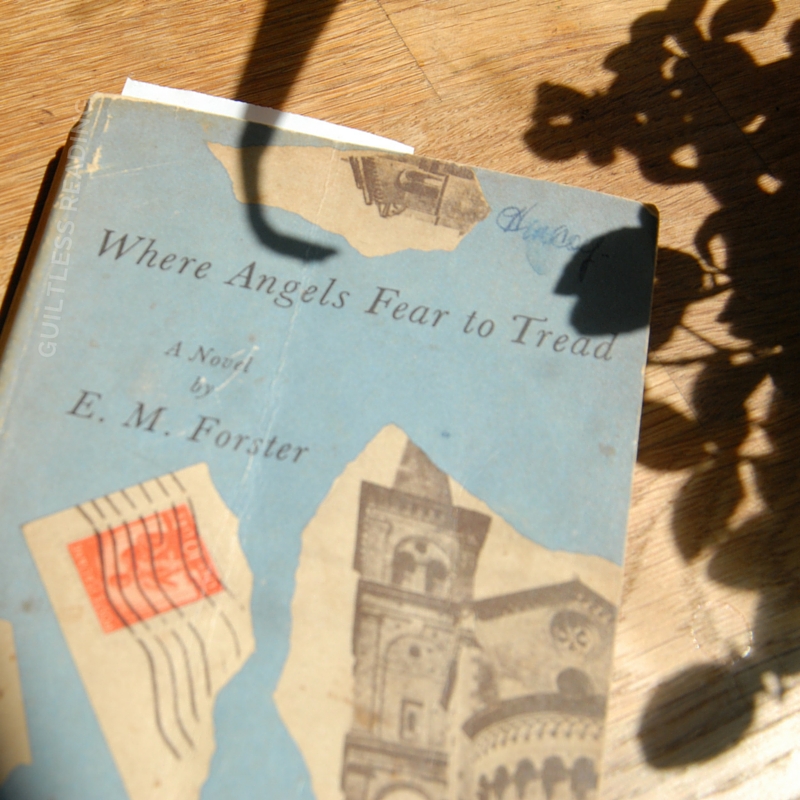
Lie in it! {Where Angels Fear to Tread by E.M. Forster}


You made your bed, now lie in it.

Synopsis of Where Angels Fear to Tread by E.M. Forster:
When attractive, impulsive English widow Lilia takes a holiday in Italy, she causes a scandal by marrying Gino, a dashing and highly unsuitable Italian twelve years her junior. Her prim, snobbish in-laws make no attempts to hide their disapproval, and when Lilia's decision eventually brings disaster, her English relatives embark on an expedition to face the uncouth foreigner. But when they are confronted by the beauty of Italy and the charm and vitality of the disreputable Gino, they are forced to examine their own narrow lives, and their reactions are emotional, violent and unexpected.

My two cents

Well, this one languished. I was uber-excited to read it but never got around to actually putting pen to paper. Now, let's take a moment to admire the cover: I admit I bought it partly because the cover (fabulous, fabulous!) is designed by Leo Lionni, one of my all-time favourite children's books illustrators!

Honestly, this book was quite the surprise. I thought with my track record for being frustrated with classics in general this may be a miss. Yet I slowly warmed up and once mired, this one didn't disappoint.

What I liked

The psychology. The psychology behind classics can't be beat. I find that there are few bells and whistles and simply a presentation of who the characters are, their motivations, and their thought processes. It's material that always seems to stand the test of time.

I keep coming back to the title: where angels fear to tread. This one is about bucking tradition, following one's true desires, and dammit ... living with the consequences because you made your bed, lie in it. Sure, "fools rush in" but sometimes just going for it is the only way to go forward.

While for the most part, the characters are frigid, self-righteous, melodramatic and generally unlikeable, I found that their unlike-ability is what makes them human and accessible. I really need to laugh: these frigid English women (Lilia! Ms. Abbott!) make for great writing! Philip was among my favourite males, an annoying "messiah" who finally came to the realization of love. Gino, make no mistake about it, is what he is, and that's what makes him stand out - there is no shyness about him.

The plot. I thought I could predict what was going to happen, but I was stunned at the final turn of events. There is a tragicomedy to the whole storyline -- plus melodramatics that somehow works -- that make this so appealing to me.

Clashes here, there and everywhere. A large part of this book relies on cultural clashes, and naturally, character clashes. The cultural differences between the repressed and highly structure English versus the emotional, free-spiritedness of the Italians bring forth the best of ...

... subtle wicked humour. Forster's humour grew on me. He has a slyness about him in expressing the horrors of his characters being at cultural loggerheads. The absurdity of some of the pressures and expectations really make me thankful that I'm not of this era.

Verdict

Call me a fool. I may just have the heart of a classics reader after all! I'm rereading this -- I feel like it'll be better the second time around.

Unexpected, unrealistic and lots of heart {The Unexpected Everything by Morgan Matson}


When the unexpected is the best thing that could ever happen.

About The Unexpected Everything by Morgan Matson*: Andie had it all planned out. When you are a politician’s daughter who’s pretty much raised yourself, you learn everything can be planned or spun, or both. Especially your future. Important internship? Check. Amazing friends? Check. Guys? Check (as long as we’re talking no more than three weeks). But that was before the scandal. Before having to be in the same house with her dad. Before walking an insane number of dogs. That was before Clark and those few months that might change her whole life. Because here’s the thing—if everything’s planned out, you can never find the unexpected. And where’s the fun in that?

My two cents

Sometimes I get an unsolicited book for review in the mail. I barely read Young Adult but I don't ever close my doors on YA because there is undeniably some great stuff out there. This was unsolicited, unexpected in many ways, and most importantly I enjoyed it!

This will be some of my thoughts, very quickly:

What I liked

  • The feeling, the tone! This is fun, upbeat, light, quick reading. But it's not too fluffy. There's a lot of feeling in the situations and the dialogues, and it's easy to relate to what is going on. 
  • The themes -- friendship, opening oneself up to change, being open to the unexpected -- I think it's a great message for those who are in the prime of their life. I'm happy to hear stories about disappointments early in life, rather than painting life to always be rosy!

What I didn't quite like

  • Sure, Andie is the daughter of a politician. She has amazing friends. She conveniently has boyfriend(s) who know all the political protocols behind dating the daughter of a politician. Probably unlikely that readers belong to the demographic but it's kind of like reading The Princess Diaries - highly improbable but the characters and storytelling make it relatable. 
  • Speaking of The Princess Diaries, why does there always have to be the requisite party bust? 
  • I doubt that teenagers will need to hear the message "loosen up" and "go party," but ok, ok, diversity in messages.
  • Plot-wise, cute... but hyperextended much at 500+ pages!


Verdict

An unexpectedly good YA read which allowed me to relax and relive younger days. Popcorn reading. Lots of heart.

Let the waterworks begin! {The Light Between Oceans by M.L. Stedman}


Crocodile tears? I couldn't get suckered into this one. Sorry.

Synopsis of The Light Between Oceans by M. L. StedmanAfter four harrowing years on the Western Front, Tom Sherbourne returns to Australia and takes a job as the lighthouse keeper on Janus Rock, nearly half a day’s journey from the coast. To this isolated island, where the supply boat comes once a season and shore leaves are granted every other year at best, Tom brings a young, bold, and loving wife, Isabel. Years later, after two miscarriages and one stillbirth, the grieving Isabel hears a baby’s cries on the wind. A boat has washed up onshore carrying a dead man and a living baby.

Tom, whose records as a lighthouse keeper are meticulous and whose moral principles have withstood a horrific war, wants to report the man and infant immediately. But Isabel has taken the tiny baby to her breast. Against Tom’s judgment, they claim her as their own and name her Lucy. When she is two, Tom and Isabel return to the mainland and are reminded that there are other people in the world. Their choice has devastated one of them.

M. L. Stedman’s mesmerizing, beautifully written novel seduces us into accommodating Isabel’s decision to keep this “gift from God.” And we are swept into a story about extraordinarily compelling characters seeking to find their North Star in a world where there is no right answer, where justice for one person is another’s tragic loss. The Light Between Oceans is exquisite and unforgettable, a deeply moving novel.

My two cents

I've had this on my radar since it got such rave reviews from the blogging community when in 2012 it won a Goodreads People's Choice Award (Historical Fiction). Then I found out that a readalong was happening so I was able to snag a copy of the book (courtesy of the publisher). Besides, the movie is out now (see trailer here) so I obviously must read book before watching movie.

Love ...

I'd pinpoint this as the book's saving grace: the setting in a lesser-known area in Australia and about life in a difficult environment - how many books depict life in a lighthouse? As I was reading this, I was under the impression that the setting was real; Stedman admits that Janus Rock is fictitious (see interview here):

[...] But the region where the Great Southern Ocean and the Indian Ocean meet is real, and the climate, weather and the landscape are more or less as I’ve described them. I wrote some of the book there: It’s a very beautiful, if sometimes fierce, part of the world. 
Promising: the themes of parenthood and of a moral dilemma of two parents, similar to the Biblical "split the baby" paradox. This was tackled quite in depth and brought forth the stronger characters - Hannah and Tom (I have reservations about him though, more later).

If you've read this and loved it, so be it. I'm not in the "love camp" so please don't read any further if you did (I'm serious). Because here's what I hated about this book.

Hate ...

I picked this up with great expectations (like all books, right?). But this isn't at all what I was expecting; it was a bit of a letdown, to be honest.  I actually sped-read about half of this because I wanted to get through it quickly and painlessly. This review has languished because I wanted to give it a chance!

I thought I'd be moved by the tragedy of the story and wowed by the literary quality of the writing. The below may sound cryptic but it is spoiler-free. So here's what I thought:
  • It's generally predictable. Actually, scratch that: it's predictable. 
  • The drama felt forced and even verged on melodramatic. So much emoting. If you cry at the drop of a hat, then you may love it. It'll tug at all your heartstrings. It didn't tug on mine because I was uneasy and I actually felt I was being emotionally manipulated ... and why did this all take so long? The drama was so drawn out that halfway is all that I could manage sanely.
  • The characters, oh my. Don't get me started. Isabel, who I so wanted to like because of her heartbreak and her pain, was just a grating character to me. Her desperation verged on the melodramatic. Meanwhile, Tom, who I warmed up to immediately, annoyed me when he acted totally out of character during a pivotal moment. Talk about a cop-out. 
  • There are niggly things, coincidences, and turns of events that seemed too easily to fall together that I was in a constant state of disbelief.
  • The writing had its lovely moments, I concede, but when combined with the above, the metaphors and flowery writing merely grated on me.

All in all, this felt like a big yawn for me.

P.S. The film will be a no go for me. I suspend judgment on the movie but I fear that it'll be in the mold of Nicholas Sparks, whose books and movies annoy me no end (*shudder).

Verdict: 

Loved the setting, the promise of the themes of parenthood ... but I did not get suckered into the melodramatics of this predictable tale. I'd say pass.

If you're interested in the readalong, check out this link: Goodreads Readalong.


Love or hate camp? Tell me!

*I received a copy of this book courtesy of the publisher for review consideration.


Pinoys, start waxing poetic {Mariposa Gang and Other Stories by Catherine Torres}


Vignettes of alienation. Vignettes of Philippine life.

Synopsis of Mariposa Gang and Other Stories by Catherine Torres: A maid packs her bags after learning that her employer values her less than a murano vase. A young man enters the priesthood when he is spurned by the woman he loves and is sent on a mission to the backwaters of West Bengal. A pampered heiress goes on exchange study in Tokyo to prove her independence and finds herself stuck without heating in the middle of winter. A seaman avenges his daughter and is banished to a penal farm, where he spends his days catching rare butterflies. These ten stories by Catherine Torres are about women and men navigating various forms of exile, and recovering, or discovering, ‘home’ in surprising, often startling, ways.

My two cents

When I was contacted by an author -- who also happens to be Filipino like me -- I couldn't resist. She sent me two of her books for review consideration. This is one of them.

This is a book that made me immensely sad. As an immigrant, my heart goes out to the many men and women who leave their homeland in search of a better life on foreign shores. But this collection takes it one step further because it is not just about being transplanted in a foreign land, but a foreign environment in general. Torres's short stories capture the feelings of alienation, of loneliness ... but of an even stronger longing for a better life. I often wonder about the paradox of economic success and stability at the expense of the deterioration of social values and structures. It is a reality many face daily.

These are vignettes of life, of the sad reality that "home" is not always where we want it to be. A tough "can do" attitude can get one very far indeed. But deep inside remains that need for connection, of familiarity to one's surroundings.

One big thing about these stories is the nostalgic sense of place that Torres is able to infuse, in her easy mentioning of places or situations or memories or sights and sounds of the Philippines. It's enough for any immigrant Filipino to start waxing poetic.

***

Quick thoughts about each story:

Mariposa Gang metaphorically captures the fleeting nature of life. A prisoner, in jail for stabbing his daughter's lover, joins a team that catches rare butterflies to be sold for the highest price. The butterflies are as elusive as the happiness he so desires.

The Sema highlights the deterioration of a marriage in a honeymoon to Turkey, surprisingly, with the beginning of a new friendship.

Mannequins depicts two young women, roommates and polar opposites, both escaping poverty and a lack of prospects and now struggling to make money in various odd jobs in Singapore.

Gilt-Edged Shadows hones in on the immense beauty that is possible only when breaking the rules. A paradoxical tale of how not giving into the new trends produces results one can be truly proud of.

Haenyo 8103
The Haenyeo of Korea (photo from here)
Hibernation takes place in the dead of winter in Japan with a female student coming for the free food at a student gathering. The event reveals a departure of a professor and a realization of the departure from her own ideals.

Blown Glass shows the heartbreaking paradox that in the subjectivity of the meaning of value in two very different cultures, things often hold more value than life.

Man of the Cloth is the quest of a young and idealistic Filipino priest for true meaning in his life, from the revolutionary to the altruistic to the settling into his calling.

Plunge is how a young Filipino husband immerses himself in the family, the culture and the life with his Korean wife, with a fascinating interplay with a backstory of traditional female divers of Korea (or Haenyeo).

The Bag Lady is a tale of the unlikely transformation of Filipino beauty queen and into a maid and bag lady in Singapore, and of a relatively content woman into one full of regret.

Cafe Masala is a Filipina's new business as she returns to her homeland from India.

Verdict

Succinct, emotional tales of immigrant hearts. Truthful, real, and meaningful. Read it!

Which of these short stories interest you?


A copy of this book was provided to me by the author for honest review consideration. All opinions are mine.

Call the Midwife. I need book 2 stat. {Call the Midwife by Jennifer Worth}


Screen, paper: do them both!

Synopsis of Call the Midwife by Jennifer Worth*: London's East End in the 1950s was a tough place: the struggles of post-war life - bombsites, overcrowded tenements, crime, brothels - bred a culture of tight-knit family communities, larger-than-life characters and a lively social scene.

It was into this world that Jennifer Worth entered as a trainee midwife. But docklands life was tough, and babies were often born in slum conditions. In funny, disturbing and heartbreaking stories, Jennifer Worth recounts her time among nuns, prostitutes, abortionists, bigamists, gangsters and expectant mothers, portraying East Enders' amazing resilience - and their warmth and humour in the face of hardship.

Written with affection and nostalgia, her midwife stories chronicle the lives, traditions and tales of a bygone era.


My two cents

Oh, movies. Or in this case, Netflix. *sigh* They spoil the book sometimes. I bingewatched the Netflix series and loved it so much that I couldn't wait to dig into the book. I can't review the book without sounding like a silly broken record, so read the Netflix review I FIRST. (Then come back and this review will be waiting).
...
...
...
...

No, I'm serious. Go on, read it first.
...
...
...
...
So, you're back from my glowing review of the Netflix series, I see. Settle down with a cuppa and let's chat.

So, yes, I loved the book!

Lest you think I hated the book, that's not the case. The book is amazing. It's a truly affecting and provoking memoir. I appreciated the epilogue which gave Worth's short personal history as well as summing up some of her key observations and realizations about her time as a midwife. It is a critical piece, as it sets the stage for the realizations that are bound to happen to you as a reader.

Overall, the book (and the series) are meaningful to me because it made me appreciate so many things that we take for granted today. If we think about how recent the 1950s is, it seems shocking to imagine the squalid conditions and the poverty of England during the time.

Even more shocking is to me is that it highlights a time where medicine was still practically in its infancy, at least against today's standards! It seems almost medieval to think of a mostly uninformed and almost barbaric methods for abortion, of separating single mothers from their children without any heed for the psychological and physical trauma this inflicts, a dearth of reliable contraception, the prevalence of tuberculosis and other totally curable diseases, and the lack of understanding of PTSD.

But let's focus on midwifery. Worth mentions that midwives are never the subject of books. Before I read this book, try as hard as I could, I couldn't remember a title of one book that dealt with the subject matter. Can you recall one?

What strikes me as even more ironic is that Worth and the midwives she worked with, with the exception of some of the older nun midwives, were in their early 20s. The gravity of their work at a young age astounds me - delivering countless children when they themselves have never borne one!

Summed up with the huge strides made in medicine in the past few generations, and the tireless work that these young women dedicated a better part of their lives, it has allowed for the life-changing benefits for women, children and communities. The impacts of this period of hardship and learning continue to influence society's attitudes towards caring for the mother's and child's well-being. We're truly blessed indeed!


Uh-ohs

Now, the disappointing news. I caution anyone who watches the series first that if you're reading the book, you will recognize some major deviations in the storyline of each of the episodes. I got slightly confused, for example, that the story of one person in a Netflix episode is actually a mishmash of the stories of 2-3 people. Credit to the screenplay writers of the series, though, to be able to cram in so much detail into one episode. I like to think of the two media as separate experiences in themselves. I simply choose to immerse myself into the written word at the moment but will no doubt rewatch the series again.

Verdict

Read the book. Watch the Netflix series. Be provoked and inspired.

Links


You can mess with my mind anytime, Ms. Flynn! {Gone Girl by Gillian Flynn}


Ms. Flynn, you got me. 

About Gone Girl by Gillian Flynn*: On a warm summer morning in North Carthage, Missouri, it is Nick and Amy Dunne’s fifth wedding anniversary. Presents are being wrapped and reservations are being made when Nick’s clever and beautiful wife disappears. Husband-of-the-Year Nick isn’t doing himself any favors with cringe-worthy daydreams about the slope and shape of his wife’s head, but passages from Amy's diary reveal the alpha-girl perfectionist could have put anyone dangerously on edge. Under mounting pressure from the police and the media—as well as Amy’s fiercely doting parents—the town golden boy parades an endless series of lies, deceits, and inappropriate behavior. Nick is oddly evasive, and he’s definitely bitter—but is he really a killer?

My two cents

(What a great book to jolt me out of my reviewing slump!)

I'm obsessed with this book.

I know I am late in joining the Gone Girl bandwagon but I'm hopping on, willingly, and with guns blazing. Because it's been a while since I've read a book so utterly engrossing and so utterly ... brilliant. I finished it ... and promptly reread it. (I'm still in the the throes of the reread, and I'm just enjoying it even more.)

I can't get into the detail of this book without spoiling it for first time readers (or movie watchers) so I will simply leave the storyline alone: a quick review that is spoiler-free but may be somewhat cryptic in places.

So, I'm obsessed. Here's why:

It's unpredictable

This entire book is a brilliant mind game played between a hubby and wife, and unwittingly a mind game that Gillian Flynn plays on her readers. There are two parts to this book and I've realized that readers either will play along with Ms. Flynn or simply hate it. It's a polarizing experience -- love it or hate it -- with a passion. I was dazed when I finished it. I went "Oh sh**" then heaved a sigh reeking of "OMG" and surprisingly, wallowed in the reality that is the twistedness and perversion that I had just read.

It's psychologically insightful

Know the whole he said, she said shebang? This is the ultimate. This is all about a marriage and highlights the very intimate mind meld relationship that can exist between a couple. It can pendulum from the good to the bad, and this particular book shows the extremes that are often difficult to stomach.

Another interesting dichotomy explored is the wide difference between reality (private persona) versus public perception. The role of media -- the good, the bad, and the ugly -- are fully expounded upon in the storyline. How many times have you passed judgment on a case or a person based on what you heard in the news, saw on TV, or even social media? We all do it. In this day of easy access to information, forming opinion based on the constant stream of fact (and plenty of fiction) is an easy trap to fall into.

Lastly, I can't believe that I fell for Flynn's "game" so easily. The way that this story is structured out makes me want to read more of her work, for the simple  (and awesome) reason that she has so much insight into her very readers' psychology. Not all authors can pull off a mind game so brilliantly, so annoyingly, and so effectively. Kudos, Gillian Flynn.

It can actually happen (scarily so)

In the back of my mind, what really struck me about Gone Girl is that it's very possible that this could happen, and to anyone. It's a difficult thing to accept that no one can really know any one person, no matter how close we can be, whatever relationship can bear some uncertainty. But it's doubly difficult to know someone's deepest, truest, and ugliest self ... and if not being able to accept it, to at least be able to acknowledge and understand.


Verdict:

Looking for a mind trip? Try Gone Girl. Then tell me if you're in the love or hate camp!

Highly recommended reading for those who despise predictable, cookie cutter characters and willingly desire to be surprised, shocked and challenged.


*Affiliate link

How does one stay whole, sane, live with integrity amidst contradictions? {Snow by Orhan Pamuk} @ReadNobels


How does one stay whole, sane, live with integrity amidst contradictions?

About Snow by Orhan PamukDread, yearning, identity, intrigue, the lethal chemistry between secular doubt and Islamic fanaticism–these are the elements that Orhan Pamuk anneals in this masterful, disquieting novel. An exiled poet named Ka returns to Turkey and travels to the forlorn city of Kars. His ostensible purpose is to report on a wave of suicides among religious girls forbidden to wear their head-scarves. But Ka is also drawn by his memories of the radiant Ipek, now recently divorced. Amid blanketing snowfall and universal suspicion, Ka finds himself pursued by figures ranging from Ipek’s ex-husband to a charismatic terrorist. A lost gift returns with ecstatic suddenness. A theatrical evening climaxes in a massacre. And finding god may be the prelude to losing everything else. Touching, slyly comic, and humming with cerebral suspense, Snow is of immense relevance to our present moment.

My two cents

So here's a review that has been languishing in draft. It's because I couldn't pick up another book for maybe about a week after reading this book: it gave me such a horrendous book hangover. In the best possible way: it provoked, it triggered so much in me. It got to me, ok, pretty hard.

This book is deceiving; it doesn't look all that thick but it is actually 426 pages, and crack it open and the text is tiny! Dense. I struggled to get past that fact in the beginning but once I made it into the second chapter, I was hooked. It is a pithy novel, like someone poured their life into it, and I doubt that's not far from the truth for Orhan Pamuk.

I loved that this was such a challenging read. I find it disconcerting that reviews are polarized. But I understand where people are coming from - it's hard to get around the fact that this is about a depressingly solitary and misunderstood life in a far flung country whose realities I know little about (although sadly, plenty in the news lately). But surprisingly that's what I loved about it: learning and getting out of my comfort zone, and realizing that despite country, culture, religion, everyone is merely trying to live their lives the best they can.

Collage of Kars, Turkey. 
By Kars Church Of The Apostles 2009.JPGBjørn Christian TørrissenKars Kalesi1.jpgSabri76Kars Panorama.JPGBjørn Christian Tørrissen - Derived from other images, as noted under Author, CC BY-SA 4.0, https://commons.wikimedia.org/w/index.php?curid=34628630

Ka's solitary life is cobbled together from the viewpoint of Orhan Pamuk who is Ka's friend. Notice the author insertion here? In that respect, this reminded me of Ilustrado by Miguel Syjuco. And like Syjuco's presentation of Philippine history, Pamuk allows us a glimpse Turkey's history, one where religion, politics, and power is complicated and multifaceted. The traditional clashes with the modern; nationalism is at odds with the status quo towards assimilation; Islamic belief, secularism and traditional religion are a contradictory mix; and the Eastern and Western belief systems collide. I wonder: how does one stay whole, sane, and live with integrity amidst these contradictions?

I love how Blue, Kars's resident revolutionary, is able to make sense of the dilemma:
"I refuse to be European, and I won't ape their ways. Im going to live my own history and be no one but myself. I for one believe it's possible to be happy without being a mock European, without becoming their slave. There's a word Europhiles very commonly use when they denigrate our people: to be a true Westerner a person must first become an individual, and then they go on to say that in Turkey, there are no individuals! Well, that's how I see my execution. I am standing up against the Westerners as an individual; it's because I'm an individual that I refuse to imitate them." - p. 314

Yet another dilemma presented is the reality of being a veiled woman in Turkey (sidenote: another book that tackles this on a more personal level is Silk Armour by Claire Sydenham, a book I highly recommend). The contradictions of revolt and freedom, of tradition and constraint is something that women must contend with daily in society to determine their own sense of identity. The rash of suicides of veiled students was an intriguing way of couching this daily struggle.

Poetry throughout, music, theatrical presentations: I reveled in the power of media in informing and agitating people, presenting fact and differing opinions, and affecting change. It highlights the fact that music and the arts is never going to disappear from our lives.

I can't not comment about the obvious theme of snow carried throughout the book -- its coldness and sadness it evokes, the stark white landscapes that it conjures. But also its beauty. Contradictions.

There is so much more to this book that I hate the idea of breaking this review down too much (plus I fear that my not completing this review will end up in my never getting this review up at all!). The most powerful thing for me about this novel is that this got me thinking and asking more questions, of learning about Turkey's multifaceted society and knowing that history shapes the lives of its inhabitants in many ways that we would never imagine possible.

Uh-ohs

There are certain aspects of this novel that raised a red flag in my mind. The most obvious is that this dense tome is intimidating. I actually read this over an entire month, in little manageable bits. I won't deny that it's heavy reading, but so totally worth it!

Another, the snow theme became academic towards the end. It kind of fell flat for me when I saw the diagrams and I thought the author carried it tad far. I often wonder with works like this if things get lost in translation (because this is a translated work), something I can only speculate about.

Setting

Set predominantly in Kars, Turkey, the landscape for this story is a fascinating mix of old and new built upon a history of conflict. Historic accounts and folkloric stories abound in this novel but one needs to read between the lines, do their research, especially if coming in from the cold.

Kars was the capital of the medieval Bagratid Kingdom of Armenia. In the 19th century, it was battled over by the Ottoman and Russian empires, with Russia eventually gaining control. During the First World War, the Ottomans took control of the city in 1918 but relinquished it to the First Republic of Armenia following the Armistice of Mudros. In 1920, Turkish revolutionaries captured captured Kars. The Treaty of Kars was signed in 1921 between the Government of the Grand National Assembly and the Soviet republics of Armenia, Azerbaijan and Georgia, establishing the current north-eastern boundaries of Turkey. Learn more here: Wikipedia - Kars, Turkey


Verdict

An intimidating and challenging read about the tragically solitary life of a revolutionary in Turkey. Dense, provoking and allowing for introspection, I highly recommend this for those who'd like to learn more about the history and realities of conflict-ridden countries, and those intrigued by Pamuk's ability to encapsulate the dilemma of national self-identity vis-s-vis personal self-identity in novel form.

***

I read this book as part of the Read the Nobels 2016 Reading Challenge. This is written by Nobel Prize for Literature Laureate Orhan Pamuk.

Read the Nobels 2016
 Join the Read the Nobels 2016 Reading Challenge anytime until December 31, 2016.

Find Read the Nobels on social media!

·
OLDER


© guiltless readingMaira Gall