#readmyowndamnbooks
Showing posts with label #readmyowndamnbooks. Show all posts

Puny smuny. Sorrow smorrow. Anything but. {All My Puny Sorrows by Miriam Toews}


When the biggest irony is that I loved loved loved it.

About All My Puny Sorrows by Miriam Toews*: You won’t forget Elf and Yoli, two smart and loving sisters. Elfrieda, a world-renowned pianist, glamorous, wealthy, happily married: she wants to die. Yolandi, divorced, broke, sleeping with the wrong men as she tries to find true love: she desperately wants to keep her older sister alive. Yoli is a beguiling mess, wickedly funny even as she stumbles through life struggling to keep her teenage kids and mother happy, her exes from hating her, her sister from killing herself and her own heart from breaking.

But Elf’s latest suicide attempt is a shock: she is three weeks away from the opening of her highly anticipated international tour. Her long-time agent has been calling and neither Yoli nor Elf’s loving husband knows what to tell him. Can she be nursed back to “health” in time? Does it matter? As the situation becomes ever more complicated, Yoli faces the most terrifying decision of her life.

All My Puny Sorrows, at once tender and unquiet, offers a profound reflection on the limits of love, and the sometimes unimaginable challenges we experience when childhood becomes a new country of adult commitments and responsibilities. In her beautifully rendered new novel, Miriam Toews gives us a startling demonstration of how to carry on with hope and love and the business of living even when grief loads the heart.

My two cents

Upon putting this down, I sighed and felt my heart was full. This is what real, raw, honest writing is ... and wow, what that does to a reader. This moved me deeply.

Very few authors can pull off what this book has accomplished: it is funny yet compassionate, sensitive and sweet yet uncloying. When I see an obviously ironic cover, I can't help but duck sometimes - but yes, suspend judgment I did, because I loved Toews's A Complicated Kindness.

And lo and behold, I didn't even roll my eyes even once or inwardly groan or cringe. And that's saying a lot about a book that delves deep into the complicated stuff of sisterhood, depression, pain, suffering, assisted death, and suicide.

Toews is unafraid to articulate all those messy bits and then some. She lays it out bare, never mind being political correct. She takes no heed for taboos.

And the humor! Her humour comes with a really honest emotion that made me unafraid to continue reading. Especially charming about this book are the banter and dialogues which are very realistic and oh-so-relatable. In my mind's eye, I relived some of my own little arguments and conversations with family members. I loved getting immersed and invested -- mentally and emotionally - in Elf and Yoli's lives and the complicated relationship that rules most siblings. I couldn't believe it when the book rolled to its close. I wanted more.

***

This book takes place in Canada, more or less equally between Winnipeg and Toronto. I am familiar with both cities so it was lovely to see mentions of specific places including restaurants and landmarks and get a real sense of the place. Locals of these cities can't help but see these subtle little nods to beloved haunts.

There also little nods to literature and classical music. Throughout, there are mentions of much-loved books. I love classical music so the fact that Elf is a famous and tortured artist appealed to me - it lent a little more humanity and the suffering behind creating beauty.


Verdict

This is a gem of a novel in my eyes. I think anyone who loves and honest book will get sucked int this one. Highly recommended.

P.S. If you pronounce the author's last name as "toes" then you're not the only one! I'd been doing it for ages until I got heard someone say it otherwise (to my dismay and embarrassment). Here's how to pronounce Toews  - properly!


This is a book that qualifies for the Travel the World in Books Challenge. The story is set in Canada and the author is Canadian. Toews is well-known for her novel A Complicated Kindness.

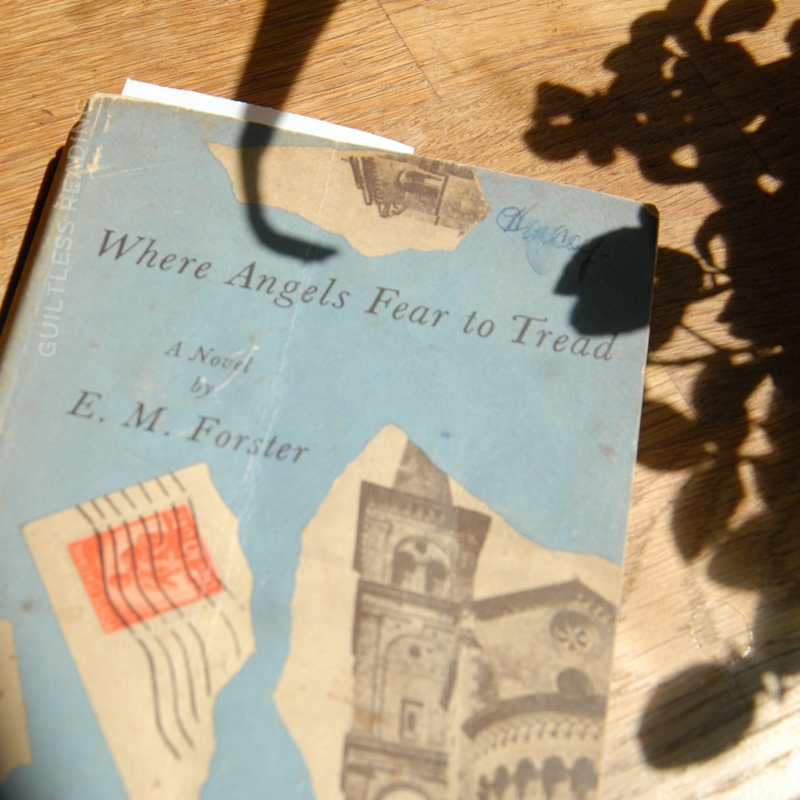
Lie in it! {Where Angels Fear to Tread by E.M. Forster}


You made your bed, now lie in it.

Synopsis of Where Angels Fear to Tread by E.M. Forster:
When attractive, impulsive English widow Lilia takes a holiday in Italy, she causes a scandal by marrying Gino, a dashing and highly unsuitable Italian twelve years her junior. Her prim, snobbish in-laws make no attempts to hide their disapproval, and when Lilia's decision eventually brings disaster, her English relatives embark on an expedition to face the uncouth foreigner. But when they are confronted by the beauty of Italy and the charm and vitality of the disreputable Gino, they are forced to examine their own narrow lives, and their reactions are emotional, violent and unexpected.

My two cents

Well, this one languished. I was uber-excited to read it but never got around to actually putting pen to paper. Now, let's take a moment to admire the cover: I admit I bought it partly because the cover (fabulous, fabulous!) is designed by Leo Lionni, one of my all-time favourite children's books illustrators!

Honestly, this book was quite the surprise. I thought with my track record for being frustrated with classics in general this may be a miss. Yet I slowly warmed up and once mired, this one didn't disappoint.

What I liked

The psychology. The psychology behind classics can't be beat. I find that there are few bells and whistles and simply a presentation of who the characters are, their motivations, and their thought processes. It's material that always seems to stand the test of time.

I keep coming back to the title: where angels fear to tread. This one is about bucking tradition, following one's true desires, and dammit ... living with the consequences because you made your bed, lie in it. Sure, "fools rush in" but sometimes just going for it is the only way to go forward.

While for the most part, the characters are frigid, self-righteous, melodramatic and generally unlikeable, I found that their unlike-ability is what makes them human and accessible. I really need to laugh: these frigid English women (Lilia! Ms. Abbott!) make for great writing! Philip was among my favourite males, an annoying "messiah" who finally came to the realization of love. Gino, make no mistake about it, is what he is, and that's what makes him stand out - there is no shyness about him.

The plot. I thought I could predict what was going to happen, but I was stunned at the final turn of events. There is a tragicomedy to the whole storyline -- plus melodramatics that somehow works -- that make this so appealing to me.

Clashes here, there and everywhere. A large part of this book relies on cultural clashes, and naturally, character clashes. The cultural differences between the repressed and highly structure English versus the emotional, free-spiritedness of the Italians bring forth the best of ...

... subtle wicked humour. Forster's humour grew on me. He has a slyness about him in expressing the horrors of his characters being at cultural loggerheads. The absurdity of some of the pressures and expectations really make me thankful that I'm not of this era.

Verdict

Call me a fool. I may just have the heart of a classics reader after all! I'm rereading this -- I feel like it'll be better the second time around.

Fan opinion in book form {The Panem Companion by V. Arrow}


Fan opinion in book form

Synopsis of The Panem Companion - from Mellark Bakery to Mockingjays by V. Arrow:
-What does Panem look like?
-How does Panem define race?
-How do Panem’s districts reflect the major themes of the trilogy?
-What allusions to our world are found in Panem names like Finnick, Johanna, Beetee, Cinna, Everdeen, and Mellark? 

Go deeper into the home of the Hunger Games with the creator of the best-known fan map of Panem. The Panem Companion gives fresh insight into Suzanne Collins’ trilogy by looking at the world of the Hunger Games and the forces that kept its citizens divided since the Dark Days. With a blend of academic insight and the true passion of a fan, V. Arrow explores how Panem could have evolved from the America we know today and uses textual clues to piece together Panem’s beliefs about class, ethnicity, culture, gender, sexuality, and more. Includes an extensive name lexicon and color-illustrated unofficial map of Panem.

My two cents

I can't deny that I love the Hunger Games (the books, the movies were so-so for me). So when I won a copy of this companion book on Goodreads years ago, I was thrilled. But I distinctly remember starting-stopping-starting-DNF this ... I just couldn't get into it. I was doing a massive clean-up of books and this one would've made it into the donation bin ... until I flipped through and chanced upon the theory that Prim may actually be Peeta's sister ... hmmm, ok, I thought, and flip here and there I did.

***

I can't deny that this book holds some intriguing theories and explores so many possibilities. Bouncing around from the origins of Panem, to class, to political power, to race and ethnicity, to gender, to beauty, and everything in between, this book is a little goldmine for a diehard fan.

Panem a ruined North America centuries down the road - check out a map of Panem that proposes how today's states coincide with the various districts, albeit a bit of a move around. Is District 12 really the Appalachia? Maybe, given the evidence of name etymology, and the description of race and ethnicity of the residents of District 12.

There is lots of this in this book, LOTS that it makes your mind spin. This could take you down the rabbit hole indeed.

I have mixed feelings about it all. On the one hand, the theorizing and speculation grabbed my attention in some areas. Who doesn't love a good long chat about the many possibilities with the already controversial and hotbed themes that The Hunger Games explores?

On the other hand, I got irked that the so-called "references" for all these theories were other fans (in fact there was one reference that said something with "and sprinkles on top" and I was ... "WHAT?"). In my mind, sure, theorize away. But maybe that's content best left for a Wiki (like this one), a forum, or a blog or some other online venue or even fan magazines.

This book confuses me because it feels like someone went online and did a compilation of fan opinion. Not a bad thing but ... uh - duh ... maybe the author Suzanne Collins (whose interviews are referenced all but a few times) can confirm-deny-shed light on any of these theories? Where better to get the true origins of the book's themes than from the author herself? I am thinking, hey J.K. Rowling revealed Dumbledore's sexuality (do tell, maybe someone wrote a book about that too?)

The bottomline is that this is an "unofficial guide." Keep that in mind. Because these aren't the only theories floating about out there.

Verdict

Fandom is a wonderful thing but I honestly didn't feel a book crammed with Hunger Games fan opinion was warranted. I give this book a meh and suggest that if you're an absolute diehard, sure, knock yourself out... but do yourself the favor and go visit more fan sites while you're at it.

I loved the books on their own and prefer to speculate by my lonesome. I feel that this book rather spoiled things for me by its over-analysis.


Are you a Hunger Games fans? Is this companion book an aye or nay?


Still lusty for life yet ruing lost youth. {Memories of My Melancholy Whores by Gabriel Garcia Marquez}


Still lusty for life yet ruing lost youth.


Synopsis of Memories of My Melancholy Whores by Gabriel Garcia Marquez: On the eve of his ninetieth birthday a bachelor decides to give himself a wild night of love with a virgin. As is his habit--he has purchased hundreds of women--he asks a madam for her assistance. The fourteen-year-old girl who is procured for him is enchanting, but exhausted as she is from caring for siblings and her job sewing buttons, she can do little but sleep. Yet with sleeping beauty at his side, it is he who awakens to a romance he has never known.

My two cents

A bad first impression

After a ten year hiatus, Marquez came back into the limelight with this extremely slim Lolita-esque novel. I am a huge fan Marquez already, so I came upon his book a few years ago, I had great expectations. My first read I immediately hated it. I couldn't get past the revulsion that this story basically glorified a "dirty old man" -- a 90-year-old man sleeping with an impoverished teenager under the banner of "love." I put the book aside in semi-disgust and couldn't process how one of my favourite authors could do this to his fans patiently waiting for his next great novel.

Redeeming qualities

Now that I'm purposely doing the Read the Nobels, I decided that this book deserved a second chance. Readers do not necessarily need to agree with a story, I reminded myself. I wanted to see if I could get a more positive takeaway. Borne out of a second chance, this review delves into what I did like about it.

Strip this down its bare bones and this is an ode to growing old, a reminiscence of youth lost, and coming to the inevitable realization of the fleeting nature of life. It is about falling in love again, both literally and figuratively, and reliving youth through someone young.

This is quite funny in places which pokes fun at the aches and pains that come with old age. Even with coarse language, naughty comments, and the discussions on sex, sexual appetites and urges, there is a charm to this voice that has shed its shyness of youth. It is matter-of-fact, no-holds-barred, and comfortable in one's own skin. There is no pretension and no need to cloak in the niceties or politeness -- and I love that about this book.

... but still not up to snuff

I gave this book the chance but honestly it cannot compare to the loftiness and grandeur that is 100 Years of Solitude or the complexity of Of Love and Other Demons. It's good reading but it is not the best of Marquez's work. I feel a little let down still but comfort myself in the fact that I still have many Marquez books still unread.

Read the Nobels 2016
Find out more about Read the Nobels!

I welcome this demon of a writer {Of Love and Other Demons by Gabriel García Márquez}


A demon of a writer, that's Gabo.

About Of Love and Other Demons by Gabriel García Márquez: On her twelfth birthday, Sierva Maria, the only child of a decaying noble family in an eighteenth-century South American seaport, is bitten by a rabid dog. Believed to be possessed, she is brought to a convent for observation. And into her cell stumbles Father Cayetano Delaura, who has already dreamed about a girl with hair trailing after her like a bridal train. As he tends to her with holy water and sacramental oils, Delaura feels something shocking begin to occur. He has fallen in love, and it is not long until Sierva Maria joins him in his fevered misery.

Unsettling and indelible, Of Love and Other Demons is an evocative, majestic tale of the most universal experiences known to woman and man.


My two cents

I first read this in 2004 and fell in love with it immediately because of Marquez's gorgeous language and a love story steeped in the religion and superstition of 18th century Colombia. I dug up my old copy so I could reread it for the Read the Nobels 2016.

But you already know I wax poetic over Marquez having read a number of his books. I already know that I can never write a review that does this book justice. I have been agonizing over this review for far too long that I know if I don't just write it, I will never hit publish. So here goes ...

The inspiration

I always find it fascinating to learn where authors derive inspiration for their stories. Inspiration alone makes me wonder about Gabo who opens his book with two and a half pages explaining just that: in 1949, cub reporter Marquez in search of a news story visited the historic Convent of Santa Clara in Colombia where burial crypts were being removed to give way to a five-star hotel (you can see the proof here of what replaced the convent).

Marquez witnesses the wholly unsentimental exhuming of bishops and abbesses buried there for hundreds of years. Until they come upon a crypt of a young girl whose copper hair fairly bursted out of the crypt ... all 22+ meters of it! Hair grows even in death and based on scientific calculations, the young girl had been dead for over 200 years.

If fact wasn't strange enough, Marquez makes an uncanny connection with a legend he heard in his boyhood: a marquise with coppery hair that trailed behind her, venerated by many for the miracles she performed, who died of rabies. Talk about serendipity! And I am always in awe of how Marquez is able to weave something beautiful, with his brand of magical realism!
 

The story

Surprisingly the plot is extremely simple. Set in the 1740s in the remote South American port town called Cartagena de Indias, twelve-year-old Sierva María de Todos los Ángeles, is bitten by a rabid dog. The only daughter of a moneyed, prestigious yet decaying family, is sadly unloved and brought up by the black slaves that served them. She grows up as an oddity, obviously white in appearance but with the language, customs and superstitions of the blacks. 

News around the town is the rabid dog is dead and those who were bitten were suffering or dead. Although Sierva María's bite wound is insignificant and she exhibits no symptoms of rabies, the news travels far and wide. Her father, attacked by his conscience, only wants to quell rumours and he seeks out doctors to cure her. When regular doctors fail, quack doctors render painful treatments, resulting in Sierva María's violently resistance. Combined with her black behaviour, she is believed to possessed and then the news reaches the Bishop.

Sierva María is brought by her father to the convent of Santa Clara and the Bishop's protégé Father Cayetano Delaura is tasked to perform the rites of exorcism. Face to face with Sierva María, he is unprepared to fall in love, the "most terrible demon of them all." This love story plays itself out in all glory and all its tragedy.

The powers of love and passion

The themes of love and passion are replete, as is its unbidden powers for good and also the ability to destroy. The main love story is that of Sierva María and Father Cayetano Delaura, a forbidden love between a priest and a teenager believed to be possessed. However, there are more love stories that play themselves out, also unusual and tragic.

There is the sad union of Sierva María's parents, Don Ygnacio de Alfaro y Dueñas and his rapacious second wife Bernarda Cabrera -- a marriage borne not out of love but of trickery and deceit. His first wife who died early meanwhile was a marriage borne out of the desire to observe propriety and ensure stability of wealth. Don Ygnacio felt he had no choice but to spurn his true love but ended up living a life devoid of love all this life.

Bernarda meanwhile is a larger-than-life character (probably my favourite in this book) who schemes to win Don Ygnacio through her sexuality. But it is her unquenchable sexual appetite that is also her downfall, destroying her beautiful body and practically selling her soul to an equally rapacious slave.

Colonization and the Church

What stands out to me is this book's milieu. It is a time where the Catholic Church ruled supreme and everyone followed unquestioning, or risk the so-called fires of hell. Traditional cultures were usurped as countries were colonized by the Catholic Church. Traditional African cultures like Yoruban, Congolese and Mandingo had belief systems that were at odds with or were misunderstood, and by default anything that ran counter to Catholic Church belief was believed to be heretic, demonic. This was exacerbated by the fact that scientific thought was also believed to be heretic and superstition became yet another layer of ignorance for the common person.

Sierva María was the poor victim of cruelty borne out of this ignorance. Despite no symptoms of rabies, her unusual behaviours had their explanation in being raised by Dominga de Adviento, the formidable black woman who taught Sierva María to live as black. At one point Bernarda remarks that "The only thing white about that child is her skin" and sadly Sierva María lived in both cultures but never really fit in either.

The people who did understand Sierva María's true situation -- Abenuncio, and later on another priest -- were in the minority and whose voices did not hold sway in the wake of the powers-that-be of the formidable Bishop and the convent's ignorant Abbess.

Characters to empathize with

Do you know how some books leave you cold because the characters are so unlikeable or you simply develop no connection with? I have read the multiple times and I am entranced by how multi-dimensional and oftentimes how complicated these characters are. I felt Sierva María's frustration and annoyance at those "ridiculous white people." I understood why Delaura sought penance for succumbing to his love for Sierva María. I felt as conflicted as Don Ygnacio to save his daughter's soul while sending her to certain death. What surprises me each time, though, is how much I gravitate towards Bernarda, who is probably among the most cruel, grotesque characters. I have a soft spot for her because of her intelligence (even though she is a brilliant scammer) and her desire, even desperation, to give to the one she loves.

Verdict

One of my favourite books by Gabriel Garcia Marquez, its simple plot and easy to read language belies that fact that this forbidden love story is only a facade for a profound look at the effects of colonization on traditional cultures. I highly recommend this read!


Read the Nobels 2016
This is my second read/review for Read the Nobels 2016! 

Shades of Alice: "We're all mad here" {Veronika Decides to Die by Paulo Coehlo}


"We're all mad here."
- the Cheshire Cat in Alice in Wonderland by Lewis Carroll

About Veronika Decides to Die by Paulo Coehlo:
Twenty-four-year-old Veronika seems to have everything -- youth and beauty, boyfriends and a loving family, a fulfilling job. But something is missing in her life. So, one cold November morning Veronika decides to die. She takes a handful of sleeping pills expecting never to wake up. But she does -- at a mental hospital where she is told that she has only days to live.

This poignant international bestseller by the author of The Alchemist takes readers on a quest to find meaning in a culture overshadowed by angst, soulless routine, and pervasive conformity. Based on events in Coelho's own life, Veronika Decides to Die questions the meaning of madness and celebrates individuals who do not fit into patterns society considers to be normal. Bold and illuminating, it is a dazzling portrait of a young woman at the crossroads of despair and liberation, and a poetic, exuberant appreciation of each day as a renewed opportunity.

My two cents

Paulo Coehlo is one of those authors many wax poetic. I haven't read his popular The Alchemist so I have no preconceptions about him or his writing. However, the blurb and the intro for this book carries some heavy heavy realities of Coehlo's personal struggle with depression and suicide, so I started this book warier than usual (semi-autobiographies are often tough to read).

Veronika is young, beautiful and has her whole life ahead of her. But she's unhappy - not in the dramatic, emotional, dark way that we've come to think of depression - but in the insidious, under-the- radar type of way. In fact, while Veronika is waiting for her overdose of pills to take effect, she is stressing about a tech article that came out in a magazine that chirpily asks "Where is Slovenia?" It triggers something strangely patriotic in her and it occurs to her that since she is in the middle of writing a tell-off letter to the editor that people may connect her suicide with this teeny tiny detail.

But her suicide attempt is thwarted as she wakes up and realizes that she is confined in a mental institution called Villete. She is told that she has irreversibly damaged her heart and that she has only days to live. Unexpectedly this awakens the desire in Veronika to fight for her life, and by default, enjoy her last moments on earth. In her so-called "journey back to sanity," she comes to the "aha" moment that she can simply do what she wants to do - inhibitions and convention be damned - as people are tolerant at least and oblivious at best to those who are labelled mad.

What Veronika doesn't realize is that she is also affecting her fellow patients, who are shocked out of their complacency by the incongruity of Veronika's situation. One of these is a long-time patient, Zedka, who is clinically depressed. Another is Mari who has panic attacks. Lastly there is schizophrenic Eduard, initially attracted by Veronika's piano playing and with whom Veronika eventually falls in love.

Explored in this slyly humorous account of Veronika's Villete stay is the concept that the world is actually collectively mad. What is insanity? It is subjective, depending on which "side of Villete" you're looking at it from. What if the mad ones weren't the people confined in asylums, the outliers, the oddities? What if they were the sane ones and everyone else in the world is mad? This brings to my mind the grinning Cheshire Cat in Lewis Carroll's Alice in Wonderland who proclaims to Alice "We're all mad here." Flipping the idea of madness on its head brings to light that sometimes it takes the desire to buck convention or conformity to be able to live joyously and honestly.

There is a surprise twist at the end that made me go "What!?" Things really have a way of working themselves out, whether by grand design or by serendipity. I still choose to think that the world is a generally benevolent place - it is up to us how we choose to live in it.

Verdict: 

A slyly humorous account of a failed suicide, bringing to light that insanity and conformity are concepts that can be grappled with from both sides of the asylum wall. Sometimes taking the "mad route" is actually the only way to live joyously and honestly. Yet to meet Coehlo? Pick up this or any one of his books as he always has an interesting viewpoint.

When the story of the common man becomes epic {The Harafish by Naguib Mahfouz} @ReadNobels


The epicness of rabble.

About The Harafish by Naguib Mahfouz: In this captivating novel, Mahfouz chronicles he dramatic history of the al-Nagi family - a family that moves, over many generations, from the heights of power and glory to the depths of decadence and decay. The Harafish begins with the tale of Ashur al-Nagi, a man who grows from humble origins to become a great leader, a legend among the common people - the harafish of the title. Generation after generation, however, Ashur's descendants grow further from his legendary example, losing touch with their origins and squandering their large fortunes, marrying prostitutes and developing bitter and eventually fatal rivalries. And yet, a small hope always remains that one day they will produce a Nagi who can restore their name to its former glory.

My two cents

Harafish translates to "rabble" and this book chronicles the family history in a community described as a little alleyway in Egypt (I like to imagine it to be like a crowded slum area of a large city).

This is an epic read. It reminds me of the broadness of scope of 100 Years of Solitude by Gabriel Marquez and the complexity of family histories (although Harafish spans not just one but two centuries!). It also reminds me of Homer's books that evoke the grandeur and exaltation of heroism. Lastly, it reminds me of the Bible because of themes that it explores, particularly of the good and bad of human nature. Specifically this reads like Ecclesiastes which questions and challenges the meaninglessness of life.

Chronicling the al-Nagi family's history over generations, this is a fascinating look at how the family pendulums from legendary greatness to folly and destitution. An interesting array of larger-than-life characters make their appearance over the centuries, from the goodness and legendary strength of Ashur; the sexual woman Zahira who is beguiling and calculated; the folly of Galal in his pursuit of immortality (oh, there is more, and I kept shaking my head at how robust and melodramatic the characters are!). Each character's story is a parable and there are nuggets of wisdom to be had from the philosophical musings emanating from their stories.

Uh-ohs

While I found the translation is beautifully simple and makes this easy reading, it may rile on your nerves a bit as at times it feel almost overly simple.

I also found myself wanting a family tree because of the sheer number of characters and the unfamiliarity of the names.

Verdict

This is my first Mahfouz book and I wasn't disappointed at the cultural richness and the universality of the themes presented in this epic chronicle of a common family's history.

Random quotes

He and Raifa each lived in hell, in a world of tedium. - p. 29 
[..] was struck by the idea of a woman's weakness is her emotions, and that her relationships with men should be rational and calculated. Life is precious, with vast possibilities, limitless horizons. Love is nothing more than a blind beggar, creeping around the alleyways. - p. 236

Why do people laugh, dance in triumph, feel recklessly secure in positions of power? Why do they not remember the true place in the scheme of things and their inevitable end? - p. 272

Nobel Facts

Naguib Mahfouz is an Egyptian writer who won the Nobel Prize for Literature in 1988 "who, through works rich in nuance - now clear-sightedly realistic, now evocatively ambiguous - has formed an Arabian narrative art that applies to all mankind." His books are originally written in Arabic. Read more about Mahfouz on Wikipedia.  


Read the Nobels 2016
This is my first read/review for Read the Nobels 2016! 

Ooh, the mind games! {Shutter Island by Dennis Lehane} #readmyowndamnbooks


Ah, the mind. Agh, my mind!

About Shutter Island by Dennis Lehane: US Marshal Teddy Daniels has come to Shutter Island, home of Ashecliffe Hospital for the Criminally Insane, to find an escaped murderer named Rachel Solando. As a killer hurricane bears down on the island, the investigation deepens and the questions mount. How has a barefoot woman escaped from a locked room? Who is leaving them clues in the form of cryptic codes? And what really goes on in Ward C? The closer Teddy gets to the truth, the more elusive it becomes. And the more he begins to believe that he may never leave Shutter Island. Because someone is trying to drive him insane...


My two cents

How do I write this review without spoiling it for those of you who have never heard of this book? If you haven't watched the movie (which stars Leonardo DiCaprio if you didn't already know based on that cover), well and good ... you should read this. If you have, then you already know that this is story is not what is makes itself out to be as per that little blurb or the marketing spiels out there.  

This a novel that starts out as one thing and morphs into something totally different. 

At face value this is a little hunting mission for two US Marshals, Teddy and Chuck, for a murderer on the loose on an island that houses the criminally insane (so naturally the escapee is also insane). If that isn't exciting enough for you, there is a huge hurricane, power outages, the prospect of more escaped wards, and oh-but-of-course, a host of clues that are begging to be solved. 

But wait. There is more! There seems to be a conspiracy that's pretty insidious in its prospects. And there are also hints throughout the novel about Teddy Daniel's personal life, a haunted past that only makes the reader wonder who the heck this US Marshal really is. 

All throughout this excitement, something deeply unsettlingly lies in store for the willing victim err, reader. I loved that Lehane took me on a journey that can only be described as being "played." It's all an elaborate mind game, not only for the lead character, but for you and me as readers. I fell for it all, hook, line and sinker, and I loved it! Ah, to recapture that feeling when I first watched The Sixth Sense! 

P.S. Books like this come rarely for me as I usually can see through elaborate plotting. If you have any recommendations for surprisingly good books that eff up your mind, let me know!


Verdict 

A suspenseful conspiracy-mystery with a surprising twist ... for the reader. If you liked The Sixth Sense, love psychological thrillers, pick this up. Or watch the movie. Or both!

Yes, I #readmyowndamnbooks! I got this from some random thrift sale. Or something. 


#Friday56 & #BookBeginnings: Snow


The silence of snow, thought the man sitting just behind the bus driver. If this were the beginning of a poem, he would have called the thing he felt inside him the silence of snow.  
- p. 3

For Friday 56:
My double life went on until the night Ipek asked me if there was another woman. I burst into tears and told her everything. She cried too.
- p. 56

About Snow by Orhan Pamuk: Dread, yearning, identity, intrigue, the lethal chemistry between secular doubt and Islamic fanaticism–these are the elements that Orhan Pamuk anneals in this masterful, disquieting novel. An exiled poet named Ka returns to Turkey and travels to the forlorn city of Kars. His ostensible purpose is to report on a wave of suicides among religious girls forbidden to wear their head-scarves. But Ka is also drawn by his memories of the radiant Ipek, now recently divorced. Amid blanketing snowfall and universal suspicion, Ka finds himself pursued by figures ranging from Ipek’s ex-husband to a charismatic terrorist. A lost gift returns with ecstatic suddenness. A theatrical evening climaxes in a massacre. And finding god may be the prelude to losing everything else. Touching, slyly comic, and humming with cerebral suspense, Snow is of immense relevance to our present moment.

***
Here's a book I have ready for three of my reading challenges. Written by Nobel Prize for Literature Laureate Orhan Pamuk, this is set in Turkey. Very poetic beginning ... and quite apt. Tons of snow in my part of the world.

Have great Friday and weekend to come!

Time to #readmyowndamnbooks in 2016. And I'm doubling up with #ReadNobels & #TraveltheWorldinBooks


When I came across Estella's Revenge's post about her desire to start reading her own damn books, I thought "I need to do that." Too many damn books getting unread around here. And my real TBR is growing to crazy proportions. I can't bear to count them all (and I may not ever do it), but if the picture above is any indication of how bad things are getting - 4 are unread and 2 remain unreviewed -  well, then I better read my own damn books, right?

Go read your own damn books.. sign up at Estella's Revenge.


In 2015 I already decided to slow down. In 2016 I'll be even pickier. Here are some books I want to read and they are just there, taunting me no end:

Doubling up for my Read the Nobels 2016 Challenge as well as Travel the World in Books (my, I'm efficient!):


Nobel Prize for Literature Laureate, 1982
Travel the World in Books: Colombia

I read this over a decade ago and think its high time for a reread. I was able to Bookmooch this copy a few years ago because it's the Vintage cover I'm collecting for GGM's books... but it remains unread. The spine needs cracking :) I've read a few GGMs already and reviewed some of them like this and this. I enjoy Marquez's magical realism and this love story remains pretty amazing in my memory.


The Harafish by Naguib Mahfouz (linked to my Friday 56 post)
Nobel Prize for Literature Laureate, 1988
Travel the World in Books: Egypt

I got this book at a fundraiser and I flipped through it once or twice. I've never read anything set in Egypt and Mahfouz's The Cairo Trilogy looks into a family history spanning three generations. I also remember enjoying the movie Midaq Alley which was based on Mahfouz's book by the same name.


Caine by José Saramago (linked to my Friday 56 post)
Nobel Prize for Literature Laureate, 1998
Travel the World in Books: N/A

This takes places in an alternate history so it probably won't qualify for Travel the World in Books. I've read four of Saramago's books, translated from Portuguese, and loved each one. I actually have read this but couldn't review it since it blew me mind! So here's hoping with a reread, I can actually get a review up this year.

The View from Castle Rock by Alice Munro (Book Depository affiliate link)
Nobel Prize for Literature Laureate, 2013
Travel the World in Books: Canada

I received a copy of this book from a friend when I moved to Canada and had it in my carry-on in the plane ride over. I vaguely remember reading it but remember nothing about the story. I think I read bits and pieces and never really got into it. Or maybe it was just excitement and tiredness kicking in?


Snow by Orhan Pamuk (Book Depository affiliate link)
Nobel Prize for Literature Laureate, 2006
Travel the World in Books: Turkey

I recently got a copy from a friend. Having enjoyed Pamuk's The Black Book which explores self-identity, I think I'm ready for another.


This is just a smattering of books I have. If actually get the courage to go through my stacks and start up a reading list, I know that I'll easily make my goal of 25 books for the year! Pretty scary how easy it is to hoard! Onwards ... (reading, and hoarding, if you can admit it!)
·
OLDER


© guiltless readingMaira Gall