Italy (setting)
Showing posts with label Italy (setting). Show all posts

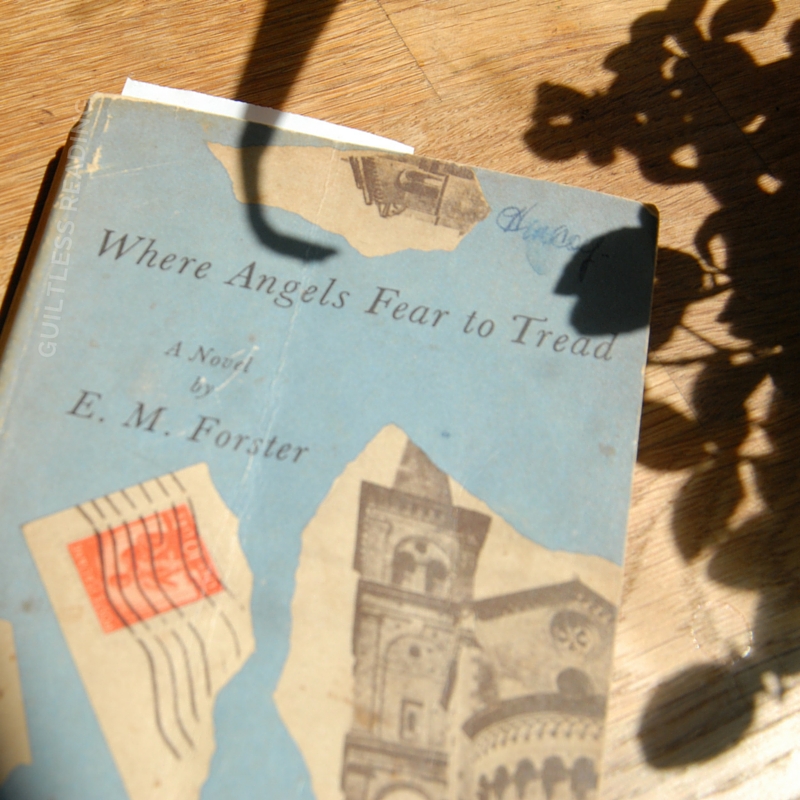
Lie in it! {Where Angels Fear to Tread by E.M. Forster}


You made your bed, now lie in it.

Synopsis of Where Angels Fear to Tread by E.M. Forster:
When attractive, impulsive English widow Lilia takes a holiday in Italy, she causes a scandal by marrying Gino, a dashing and highly unsuitable Italian twelve years her junior. Her prim, snobbish in-laws make no attempts to hide their disapproval, and when Lilia's decision eventually brings disaster, her English relatives embark on an expedition to face the uncouth foreigner. But when they are confronted by the beauty of Italy and the charm and vitality of the disreputable Gino, they are forced to examine their own narrow lives, and their reactions are emotional, violent and unexpected.

My two cents

Well, this one languished. I was uber-excited to read it but never got around to actually putting pen to paper. Now, let's take a moment to admire the cover: I admit I bought it partly because the cover (fabulous, fabulous!) is designed by Leo Lionni, one of my all-time favourite children's books illustrators!

Honestly, this book was quite the surprise. I thought with my track record for being frustrated with classics in general this may be a miss. Yet I slowly warmed up and once mired, this one didn't disappoint.

What I liked

The psychology. The psychology behind classics can't be beat. I find that there are few bells and whistles and simply a presentation of who the characters are, their motivations, and their thought processes. It's material that always seems to stand the test of time.

I keep coming back to the title: where angels fear to tread. This one is about bucking tradition, following one's true desires, and dammit ... living with the consequences because you made your bed, lie in it. Sure, "fools rush in" but sometimes just going for it is the only way to go forward.

While for the most part, the characters are frigid, self-righteous, melodramatic and generally unlikeable, I found that their unlike-ability is what makes them human and accessible. I really need to laugh: these frigid English women (Lilia! Ms. Abbott!) make for great writing! Philip was among my favourite males, an annoying "messiah" who finally came to the realization of love. Gino, make no mistake about it, is what he is, and that's what makes him stand out - there is no shyness about him.

The plot. I thought I could predict what was going to happen, but I was stunned at the final turn of events. There is a tragicomedy to the whole storyline -- plus melodramatics that somehow works -- that make this so appealing to me.

Clashes here, there and everywhere. A large part of this book relies on cultural clashes, and naturally, character clashes. The cultural differences between the repressed and highly structure English versus the emotional, free-spiritedness of the Italians bring forth the best of ...

... subtle wicked humour. Forster's humour grew on me. He has a slyness about him in expressing the horrors of his characters being at cultural loggerheads. The absurdity of some of the pressures and expectations really make me thankful that I'm not of this era.

Verdict

Call me a fool. I may just have the heart of a classics reader after all! I'm rereading this -- I feel like it'll be better the second time around.

Juliet's Nurse by Lois Leveen


Spicier and more engaging retelling of one of the greatest love stories

Synopsis of Juliet's Nurse by Lois Leveen: An enthralling new telling of Shakespeare's "Romeo and Juliet"--told from the perspective of Juliet's nurse.

In Verona, a city ravaged by plague and political rivalries, a mother mourning the death of her day-old infant enters the household of the powerful Cappelletti family to become the wet-nurse to their newborn baby. As she serves her beloved Juliet over the next fourteen years, the nurse learns the Cappellettis' darkest secrets. Those secrets--and the nurse's deep personal grief--erupt across five momentous days of love and loss that destroy a daughter, and a family.

By turns sensual, tragic, and comic, "Juliet's Nurse" gives voice to one of literature's most memorable and distinctive characters, a woman who was both insider and outsider among Verona's wealthy ruling class. Exploring the romance and intrigue of interwoven loyalties, rivalries, jealousies, and losses only hinted at in Shakespeare's play, this is a never-before-heard tale of the deepest love in Verona--the love between a grieving woman and the precious child of her heart.

In the tradition of Sarah Dunant, Philippa Gregory, and Geraldine Brooks, "Juliet's Nurse "is a rich prequel that reimagines the world's most cherished tale of love and loss, suffering and survival.

My two cents

When I had to read Romeo and Juliet in school, I didn't exactly enjoy it. I found it difficult to read (and frankly, thought Romeo and Juliet were a bit stupid). But such is the story of Shakespeare's  lovelorn youths.

This book turns everything upside down in so many ways and I absolutely loved it!

Gone is the stuffiness and over-romanticized version by Shakespeare. This is told from a very unlikely source, Juliet's nurse, Angelica. This retelling is coloured by her class perspective, her loving personality, and her own rather tragic life story.

The love story between Romeo and Juliet seems to be an afterthought. Rather this is a poignant relationship between a loving woman and her ward, with an intriguing twist in this all. The story kept me on tenterhooks as to whether the "secret" would actually come to light. (It's a secret, so I can't spoil this whole book for you!)

This main arc alone would've kept me turning the pages at a fast clip. But there was so much more to enjoy: Juliet and Tybalt's tender childhood friendship, Angelica's own love story (and love making!) as well as rather tragic desire for motherhood, the complicated dynamic between classes, and the machinations of the church in Verona, Italy's everyday life during the Renaissance.

This reminded me so much of my first time reading Philippa Gregory's work where she brings dreary history out of the dregs with the sexual escapades, the intrigue and the conspiracies of the noblemen. It's probably not Shakespeare's intent (especially downplaying Romeo who is quite annoying here) but the story retold from the nurse made this so much more interesting for me!

Verdict: Alternately funny, heartbreaking, and tender, richly layered and wonderfully researched, it puts one of the most beloved love stories in a totally new light. I loved everything about this classical retelling.

If you like Philippa Gregory or are just curious about how Romeo and Juliet can become spicier and even better reading, get a copy.

I received an advanced reader copy from Goodreads First Reads.


Eight Girls Taking Pictures by Whitney Otto


Life lived. And reimagined through a woman's camera lens.

Synopsis of Eight Girls Taking Pictures by Whitney OttoA deeply affecting meditation on the lives of women artists, Whitney Otto's vivid novel explores the ambitions, passions, conflicts and desires of eight female photographers throughout the twentieth century. This spectacular cast of spirited, larger-than-life women offers wide-ranging insight about the times in which they lived. From San Francisco to New York, London, Berlin, Buenos Aires, and Rome, Otto spins a magical, romantic tale that creates a compelling portrait of the history of feminism and of photography.

While their circumstances may differ, the tensions these women experience—from wanting a private life or a public life; passion or security; art or domesticity; children or creative freedom—are universal. Otto seamlessly weaves together eight breathtaking vignettes to form a moving and emotionally satisfying novel.

My two cents 

The book in one sentence: Live life large whether in front or behind the lens.

Amazing! This makes it as another of my favourite reads for the year. With the same appeal as Otto's How to Make an American Quilt, this is altogether bold, romantic, tender and outspoken. I loved everything about it and I could relate on so many levels, as a woman, and as someone who has always been fascinated with photography and art in general.

The novel is broken up into eight sections, each featuring a famous female photographer and her story. The obvious common thread -- photography -- is just one among the many threads that hold the individual stories together. Spanning decades (early 1990s to the present), across several continents, during various historical moments -- these themes are the stuff of our lives. I just breathed it all in! I am betting that women readers will be able to relate to one (or more) of the eight characters in some way.

Women photographers are simply ordinary women who face the issues all women do: the men (or women) who we love, fulfilling the roles expected of women (or breaking out of them), feeling comfortable in one's sexuality, children (or none at all), of wanting to carve out one's one path personally and career-wise. What makes a woman happy? What makes you happy?

What sets these eight women apart is their vision (and tempestuousness) to continue with their craft -- and do so with great courage and passion -- despite (or inspite) of the many hurdles. They all managed to make their mark in photography in rather profound ways.

Opening photo for first photographer,
Cymbeline Kelly (US)
Each vignette opens with a photograph which figures in the story somehow (and which I tended to flip back and forth to try and see the image through that particular photographer's eyes).


The first photographer's story opens with the photo of an unmade bed with some hairpins. Note that all these photos are apparently taken by real women photographers, and then the characters' lives are reimagined by the author based on that photo. How creative and what a wonderful way to draw readers in! Of course I want to find out who Cymbeline is, who this "woman in love" is! Of course I want to know the story behind that unmade bed. Like we always say, a picture is worth a thousand words ... in this case, the words follow.

Each has made their own distinctive mark in the world of photography -- with some extremely fascinating points woven into the narratives. There are references to photography styles and influences, lenses and cameras and details that will satisfy the photography buff. And since this draws from the lives of women photographers, there is a list at the end of the book you can check out.

The stories are interspersed and coming from a small art niche, the paths of some of these women either cross physically or professionally. This makes for the reappearance or reference to the eight main characters throughout the book (and the first time it happened, I was a little surprised!)

***
Photo for photographer Amadora Allesbury (UK)
What I liked: 

  • The combination of story and photography history lesson. 
  • The photos at the beginning of each section.
  • The realistic depiction that women are complicated creatures. Add that to a hard-headed artist wanting to make their mark in the artwork, and you've in for fireworks. 

What I didn't like:

  • The characters seem to be made from the same stuff - they're all very outspoken, very comfortable in their sexuality, and yet ... their relationships are such messes! I attribute that to the fact that they are women artists. And that photography was a male-dominated industry. Or is this just a stereotype? I'm a little on the fence about this because I loved this book!

***

Verdict: A beautifully written set of vignettes about the complexity of women and their photography. Highly recommended for Otto fans and photography buffs.

***
Random quotes:

Among the things she said: "Women seem to possess all the natural gifts essential to a good portraitist ... such as personality, patience and intuition. The sitter ought to be the predominating factor in a  successful portrait. Men portraitist are apt to forget this; they are inclined to lose the sitter in a maze of technique luxuriating in the cleverness and beauty of their own medium." - p. 66 (ARC, page may change)

It was hard not to feel resentment that men weren't forced into these choices. Some days she felt that she would spend all her time trying to forget her life before children because she loved them too much to be reminded of the heat of Rome in the summer and a beautiful girl who turned heads as she walked down an Italian strada. - p 253 (ARC, page may change)

Later, Jenny would say she seldom knew what she would take a picture of when she picked up a camera, that she only knew once she peered through the viewfinder, as if the photograph had finally found her. - p. 309 (ARC, page may change)

Read more at Whitney Otto's Official Website.

I received an ARC on Goodreads First Reads.

A Lovely, Indecent Departure by Steven Lee Gilbert

Book Depository | Amazon - paperbackAmazon - Kindle Edition
Leaving may be lovely ... but not any easier. 

The book in one sentence: A woman flees an abusive husband to protect her child.   

Synopsis: A Lovely, Indecent Departure is the riveting and emotionally-charged debut from a promising new voice in literary thrillers, and a captivating story about a mother’s love and desperation set amidst the heart wrenching landscape of child custody. Anna Miller wants only one thing, her son, and she will do anything to keep him. When a district court awards custody of Oliver to his father, she abducts the five year old and flees to Italy where with her family’s help they disappear into the fabric of her native homeland.

Told in prose that is both stripped-down and overpowering, Gilbert shapes the everyday conflict of child custody into a stunning search for sense of worth. Standing in the young woman’s way is Evan Meade, the boy’s guileful and mean-spirited father, who hires a private investigator when the efforts of the embattled local sheriff, Monroe Rossi, fail to track them down. But as the investigation draws them all closer to Anna, Evan’s true nature betrays itself and the question of what’s in the child’s best interest becomes not so clear anymore.

Objectively detailed, in a voice that refuses to intrude on the minds of its characters, A Lovely, Indecent Departure, captures in stark detail a world in which modern archetypes are turned upside down and shows what an extraordinary splash Steven Lee Gilbert has made with his first novel.

My two cents

The juxtaposition of the words in the title sort of prepared me for the unusual way this seemingly straightforward story was written. Lovely yet indecent. How aptly true for Anna, our main character. And how aptly true for this book overall, which is a lovely departure from the predictable good guy-bad guy story.

The book opens with Anna described thus: "... she is not one of them, and never has been." It is a  foreshadowing of events to come and the discovery of why "she is not one of them."

We are introduced to the family: Anna, the mother; Evan, the father; Oliver, their five-year-old-son. We learn that she and her husband are divorced, Oliver is in his father's custody and Anna having only visitation rights. Right off, I ask myself, why? Typically custody is awarded to the mother. Hmmm ... is there something wrong with Anna?

The story starts off quietly and slowly, with Anna coming to pick up Oliver for her regular visit. We are rewarded with small glimpses into Anna's and Evan's strained relationship, and how loving Anna is to Oliver. Then the rather offputting cruelty of Evan in his small gesture of shredding Oliver's  handmade birthday card to is mother.

That is the last time Evan sees Oliver and then a wild search for the kidnapped and the kidnapper ensues. The tension is built up slowly, and with the introduction of new characters and the unfolding of events, we learn the "facts" of the story and the back stories of the characters ... sort of like peeling back the skins of an onion, or putting together the pieces of the puzzle. Yes, there is a bigger picture ... but Gilbert masterfully only lets us in when he feels we must.

I really liked these elements of the book:
  • The title which is unusual and jarring in its juxtaposition. 
  • The cover which captures both the richness of Italy, where Anna flees; as well as the relationship between mother and child in classic and elegant sculpture no less.     
  • How the characters are multi-dimensioned so that I kept flip-flopping trying to make out who the good guy - bad guy was. Conclusion: there is no good guy or bad guy; it is not as simple as that. Anna: bad because she kidnapped her son? Evan: bad because he has a horrible temper? Anna: good ... because she kidnapped her son? People have their motivations, their personalities, their strengths, their flaws. In fact, Gilbert described Anna as an "anti-hero" which seems to better capture the complexity of people. 
  • An appreciation for just how complicated child custody cases are! This story humanizes one case but it does raise many questions in my mind about Anna and Evan, and of how custody cases are decided. Up until the end of the book, I kept wondering why custody was awarded to Evan in the first place. 
  • The quietness and elegance of the language. I felt like that this story grew on me, like someone whispering a story to me in the dead of the night. It is so quietly told that there were times when the shouting would start. Completing the book, I realize that the tension was so well built up that no shouting was required. 
Uh-Ohs
  • The first thing that bothered me was that there were no quotation marks as soon a dialogue kicked in. I first thought it was a typo ... until I realized maybe a few chapters in that it was intentional! (How could an author do this to their readers? Flout all conventions for the heck of it?!) However, as I kept reading I got used to it and feel that this device (or lack thereof) dispensed of how "cluttered" the page would look and provided for a seamlessness of action and dialogue. 
  • A warning that there are Italian phrases peppered throughout, initially confusing but got me looking thing up. For the most part I could figure things out based on context. 
  • There are some side stories (particularly that of the personal life of detective Monroe) that I felt could have been tightened up a bit as they distracted from the main storyline. 
Verdict: A quietly and elegantly told story, highly recommended for those looking for an insightful probe into the emotional and legal complexities of child custody.  

***
First line: Look, here comes the girl. She is treading alone up the sidewalk. Looking like everyone else of the noontime crowd blissfully strolling the strip mall. But she is not one of them, and never has been.

Last Line: Then he turned back and stood with his feet wide apart to steady himself against the tide's current and he reached his arms out to the boy.


Check out these other reviews:

I received a copy of this book in exchange for an honest review. I have also hosted Steven Lee Gilbert's guest post "A Lovely Anti-Hero" and a giveaway of this book. Check out my Friday 56/Book Beginnings post.

Eat Pray Love by Elizabeth Gilbert


Serious summary of Eat Pray Love by Elizabeth GilbertAt the age of thirty-one, Gilbert moved with her husband to the suburbs of New York and began trying to get pregnant, only to realize that she wanted neither a child nor a husband. Three years later, after a protracted divorce, she embarked on a yearlong trip of recovery, with three main stops: Rome, for pleasure (mostly gustatory, with a special emphasis on gelato); an ashram outside of Mumbai, for spiritual searching; and Bali, for “balancing.” These destinations are all on the beaten track, but Gilbert’s exuberance and her self-deprecating humor enliven the proceedings: recalling the first time she attempted to speak directly to God, she says, “It was all I could do to stop myself from saying, ‘I’ve always been a big fan of your work.’” 


My two cents

I decided to read this because: I’ve heard the hype and I’m not one to be turned off by it; in fact I could be missing out!

First line: I wish Giovanni would kiss me.

The book in one sentence: All expense paid travel – to unabashed pig-outs in Italy, prayer in India, and balance in Bali, Indonesia – does wonders for a young divorcee’s search for spirituality.

Who would you recommend it to: This verges on chick lit so I wouldn’t recommend this for a man. At all.

I liked:

Gilbert’s writing style – she’s very easy to read, she’s funny. But maybe this is this book’s only saving grace. Oh, and I loved the cover of pasta, beads and flower petals forming the words “eat pray love!”

I didn’t like:

The feeling that Gilbert wasn’t telling all, that she was taking her readers on a ride by giving a sanitized version … or maybe because her insights were shallow and not as earthshaking as they really were? Overall I had a feeling that the whole spiritual journey was contrived and put together for the sole purpose of selling the book. Do you go on a journey self-discovery by planning to go to three countries, with the eat-pray-love concept so wonderfully, magically fitting together? Methinks not.

Ok, she’s also quite funny. Hyper in fact. But it can get tiresome quick. Trying to be witty chapter after chapter will definitely get old sooner or later. I had a sense that she was trying too hard to encapsulate her learnings which sounded sorely of bumper sticker slogans.

I wanted to shake my head at some of the crazy things in this book. She realizes that she doesn’t need to travel to learn what she does (but since her publishers’ footing the bill, heck why not?), she very nearly gets scammed by the medicine woman she “loves” (and yet she somehow comes to terms with it). I also hate the fact that she, like many Westerners tend to romanticize all things Eastern or anything remotely foreign – the whole section in India seemed to trivialize religion and spirituality (read the random quote below – someone please explain to me what she meant).

Random quote:
So now I have found out. And I don’t want to say that what I’ve experienced that Thursday afternoon in India was indescribable, even though it was. Simply put, I got pulled through the wormhole of the absolute, and in that rush I understood the workings of the universe completely. I left my body, I left the room, I left the planet, I stepped through time and I entered the void. I was inside the void, but I also was the void and I was looking at the void, all at the same time. The void was a place of limitless peace and wisdom. The void was conscious and it was intelligent. The void was God, which means that I was inside God. But not in the gross, physical way – not like I was Liz Gilbert stuck inside a chunk of God’s thigh muscle. I was just part of God. In addition to being God.
I wish I had never caught that interview on evening where Oprah was interviewing Elizabeth Gilbert. Apparently Oprah was so enamored by the book that she devoted two entire shows to it! I was actually enjoying reading the Italian leg when I had to watch that fated show. Do you know those times when Oprah ingeniously is able to get the whole room clapping as to how great she is for overcoming the odds? (I just can’t help rolling my eyes at how self-absorbed she can sometimes). Well, Gilbert is of the same mold – she was spouting her witticisms, nodding her head to Oprah’s “I love this part” then reading whole sections. What Gilbert said on the show was exactly the same as what’s written in the book, more or less verbatim. I guess I was looking for the “inside story” but she never said anything not already in the book.

Don’t get me wrong. I enjoyed her descriptions of traveling and how honest she is that she is not living the life she wants. But really, I had to shake my head and sigh at how a spiritual journey can leave such a sour taste in the mouth. Needless to say, I was not inspired.


Verdict: Hey, to each her own. I have a love-hate relationship with this book. It has its moments. Worth giving a try. But I think this is the last Gilbert book I’ll read! 

Other reviews:
·
OLDER


© guiltless readingMaira Gall