2008
Showing posts with label 2008. Show all posts

A Holiday for Murder by Agatha Christie


About A Holiday for Murder by Agatha Christie: Motives for Murder: A fortune in uncut diamonds, hidden by an eccentric old man
A woman's love, too freely given
A business empire built on ruthlessness

Each of them may have been a motive for the brutal slaying of wealthy old Simeon Lee. Coupled with Lee's family, each member of which hated him and wished to see him dead, they presented Hercule Poirot with a baffling challenge--one which the astute detective solved only through his uncanny ability to see "the little things."

My two cents

A re-read of my uber-ratty copy! Love Agatha Christie!

The Christmas season is not the time for good cheer, in fact it is a murderous season. Simeon Lee's puzzling murder (a closed door, a wail from hell, lots of blood, and seemingly no means of escape for the murderer) puts each his family members under suspicion. Money? Power? Revenge? Who killed him ... and how? Poirot comes in and gives us another surprising solution to the mystery. The clue: the character of the man murdered.

Hallowe'en Party by Agatha Christie


Summary of Hallowe'en Party by Agatha Christie: At a Hallowe'en party, Joyce -- a hostile thirteen-year-old -- boasts that she once witnessed a murder. When no-one believes her, she storms off home. But within hours her body is found, still in the house, drowned in an apple-bobbing tub. That night, Hercule Poirot is called in to find the 'evil presence'. But first he must establish whether he is looking for a murderer or a double-murderer...

My two cents

The setting: a children's halloween party complete with bobbing for apples, looking in the mirror to see your true love, a "real" witch ... and the presence of a well-known writer of mystery stories. A child boasts that she witnessed a murder, and hours later she is drowned. See how a murder committed years ago comes back to haunt a community.

With Christie's characteristic references to Greek mythology of a bevy of characters, a beautiful garden .... and a complicated plot of money and saving beauty for beauty's sake. And Poirot saves the life of yet another just in time!

Eat Pray Love by Elizabeth Gilbert


Serious summary of Eat Pray Love by Elizabeth GilbertAt the age of thirty-one, Gilbert moved with her husband to the suburbs of New York and began trying to get pregnant, only to realize that she wanted neither a child nor a husband. Three years later, after a protracted divorce, she embarked on a yearlong trip of recovery, with three main stops: Rome, for pleasure (mostly gustatory, with a special emphasis on gelato); an ashram outside of Mumbai, for spiritual searching; and Bali, for “balancing.” These destinations are all on the beaten track, but Gilbert’s exuberance and her self-deprecating humor enliven the proceedings: recalling the first time she attempted to speak directly to God, she says, “It was all I could do to stop myself from saying, ‘I’ve always been a big fan of your work.’” 


My two cents

I decided to read this because: I’ve heard the hype and I’m not one to be turned off by it; in fact I could be missing out!

First line: I wish Giovanni would kiss me.

The book in one sentence: All expense paid travel – to unabashed pig-outs in Italy, prayer in India, and balance in Bali, Indonesia – does wonders for a young divorcee’s search for spirituality.

Who would you recommend it to: This verges on chick lit so I wouldn’t recommend this for a man. At all.

I liked:

Gilbert’s writing style – she’s very easy to read, she’s funny. But maybe this is this book’s only saving grace. Oh, and I loved the cover of pasta, beads and flower petals forming the words “eat pray love!”

I didn’t like:

The feeling that Gilbert wasn’t telling all, that she was taking her readers on a ride by giving a sanitized version … or maybe because her insights were shallow and not as earthshaking as they really were? Overall I had a feeling that the whole spiritual journey was contrived and put together for the sole purpose of selling the book. Do you go on a journey self-discovery by planning to go to three countries, with the eat-pray-love concept so wonderfully, magically fitting together? Methinks not.

Ok, she’s also quite funny. Hyper in fact. But it can get tiresome quick. Trying to be witty chapter after chapter will definitely get old sooner or later. I had a sense that she was trying too hard to encapsulate her learnings which sounded sorely of bumper sticker slogans.

I wanted to shake my head at some of the crazy things in this book. She realizes that she doesn’t need to travel to learn what she does (but since her publishers’ footing the bill, heck why not?), she very nearly gets scammed by the medicine woman she “loves” (and yet she somehow comes to terms with it). I also hate the fact that she, like many Westerners tend to romanticize all things Eastern or anything remotely foreign – the whole section in India seemed to trivialize religion and spirituality (read the random quote below – someone please explain to me what she meant).

Random quote:
So now I have found out. And I don’t want to say that what I’ve experienced that Thursday afternoon in India was indescribable, even though it was. Simply put, I got pulled through the wormhole of the absolute, and in that rush I understood the workings of the universe completely. I left my body, I left the room, I left the planet, I stepped through time and I entered the void. I was inside the void, but I also was the void and I was looking at the void, all at the same time. The void was a place of limitless peace and wisdom. The void was conscious and it was intelligent. The void was God, which means that I was inside God. But not in the gross, physical way – not like I was Liz Gilbert stuck inside a chunk of God’s thigh muscle. I was just part of God. In addition to being God.
I wish I had never caught that interview on evening where Oprah was interviewing Elizabeth Gilbert. Apparently Oprah was so enamored by the book that she devoted two entire shows to it! I was actually enjoying reading the Italian leg when I had to watch that fated show. Do you know those times when Oprah ingeniously is able to get the whole room clapping as to how great she is for overcoming the odds? (I just can’t help rolling my eyes at how self-absorbed she can sometimes). Well, Gilbert is of the same mold – she was spouting her witticisms, nodding her head to Oprah’s “I love this part” then reading whole sections. What Gilbert said on the show was exactly the same as what’s written in the book, more or less verbatim. I guess I was looking for the “inside story” but she never said anything not already in the book.

Don’t get me wrong. I enjoyed her descriptions of traveling and how honest she is that she is not living the life she wants. But really, I had to shake my head and sigh at how a spiritual journey can leave such a sour taste in the mouth. Needless to say, I was not inspired.


Verdict: Hey, to each her own. I have a love-hate relationship with this book. It has its moments. Worth giving a try. But I think this is the last Gilbert book I’ll read! 

Other reviews:

Goodnight Nobody by Jennifer Weiner


About Goodnight Nobody by Jennifer Weiner (from Goodreads): Kate Klein is a feisty, charmingly insecure Connecticut housewife who trades in a life of late-night karaoke sing-a-longs and West Village brunches with her best friend Janie for a world of mini-vans and Mommy and Me pilates classes. Life in Upchurch, Connecticut, heats up when Kate discovers picture-perfect wife and mother Kitty Cavanaugh dead on the pickled maple hardwood floor of her recently remodeled kitchen. A former chronicler of celebrity gossip, Kate takes it upon herself to solve the mystery of Kitty's murder and the disappearance of Lexi Hagen-Holdt, another Upchurch supermom. Along the way, the mysteries and disappointments in Kate's personal life begin to unravel, including her marriage to the kind-yet-uptight Ben, and her unresolved crush on Evan McKenna, a former neighbor with whom a one-night tryst ended in disaster. Thrown in for comic relief, and perhaps to show the depth of Weiner's talents as a writer, are Kate's twin boys and adorably sophisticated 5-year old daughter Sophie ("Sophie was sitting on the toilet, applying lipstick and waiting her turn..."). 

Goodnight Nobody is chock full of plot twists and turns which can be overwhelming and superfluous. However, Weiner's charm and grace are usually enough to rescue readers from these moments of confusion, and reaffirm our commitment to this endearing contemporary voice. 

Supershort thoughts

Weiner is obviously a talented writer. But the storyline is like Stepford Wives meets heavy dose of reality. I didn't quite get it.

Don't bother.

Family Trust by Amanda Brown


Synopis of Family Trust by Amanda BrownFirmly planted on the Wall Street fast track to success, Becca Reinhart has no desire to marry and raise a family. Ditto Edward Kirkland, a charming playboy who has never known what it means to work for a living, and hopes never to find out. Enter Emily, who becomes Becca and Edward's common denominator when a quirk of fate gives them joint custody of the precocious little girl. Suddenly, two people who have never met find themselves sharing the trials and tribulations of domestic life as they navigate the rocky shoals of parenthood, from naptime to play dates to pre-school admissions. And amid the daily demands of raising a young child, Becca and Edward discover something else: They're made for each other.

My two cents

Funny quick-paced chick lit ... I actually think I should read Legally Blonde for the heck of it! Though I do find the idea unbelievable - that of a single career-driven woman so easily making the shift to full-time-mother so easily, and without losing her temper either! And the child seems too good to be true. Ahh well, escapism at its best! :)

Down to a Sunless Sea by Mathias B. Freese


Serious summary of Down to a Sunless Sea by Mathias B. Freese: Down to a Sunless Sea plunges the reader into uncomfortable situations and into the minds of troubled characters. Each selection is a different reading experience-poetic, journalistic, nostalgic, wryly humorous, and even macabre. An award-winning essayist and historical novelist, Mathias B. Freese brings the weight of his twenty-five years as a clinical social worker and psychotherapist into play as he demonstrates a vivid understanding of-and compassion toward-the deviant and damaged.

My two cents

OK bits

Quite unlike anything I have ever read. I felt like I was intruding into someone’s private thoughts, story after story, wading through thoughts that one would not normally reveal. Each story felt like it was told all from a first person point of view, stories that are begging to be told; and told sensitively and without shame nor condescension.

It gives a voice to the voiceless – the handicapped, the abused, the traumatized, and the tormented.

Some stories that really hit me were:

I’ll Make it, I Think
The story of a handicapped man who struggles to deal with what life hands him. His afflicted body parts – named Lon, his huge deformed foot; and Ralph, his webbed hand – play into story personified and are in on the game.
I often feel like a Slinky flopping down a stoop when I speak – life as a Slinky. The more edgy I get the worse it is. Ralph and Lon have nothing to do with Schmuck, that’s me. So that makes the three of us, at compass odds.

Alabaster
Sometimes only the young can truly show compassion. And it only through a life lived that the young truly understand how it is to live. I love this piece.
“Can I go now?” I was rude, but it was a feeling and I said it. I was safe with her, free.
“Of course, child. I can’t hold you to me. You are the freest thing I know.”
I left. I was uneasy with all I heard. I had never before had such a talk with an adult, as an equal.

Small Errands
Do you obsess about things? I do. Like whether I shut the fridge door properly and I go downstairs, after having gone through my nightly rituals, in the middle of night just to check, then doublecheck. This short story looks into the mind of an individual with OCD and the agony of dealing with these compulsions.


Herbie
The horrible cycle of abuse and need for acceptance between a father and his son, highlighted through the son’s simple desire to shine shoes properly.
 

Young Man
Oh the futility of life, a modern-day take of Ecclesiastes in the Bible. 
I can’t be who I am in real life , so I can be who I am in thought, but who I am in thought is not who I am in deed, so I live between what is and what should be, and this serves to make sharper the cleavage – the crevices are clearly marked.

Boring bits 

Nothing. That is the beauty of short story collections, and I am sure that in the book at least one story is bound to speak to you.

Verdict: I must admit that I had a hard time initially getting into this book, which was so graciously sent to me for review by the author himself. I read it story by story over a 3-month period. I feel it is not a book to speed read, but to savor slowly, ruminate upon, and re-read. I highly recommend it. Please get a copy and read it!

***
First line (of the first short story): While a young child growing up in Brighton Beach, Adam would go shopping with his mother on Brighton Beach Avenue.

The book in one sentence: Fifteen short stories that make you feel like you are prying into someone’s life, finding out their secret thoughts and feelings.

Who would you recommend it to: For those who like to understand people and themselves, and probably journal in detail about their own lives. Those who love to find a glimmer of meaning or understanding in what many may dismiss as trivial.


P.S. My sincere thanks to Mathias Freese for sending me his book, and yes, this review was long in the coming.

The Tao of Pooh by Benjamin Hoff


Summary of The Tao of Pooh by Benjamin Hoff: The Tao of Pooh by Benjamin Hoff is a perfect introduction to the ideas of Taoism as illustrated by an unaware Taoist, Winnie the Pooh. Using Winnie the pooh books, Benjamin Hoff shows the practical application of the taoist philosophy. reveling answers to difficult concepts like, 'doing without doing' and the 'uncarved block'.

My take

"Lots of people talk to animals," said Pooh.
"Not that many listen though."
"That's the problem."

Interesting insights. I have always loved Pooh bear so a philosophical slant of Pooh lends to interesting reading! I knew that Pooh was more than a children's character, he always had a certain wisdom about him which makes him endearing to both kids and adults.

Read more: The Tao of Pooh website


Breakfast at Tiffany’s by Truman Capote


About Breakfast at Tiffany's by Truman Capote: In this seductive, wistful masterpiece, Truman Capote created a woman whose name has entered the American idiom and whose style is a part of the literary landscape. Holly Golightly knows that nothing bad can ever happen to you at Tiffany's; her poignancy, wit, and naïveté continue to charm.

My two cents

I got a hold of Breakfast at Tiffany's and sped-read it, was utterly charmed by Miss Holiday Golightly, Traveling and kept imagining Audrey Hepburn and hearing Moon River. The icon created by Truman Capote has burned itself in my mind, quite unconsciously, and funnily I couldn't help but be pissed that the movie was not the book. (Honestly, I read the book AFTER the movie.)


Holly Golightly is a charmingly heartbreaking character - a street-smart, cynical, tougher-than-nails callgirl (though Capote never called her that ever in the book) who has a tender, childlike side. Deep inside she is only looking for her place in the world. "... home is where you feel at home. I'm still looking," she says. This theme resonates throughout the book, with the mini-story of her "adopted" cat as a metaphor possibly for herself?

Then I read through the three other short stories - "House of Flowers," "A Diamond Guitar" and "A Christmas Memory" - in the same book, and was blown away by Capote's writing. These stories are a far cry from Breakfast at Tiffany's. I especially enjoyed "A Christmas Memory" which tells a heartwarming story about a young boy's friendship with an old lady and how they lived and loved in the countryside.

I felt I understood Capote a little better after having watched Capote, an incredible film which is disturbing account of how he came to write In Cold Blood (a book I am on the lookout for now). Capote passes the book off as non-fiction, but it is based on real events of a brutal Kansas murder. The film explores how a writer can get deeply involved in creating a story ... to the point that it not only absorbs but can swallow you alive.

Capote is one of the most powerful writers I have read so far. And I will surely be reading more of work.
  • Read more about Breakfast at Tiffany's, the novel here. Great insights and analysis by Mathew Cash.
  • Truman Capote on Wikipedia.

And Then There Were None (Ten Little Indians) by Agatha Christie


Serious summary of And Then There Were None (Ten Little Indians) by Agatha Christie: First, there were ten – a curious assortment of strangers summoned as weekend guests to a private island off the coast of Devon. Their host, an eccentric millionaire unknown to all of them, is nowhere to be found. All that the guests have in common is a wicked past they’re unwilling to reveal – and a secret that will seal their fate. For each has been marked for murder. One by one they fall prey. Before the weekend is out, there will be none. And only the dead are above suspicion.

My two cents

I decided to read this because: I’ve been a Christie fan since high school and this has been sitting on my shelf for ages and I’ve never read it! I did join the Agatha Challenge too, so I could catch up on my Christie reading!

I liked: The plot itself: put 10 strangers on an island with no means of escaping and they all start dying off. The common denominator for them all is that they have been accused of murder. Now, obviously the murderer (of these alleged murderers) is among the 10. But why? And who? I kept wavering back and forth throughout the book speculating on who it could possibly be, and was of course totally proven wrong each time the character was killed off.

As always, insight into human nature is part and parcel of this piece. Motivations for murder (and other things) are key to solving any mystery!

I didn’t like: I'm a nitpicker when I say this. Death after death can get a little boring. After all from the onset you know that everyone is going to die. I kept going back to the nursery rhyme which was established early on as how each person would die. Ok, 5 dead, 5 more to go … Ho-hum.

I also felt that the letter at the end which reveals whodunit would of course have to get to the police (typical of Christie to wrap things up nicely, but hey she has a very strong sense of justice). After all the murderer was among those dead too! For once it would be nice to have a totally unsolved mystery!

Verdict: One of the better(er) Christies. And no Miss Marple or Hercule Poirot in sight!

Factoids: Having sold 115 million copies to date, making it the world’s best-selling mystery! The original title was Ten Little Niggers in the 1930s (can you imagine if it were still named this?). This has been on stage, film, radio, TV, a PC game, and soon, a graphic novel [Via].

***
First line: In the corner of a first-class smoking carriage, Mr. Justice Wargrave, lately retired from the bench, puffed at a cigar and ran an interested eye through the political news in the Times.

The book in one sentence: A wonderful whodunit of 10 people being killed off one by one on a remote island with no means of escape.

Who would you recommend it to: If you are an Agatha Christie fan, don’t DON’T miss this one! Anyone who likes a good mystery.

Random quote:
Ten little Indian boys went out to dine; One choked his little self, and then there were nine.
Nine Little Indian boys sat up very late; One overslept himself and then there were eight.
Eight little Indian boys traveling in Devon; One said he’d stay there and then there were seven.
Seven little Indian boys chopping up sticks; One chopped himself in halves then there were six.
Six Indian boys playing with a hive; A bumble-bee stung one then there were five.
Five Indian boys going in for law; One got in Chancery then there were four.
Four Indian boys going out to sea; A red herring swallowed one then there were three.
Three Indian boys walking in the zoo; A big bear hugged one then there were two.
Two Indian boys sitting in the sun; One got all frizzled up then there was one.
One Indian boy left all alone; He went and hanged himself and then there were none.

Three Blind Mice by Agatha Christie


About Three Blind Mice And Other Stories by Agatha Christie: A blinding snowstorm--and a homicidal maniac--traps a small party of friends in an isolated estate. Out of this deceptively simple set-up, Agatha Christie fashioned one of her most ingenious puzzlers, which, in turn, would provide the basis for The Mousetrap, the longest-running play in history. From this classic title novella to the deliciously clever gems on its tail (solved to perfection by Hercule Poirot and Miss Jane Marple), this rare collection of murder most foul showcases the inimitable Christie at her inventive best, proving her reputation as "the champion deceiver of our time."

My two cents

I didn't realize that this was a re-read (way way back in high school when I swiped one of my grandmother's Agatha Christies off her shelf). This is collection of short stories featuring Miss Marple, Hercule Poirot and Harley Quinn (only one story though but I never much liked him). Again relived some of my favorites: The Third Floor Flat, The Adventure of Johnnie Waverly and Four and Twenty Blackbirds.

Must read!

The Twenty-One Balloons by William Pène du Bois


About The Twenty-One Balloons by William Pène du Bois: Professor William Waterman Sherman just wants to be alone. So he decides to take a year off and spend it crossing the Pacific Ocean in a hot-air balloon the likes of which no one has seen. But when he is found after just three weeks floating in the Atlantic among the wreckage of twenty hot-air balloons, the world is naturally eager to know what happened. How did he end up with so many balloons ... and in the wrong ocean?

My take

I got this for a steal at a recent book sale, still wrapped up in plastic. I was having second thoughts but realizing that it is a Newbery winner, I decided that it was a good buy not just for me but for D too (eventually).

***
I didn't regret this read. And at the risk of spoiling things for you, I come back with more questions ... questions one step ahead of those above:

If you were shipwrecked (ok, balloon-wrecked) on a supposedly uninhabited island, only to discover that on that island, you are probably among the richest people in the world with close to a billion dollars to spend a day. Everyday could be a vacation and there is no limit to what you occupy your time with. Would you want to stay or go? What if you were forced to stay as a perennial guest? What if you had to stay even in the light of dire circumstances?

This is what the Professor went through in his three-week disappearance.

It's a very tall tale. But its told with such an incredible amount of detail as well as plausible descriptions of inventions and the science behind them that you want to believe everything written down. Take note that this book won the Newbery in 1948, an era where great inventions were being made.

What makes the story even moreso charming is that Mr. Du Bois also happened to draw all the illustrations. One of my favorite inventions is the balloon merry-go-round.

Definitely a classic.

The Inheritance of Loss by Kiran Desai


Serious summary of The Inheritance of Loss by Kiran Desai: This stunning second novel from Desai (Hullabaloo in the Guava Orchard) is set in mid-1980s India, on the cusp of the Nepalese movement for an independent state. Jemubhai Popatlal, a retired Cambridge-educated judge, lives in Kalimpong, at the foot of the Himalayas, with his orphaned granddaughter, Sai, and his cook. The makeshift family's neighbors include a coterie of Anglophiles who might be savvy readers of V.S. Naipaul but who are, perhaps, less aware of how fragile their own social standing is—at least until a surge of unrest disturbs the region. Jemubhai, with his hunting rifles and English biscuits, becomes an obvious target. Besides threatening their very lives, the revolution also stymies the fledgling romance between 16-year-old Sai and her Nepalese tutor, Gyan. The cook's son, Biju, meanwhile, lives miserably as an illegal alien in New York. 
All of these characters struggle with their cultural identity and the forces of modernization while trying to maintain their emotional connection to one another. In this alternately comical and contemplative novel, Desai deftly shuttles between first and third worlds, illuminating the pain of exile, the ambiguities of post-colonialism and the blinding desire for a "better life," when one person's wealth means another's poverty. {Via}


My two cents

OK bits: I love Desai's writing. She has a comfortable way of describing the most mundane while capturing her character's moods. For example, when Biju finally gets his American visa:
"Raw sewage was being used to water a patch of grass that was lush and stinking, grinning brilliantly in the dusk."
It's been a while since I've read a novel which hits home, as the Indian experience is so very much like the Philippine one (a long history of colonial rule, every family is bound to have one immigrant, persistence of colonial mentality). While there is always a drive to seek a better life, immigrant life is not easy. Desai captures so many issues in her book - the phenomenon of globalization, economic inequality, of power (and lack thereof), multiculturalism, colonialism, prejudice and racism, and the whole struggle for self-identity and the issue of nationalism when being part of both Western and Eastern cultures.

However, while these bigger themes are running thoughout the storyline, she still manages to retain her readers' emotional empathy to each character. For example, I liked the love story of Sai and Gyan as well as the struggles of Biju. People have coped in different ways to the changing world and how Desai explores this is fascinating. Desai gives immigrants a voice.

As a sidebar, the description of the sacrifices made and the visa issue system is highly accurate based on what I have heard from other immigrants.

Boring bits: I didn't find anything boring in this one. The multiple stories kept me going as I had to find out what happened to each character.

Just don't read this if you're feeling down, as reading misfortune after misfortune can get a bit depressing. It may come across as bitter, bleak, cynical - I say it's honest.

Verdict: Powerful. A very worthwhile read.


***

First line: All day, the colors had been those of dusk, mist moving like a water creature across the great flanks of mountains possessed of ocean shadows.

The book in one sentence: The stories of heartache of Indian immigrants (to New York and England) and of the families and communities they have left behind.

Who would you recommend it to: Readers who are not reading for escape, but are ready to face the very sad reality of injustice in this world.

Factoids: Desai, at 35, is the youngest female winner of the Man Booker Prize which she won in 2006. It took her eight years to write The Inheritance of Loss. She is the daughter of novelist Anita Desai who was nominated for the Booker Prize three times but never won.

Desai has retained her citizenship of India and is a Permanent Resident of the United States.

Random quotes:

Love must surely reside in the gap between desire and fulfillment, in the lack, not the contentment. Love is the ache, the anticipation the retreat, everything around it but the emotion itself.

... he forgot how to laugh, could barely manage to lift his lips in a smile, and if he ever did, he held his hand over his mouth, because he couldn't bear anyone to see his gums, his teeth.They seemed too private. In fact, he could barely let any of himself peep out of his clothes for fear of giving offence. He began to wash obsessively, concerned he would be accused of smelling. To the end of his life, he would prefer shadow to light, faded days to sunny, for he was suspicious that sunlight might reveal him, in his hideousness, all too clearly.

Interesting links:

The Shadow of the Sun by A.S. Byatt

Serious summary of The Shadow of the Sun by A.S. Byatt: Written when A.S. Byatt was an undergraduate, THE SHADOW OF THE SUN is the story of 17-year-old Anna Severel, daughter of a lionized novelist. As Anna struggles to get a grip on her own life, she knows that, in order to survive, she must somehow throw off the influence of her father. A classic coming-of-age story, Byatt's first novel introduces one of the themes that will inform her later work: the artist's relentless search for identity. 


My two cents

OK bits:  I actually bought the book for its cover (don't laugh) because Van Gogh has always been a favorite. Kidding aside, the prose is lovely! I like the whole metaphor upon which the book is based:  think about it, a sun can never have a shadow.

Boring bits: Be prepared for really long-winded descriptions. In fact Byatt herself says that her first piece is "overwritten" but she has a lovely way of saying things.  

Maybe the whole story is a bit of a cliche too. If I had read it when I was in my early twenties I could have related a bit more or maybe oohed-ahhed some. But this has the cliche crush on the good-looking guy, cliche affair with a middle-aged man who "saves" her throughout the novel, and the cliche pregnancy. 

Verdict: Quite good! Find out why Byatt is such a celebrated writer, her first book reveals quite a bit already!


***
First line: The house was waiting; low and still and grey, with clean curtains in the long windows, and a fresh line of white across the edge of the steps. 

The book in one sentence: A rebellious daughter finally comes into her own after struggling to escape her famous father-writer's shadow.

Who would you recommend it to: Any fan of A.S. Byatt, as this is her debut novel! And if you like coming-of-age stories, this is a good one!


Random quote:
Love exposes one so, she thought, one is so dependent on it, and maybe one will never be intimate enough not to care if anything goes a bit wrong. I can see one would be, she thought vaguely. (p. 45)

In the Time of the Butterflies by Julia Alvarez


In the Time of the Butterflies by Julia Alvarez

Quick take:

Beautiful and sensitive storytelling of a revolution and four sisters in the Dominican Republic. Wonderful historical fiction.

The Tenko Club by Elizabeth Noble

Not-so-fluffy check lit

Synopsis of The Tenko Club by Elizabeth Noble: Club Rules Men, children, work, shopping, wine and chocolate. Important, but not AS important. When they need you, you are there. No giving up. Members Freddie, Tamsin, Reagan and Sarah They meet at university in the heady days of the 80s: four women with little in common but an eagerness to live life to the full. And over romantic crises, long gossipy nights and too many bottles of wine, they form the Tenko club and swear they'll always be there for each other. Life Membership. Twenty years later, that promise is put to the test.

My two cents: I was expecting another non-thinking book (which is why I actually LIKE chick lit) but was surprised that this Yaya sisterhood-like book would go so deeply into problems of marriage and children.

More reality than expected, but not at all bad.

Got a little lost with the names, and the story seemed to revolve on one of the four girls (in fact, what happened in her life was quite definitive for the others) - but hey, ok, ok, whatever.

Read this if you want a more sobering Sisterhood of the Traveling Pants.

The Melancholy Death of Oyster Boy by Tim Burton

The Melancholy Death of Oyster Boy by Tim Burton

The book in one sentence: A hodgepodge of 23 short poems about the poor lives of misshappen oddities, aptly named what they are - Oyster Boy, Staring Girl, Stain Boy, among others.

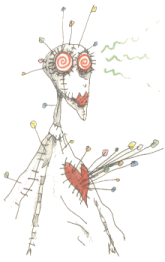
Voodoo Girl
Staring Girl
Who would you recommend it to: Those who love Tim Burton and his macabre humor. This definitely isn't a book for kids!  

OK bits: Its brevity, its dark humor, its lovely illustrations - all done in trademark Burton style. This book is so much more than what it seems, a commentary on violence, being different, and the alienation of being different.  

Boring bits:  The poetry feels a little stilted at time. Nothing rhymes (not that I really expect it to). I got a tad "sick" after a few stories and put the book down and read some more when I had "recovered." I tend to be really affected by books, and yet in its simplicity, this really hit me.   

Verdict: I've been a vascillating Burton fan. For example, Edward Scissorhands I loved/hated. I find it deeply disturbing to find humor in other people's misfortunes; and while there is a humorous side, I laugh with a hollow feeling within. Enjoy yet understand.  

Random quote:
For Halloween,
Oyster Boy decided to go as a human.
If you'd like to read this book in full, click here.

To view a very well-made video:


{Originally here.}

Back When We Were Grownups by Anne Tyler


Back When We Were Grownups by Anne Tyler

First line: One upon a time there was a woman who discovered she had turned into the wrong person.

The book in one sentence: Rebecca Davitch, widowed young is left to take care of a big family, feels like she "fell" into her life and her "What if's" turn out with a surprisingly simple answer.

Who would you recommend it to: Anyone who enjoys a thinking novel, or loves highly nuanced characters. Those who like chicklit (with a heavy dose of reality).

OK bits: I enjoyed the entire premise of the book, with Rebecca trying to figure out: "How on earth did I get like this? How? How did I become this person who's not really me?"

The characters are highly credible (the step-daughters are generally unlikable people) as are the dynamics within this large extended family. I did like the character of forgetful 100 year-old Poppy. I followed with bated breath the rekindling of romance (or what could-have-been) with Rebecca's first love Will Allenby.

That Rebecca is a "professional" party hostess was a nice twist. I actually looked forward to her little rhyming toasts which are scattered throughout.

Who would have thought that such trivial things could be so interesting and profound? I could relate to Rebecca's realizations as the book progressed. The small nuggets of wisdom may seem a little trite, but they sure hit home.

Boring bits: I initially balked at the cutesy names - Bek, Biddy, Nono, Min Foo, Poppy - are these people, or pets? Once I got over that, I was in love with this book. 

Verdict: Don't we all think that the life-that-could-have-been is better than what we have? Need a reality check? Read this book and be amazed at Tyler's wonderful portrait of real life.

I like these phrases: Beck's unrelenting jollity (p. 270) , palindromic birthday (p. 272)

Random quote:
There is no true life. Your true life is the one you end up with, whatever it may be. You just do the best you can with what you've got.
Linkshttp://thebookhaven.homestead.com/Z_Back_When_We_Were_Grownups.html

{Originally here.}

All the Names by Jose Saramago


Synopsis of All the Names by Jose Saramago: Senhor José is a low-grade clerk in the city's Central Registry, where the living and the dead share the same shelf space. A middle-aged bachelor, he has no interest in anything beyond the certificates of birth, marriage, divorce, and death that are his daily routine. But one day, when he comes across the records of an anonymous young woman, something happens to him. Obsessed, Senhor José sets off to follow the thread that may lead him to the woman-but as he gets closer, he discovers more about her, and about himself, than he would ever have wished.

The loneliness of people's lives, the effects of chance, the discovery of love-all coalesce in this extraordinary novel that displays the power and art of José Saramago in brilliant form.

The book in one sentence: Senhor Jose’s otherwise humdrum life as a clerk in the Central Registry turns topsy-turvy as in the course of collecting info on famous people, he picks up an ordinary woman’s birth certificate … and obsesses to track her down.

I would recommend it to: Those who love to get lost in meandering descriptions.

OK bits: I loved this book – but I think you need to get into a state of mind. Don’t read this if you’re in a rush or looking for a quick read. This is a book to get lost in during a boring rainy day with nothing to do. The story is sparse but how it is told is amazing. Saramago tells it like he were right next to you, conversational and in run-on sentences (in fact some sentences would run on for over a page!). But the voice is clear, honest, direct. I got so drawn into the mundanity of Senhor Jose’s life, I actually found myself rooting for him.

Boring bits: While the book’s strength is its prose, it is also its Achilles heel. If you flip through the book and see how dense the paragraphs are, you may just be turned off. Don’t be daunted, don’t shortchange yourself.

Verdict: Loved it. I’m in awe at how Saramago weaves this tale about loneliness, anonymity and how people naturally seek meaning and identity throughout their lives.

Random quote:
Apart from his first name, Jose, Senhor Jose also has surnames, very ordinary ones, nothing extravagant, one from his father’s side, another from his mother’s, as is normal, names legitimately transmitted, as we could confirm in the Register of Births in the Central Registry if the matter justified our interest and if the results of that inquiry repaid the labour of merely confirming what we already know.
Links:

N.P. by Banana Yoshimoto


About N.P. by Banana YoshimotoIn N.P., Banana Yoshimoto’s enchanting novel of uncanny subtlety, style, magic, and mystery, a celebrated Japanese writer has committed suicide, leaving behind a collection of stories written in English. But the book, itself titled N.P., may never be published in his native Japan: each translator who takes up the ninety-eighth story chooses death too—including Kazami Kano’s boyfriend, Shoji. Haunted by Shoji’s death, Kazami is inexorably drawn to three young people whose lives are intimately bound to the late writer and his work. Over the course of an astonishing summer, she will discover the truth behind the ninety-eighth story—and she will come to believe that “everything that had happened was shockingly beautiful, enough to make you crazy.”

My two cents

The book in one sentence: Kazami is unexplainably drawn into a web of death, mystery linked to the translation of a collection of stories written in English, N.P.

Who would you recommend it to: Fans of Haruki Murakami; those who actually enjoy getting the uncomfortable chill of someone possibly watching you.

OK bits: You just never know what to expect. Yoshimoto has the same eerie otherworldly quality as Murakami. The writing is minimalist. The entire story quite short. But it delves into so many themes – love, incest, lust, obsession, insanity – you’ll shake your head in disbelief.

Boring bits: I think this is too short to get remotely boring. You’ll want to find out what the heck this 98th story is all about, and keep asking why, why, why?

Verdict: My first Banana Yoshimoto. It didn’t disappoint. I will definitely be looking out for more of her work. You should try her too!

Random quote: 
Everything that had happened was shockingly beautiful enough to make you crazy.

The Official Banana Yoshimoto Site: http://www.yoshimotobanana.com

Shopgirl by Steve Martin


Shopgirl by Steve Martin

The book in one sentence: Twenty-something Mirabelle, disenchanted salesgirl and aspiring artist, must make a choice between wealthy (and much older) divorcee Ray Porter or struggling musician Jeremy ... in a journey about making your life choices and living with them.

Who would you recommend it to: Those who like chick lit, but don't want the sappy stuff.

OK bits: Very interesting perspectives (male, female) on relationships.

Boring bits: I didn't find anything especially boring. Steve Martin has a tendency to get all clinical in some of his psychoanalyzing (granted its less sappy and mushy). I don't know how some feminists would react to the stereotype of this May-December romance.

Verdict: Read it! It's a short but packed read!

Random ramblings: I don't know why I have been reading a lot of chick lit lately. Though I never thought to classify this Steve Martin book as chick lit (because it's written by a man?). And yes, Steve Martin, that Steve Martin - the comedian - wrote it.

Read also: http://januarymagazine.com/fiction/shopgirl.html

N.B. Languished as a post for months now.

{Originally here.}
·
OLDER


© guiltless readingMaira Gall