mental health
Showing posts with label mental health. Show all posts

Baker's Blues by Judith Ryan Hendricks + #Giveaway!


Food is the salve for all hurts

About Baker's Blues by Judith Ryan Hendricks (Bread Alone Series, Book 3): 
In Wyn Morrison’s world a 5 AM phone call usually means problems at her bakery—equipment trouble or a first shift employee calling in sick—annoying but mundane, fixable. But the news she receives on a warm July morning is anything but mundane. Or fixable.

Mac, her ex-husband, is dead.

Ineligible for widowhood, Wyn is nonetheless shaken to her core as she discovers that the fact of divorce offers no immunity from grief. Friends and family are bewildered by her spiral into sadness, Mac’s daughter Skye blames her for his death.

For the last several years Wyn has been more businesswoman than baker, leaving the actual bread making to others. Now, as she takes up her place in the bread rotation once more, she will sift through her memories, coming to terms with Mac and his demons, with Skye’s anger, and with Alex, who was once more than a friend. Soon she will re-learn the lessons of bread that she first discovered at the Queen Street Bakery in Seattle…bread rises, pain fades, the heart heals, and the future waits.

My two cents

Food permeates our lives. This book is a a testament to the healing power of food -- creating it, eating it, sharing in it. In the third book of the series Bread Alone), readers are drawn into the baking world of Wyn and her little circle, as her husband Mac battles depression.

I liked ...

The fact this is a foodie read. I love to eat. It's the cure-all for everything, in my opinion. I'd choose a good meal over a new dress. Or a chocolate bar over a pill. So I naturally have a penchant for foodie reads though I admit that I don't seem to get enough of them in my reading fare lately.

The baking details and the cooking descriptions throughout this book are quite engrossing. I could almost imagine the smell of freshly baked bread! There is one bread baking scene in the earlier part of the book that I found informative and extremely inspiring: from waking up early, to the technicalities of the starter, the consistency and feel of bread, and lastly the sheer passion required for making delicious bread. I already have a profound appreciation for artisanal bread -- making bread is truly an art and a science.

The healing power of food is also an interesting angle explored throughout the novel. Wyn turns to food many times -- whether burying herself in her baking bread at her bakery, or indulging in a delicious meal -- as she goes through the challenging time of Mac's depression. These scenes are interwoven seamlessly into the narrative in a logical fashion so they become integral to the storyline.

Empathetic, balanced portrayal of characters in real-life issues. I was expecting this to be a fluffy foodie read but instead I got a rather in-depth peek into a husband and wife who are both impacted by depression, as well as their circle of family, friends, and colleagues. This was a surprise (initially unwelcome) until I realized that there was depth to it.

With more recent interest in raising awareness about mental health challenges, I thought Hendricks was able to present a balanced picture of depression from the viewpoints of the depressed persons as well as those close to the depressed.

A large part of the book deals with Wyn's viewpoint as the spouse; I understood her confusion and her frustration since she struggled to understand Mac but never really could. Being a fixer-upper type of person, the frustration level was even greater.

Meanwhile, indicated by font changes in the narrative, Mac's own recounting of his struggles were also illuminated. I rather disliked Mac at the onset of the novel but as a rounder fuller picture of the beginnings of his depression and the different stress points were presented, I agreed with (yet struggled with) Wyn's same conclusion that depression is no one's fault.

Other characters are also drawn into the dangerous pull of depression, which shows how complex and difficult depression is to deal with. A disintegrating marriage, tenuous relationships, a death, are probably the last things anyone wants to read about but these are unfortunate yet natural outcomes of depression.

Uh-ohs

I decided I wanted in on this book tour based on the cover. And therein lies its strength and its weakness: Is it a foodie memoir? a cookbook? foodie fiction? a cozy? I must remember to read blurbs carefully.

This is the third book in a series. If you've read the first two books and loved them, I know you'll want to pick this up. For someone like me who has come in from the cold, the first part of this book was disorienting with a bevy of characters making their appearance. It took me a good 1/3rd of the book to make sense of it all (Wyn - female, right? Skye - male or female? CM - who is this person?) This can be a standalone read but Mac starts out as dead which is rather unnerving because everything told in his voice is all in retrospect! I can't expect anything else -nor should I-- from his character if there is a future book!

One thing that didn't sit quite right with me is that I lost steam close to the end of book. This is alternately a draining-uplifting read but I felt it was overly drawn out and it left me exhausted (or was this just catharsis for me? I've been down but never really depressed). I really didn't want to finish the last few chapters since what happened in them were already implied. Overkill in my opinion.

Verdict: This is an insightful novel about relationships impacted by depression. Alternately depressing and inspiring, and interspersed with plenty descriptions of the power of food to heal, I'd recommend this novel to foodie fiction lovers, women's fiction readers, and those who want a better understanding of the dynamics of depression.

Giveaway!

You can win a copy! (US/Can)
Please enter using Promosimple.

About Judith Ryan Hendricks

Judith Ryan Hendricks was born in San Jose, California, when Silicon Valley was the Santa Clara Valley, better known for orchards than for computer chips.

Armed with a degree in journalism, she worked as a journalist, copywriter, computer instructor, travel agent, waitress and baker before turning to fiction writing. Her experiences at the McGraw Street Bakery in Seattle led to her first novel, Bread Alone and the sequel, The Baker’s Apprentice.

A life-long infatuation with the Southwest provided inspiration for Isabel’s Daughter and her fourth book, The Laws of Harmony. Hendricks’ fiction has been translated into 12 languages and distributed in more than 16 countries worldwide.

Her nonfiction has appeared in The San Francisco Chronicle and Tiny Lights, A Journal of Personal Essay, Grand Gourmet in Italy and The London Sunday Express. Her short fiction has appeared in Woman’s Weekly in Britain and AMERICAN GIRLS ON THE TOWN, an anthology, in the U.S. and U.K.

She lives in New Mexico with husband Geoff and dog Blue.

Connect with Judi at her website, judihendricks.com.


I received a copy of this book from the publisher via TLC Book Tours in order to participate in this tour with an honest review. Don't forget to check out the rest of the tour here. 


All consuming, deeply affecting, disturbingly hard to shake off {A Little Life by Hanya Yanagihara}


All consuming, deeply affecting, disturbingly hard to shake off

About A Little Life by Hanya Yanagihara: When four classmates from a small Massachusetts college move to New York to make their way, they're broke, adrift, and buoyed only by their friendship and ambition. There is kind, handsome Willem, an aspiring actor; JB, a quick-witted, sometimes cruel Brooklyn-born painter seeking entry to the art world; Malcolm, a frustrated architect at a prominent firm; and withdrawn, brilliant, enigmatic Jude, who serves as their center of gravity. Over the decades, their relationships deepen and darken, tinged by addiction, success, and pride. Yet their greatest challenge, each comes to realize, is Jude himself, by midlife a terrifyingly talented litigator yet an increasingly broken man, his mind and body scarred by an unspeakable childhood, and haunted by what he fears is a degree of trauma that he’ll not only be unable to overcome—but that will define his life forever. 

My two cents

I started this book with a lot of apprehension. One, it's 736 pages (seriously, what a chunkster! How many books have you read that are over 500 pages?). Two, I've read only raves (so what if I hate it?) Three, it deals with very dark subject matter (sexual abuse, cutting, violence, suicide) and honestly,  I generally steer because I find it hard to shake. 

However, despite these disclaimers, I can only add my voice to the raves. A Little Life cannot be called "little" in any way. This novel has the scope and breadth of an epic novel, which is a lot to say for a story that focuses on the life of a man who is named after the patron saint of lost causes. 

I can't go into the detail of the plot because it would spoil too many things for first-time readers. In sum, reading this is a journey in itself. It made me feel such a rollercoaster of emotions: it made me laugh, cry, cringe, want to throw up, cheer, and it even traumatized me slightly. I can't describe it myself as being empathic because I could never ever imagine myself in Jude's shoes (nor would I dare to). But this novel is all consuming, deeply affecting, disturbingly hard to shake off. It made me totally uncomfortable with its graphic descriptions of neglect, abuse and self-inflicted pain ... but then when I felt the desire to look away, it just sucked me right back in. 

Why couldn't I put this down? The characters are realistically multi-dimensional and following them though their lifetimes, I couldn't help but buy into the notion that are real people. Then there is the writing, which is simple and beautiful. The highs and the lows of this novel are extreme and necessary, if only to highlight that everyone has a "little life" that is begging to be lived. 

As I navigated this novel, I had to stop and breathe at many points. Literally. When I finished, I didn't pick anything else up, if only to just soak up and realize how beautifully tragic and real this book was.


Uh-oh

I hate the cover. Why does it have to be such a literal take of the contents? If it bothers you too, read this novel sans book jacket. 

My verdict: Dark, realistic, disturbing, epic. Read it if you dare.

I received a copy of this book through the publisher for honest review consideration.

Mental Health Awareness Month (3) #MHAMJune

Mental Health Awareness Month is hosted by Leah at Uncorked Thoughts and Ula at Blog of Erised. It is a bookish event aimed at spreading awareness and discussing mental health, which many remain silent on, stigmatized, and often have debilitating impacts. The month of June is dedicated to reading, reviewing and discussing books about mental health.

Check out the Intro Post for the full month's schedule, the Review Link-Up and don't forget to join in the giveaways!


Welcome to my third and last post for Mental Health Awareness Month this year! Last week was pretty busy here. I've decided to post this early so it gets a bit more read time.


Bee Season by Myla Goldberg: A fascinating, nuanced look at a mother’s madness and eventually, how the family disintegrates and its members descend into their own forms of fanaticism.


Down to a Sunless Sea by Mathias B. Freese: This collection of short stories felt like I was intruding into someone’s private thoughts, story after story, wading through thoughts that one would not normally reveal. Each story felt like it was told all from a first person point of view, told sensitively and without shame nor condescension. It gives a voice to the voiceless – the handicapped, the abused, the traumatized, and the tormented.


If you missed my other posts for Mental Health Awareness Month, here they are:

Memoirs of an Imaginary Friend by Mathew Dick
The Curious Incident of the Dog in the Night-time by Mark Haddon
Colin Fischer by Ashley Edward Miller & Zack Stentz
I welcome any book recommendations about mental health. Let's keep the conversation going.

Mental Health Awareness Month (2) #MHAMJune

Mental Health Awareness Month is hosted by Leah at Uncorked Thoughts and Ula at Blog of Erised. It is a bookish event aimed at spreading awareness and discussing mental health, which many remain silent on, overlooked, stigmatized, and often have debilitating impacts. The month of June is dedicated to reading, reviewing and discussing books about mental health.

Check out the Intro Post for the full month's schedule, the Review Link-Up and don't forget to join in the giveaways!


Welcome to my second post for Mental Health Awareness Month!

According to Wikipedia, autism is a neurodevelopmental disorder characterized by impaired social interaction, verbal and non-verbal communication, and by restricted and repetitive behavior.

I am featuring three books that portray the mind of young boys with autism:  

Memoirs of an Imaginary Friend by Mathew Dick is a story that completely entranced me. My heart just melted! It is sweet and heartwarming tale of friendship, and it has an honest voice ... and there's the rub: it's all told by Budo, Max's imaginary friend.

The Curious Incident of the Dog in the Night-time by Mark Haddon is a mystery-of-sorts, where 15-year-old savant Christopher tries to figure out who killed the neighbour's dog. He goes around investigating like his idol Sherlock Holmes and in the process, he discovers the disturbing truth behind his mother's "death." The storyline is interspersed with interesting trivia, diagrams and drawings galore, and lots of Mensa-like problems, all told from Christopher's viewpoint.

Colin Fischer by Ashley Edward Miller & Zack Stentz is a middle-grade book which involves a mystery about an exploding cake! The book alternates between a few pages from Colin's diary entries and the mystery he must solve. As each chapter open with a diary entry, each page also gives us a glimpse into how Colin's mind works -- he is brilliant, caring, insightful -- just like his heroes Sherlock Holmes and Dr. Spock.

Have you read any of these? Which did you enjoy? 

Mental Health Awareness Month (1) #MHAMJune

Mental Health Awareness Month is hosted by Leah at Uncorked Thoughts and Ula at Blog of Erised. It is a bookish event aimed at spreading awareness and discussing mental health, which many remain silent on, overlooked, stigmatized, and often have debilitating impacts. The month of June is dedicated to reading, reviewing and discussing books about mental health.

Check out the Intro Post for the full month's schedule, the Review Link-Up and don't forget to join in the giveaways!

I first heard about this event from Lianne at The Caffeinated Life a week ago. I thought immediately I wanted to be part of it, but had things happening and looming that I promptly forgot about doing anything with it.

But I think mental health awareness is such an important issue to bring focus to. In the years I have been blogging, I have come across some amazing books that are able to shed light on how the mind can have tremendous impacts on how people live their lives.

I'll put up three posts until the end of this month to show you some of these books. This week, I have two (well, technically, three) books to share:


The Isolation Door by Anish Majumdar
Heavily based on his own personal experience growing up with a schizophrenic mother, this fictionalized tale is an affecting, empathetic portrayal of a young life forced to cope with the devastation of mental illness in the family.

Incisive, brutal, raw and honest, it kicks the door wide open on the travails of families dealing with mental illness. This highlights how important family and community are in addressing this issue. It is a dark yet empowering read.

Check out: My review | Q&A With Anish Majumdar 


I can't mention one book without the other. As most people are familiar with Sylvia Plath, the brilliant author who committed suicide at a young age, The Bell Jar is one of those books most people will decide to read within their lifetimes because of the allure of the person that Plath is, or because of the dark subject matter explored in this only novel penned by Plath.

I had The Bell Jar on my TBR for so long that I probably wouldn't have gotten around to it unless there was a push. And I got that kick in the pants when I was offered a biography of Plath entitled Pain, Parties, Work: Sylvia Path in New York, Summer 1953 for review. The biography is a magazine-like treatment with accounts from people Plath encountered and how this particular summer transformed Plath from young and naive to depressed.

My realization in reading these two books was how much of Plath's personal experience is mirrored in The Bell Jar's Esther, in recounting of her descent into madness.

Check out my reviews here:


This is it for this week. I'll have more for you next week!

Q&A with Anish Majumdar, author of The Isolation Door


I recently reviewed Anish Majumdar's book The Isolation Door and found it an intimate yet brutal read. You can read my review here and make sure you join in the GIVEAWAY  (3 copies, US/Can) which can be found at the end of my review post. 

I am happy to welcome the author on Guiltless Reading to shares his insights and how his personal story influenced his novel. Welcome, Anish! 

Tell us about your book, The Isolation Door.
Anish Majumdar
The Isolation Door tells the story of a 23-year-old named Neil Kapoor who is taking his first steps towards manhood in the shadow of a schizophrenic mother.

When you grow up with that kind of insecurity—forced committals in mental hospitals and difficult periods of rehabilitation, witnessing paranoid behavior and changes in personality so severe that the person you love becomes all but unrecognizable—it fundamentally changes how you function in the world and your dreams of what the future might hold.

Amidst his mother’s latest breakdown, Neil attends college, falls in love, and discovers the magic of true friendships. But it’s all clouded in secrecy. These people hold the promise of a new life, yet how can he tell them the truth about his mother and how it’s affected his family without marking himself as damaged in the process? How do you grasp happiness when isolation is the strongest feeling you’ve ever known? Finding an answer to this lies at the heart of this book, and it’s something millions of other family members across the United States affected by mental illness in a loved one are struggling to answer.

What prompted you to write this novel?
Necessity. Up until age 25, secrecy was how I dealt with my mother’s continuing battle with schizophrenia and its effect on me.

I was working as a professional film/TV actor in Montreal, trying on the mask of different personas at work and continuing to turn the trick in my personal life. I had serious relationships with two women who loved me, but the thought of telling them something other than a made-up version of my past was inconceivable. I had great friends in Montreal and Toronto, but the fear that one day this horrible skeleton in my closet would be revealed always caused me to burn bridges preemptively. The end result was living alone with no one but my cat for company, sinking into a bottomless well of depression, unable to find a way out.

Out of desperation, I began writing some of my memories down on paper. As I spent more and more time facing these demons, a magical alchemy took place and a new world, filled with people I’d come to love like Neil Kapoor, began coming out of the woodwork. I discovered a talent for writing novels, but more importantly, I gained the perspective necessary to see that my past did not have to define my future. By sharing my experiences and allowing them free reign, I was able to leave my old life in Montreal behind and start anew in the U.S. By being honest about myself, I struck up a relationship with Erin, the woman who’d become my wife in 2009. Today we enjoy a happy life with a baby boy and way too many pets. It’s a million miles removed from the isolation that threatened to drown me just a few short years ago, and I couldn’t be more grateful.

Tell us how much of yourself you put into the character of Neil.
In many ways, Neil is a younger version of myself—less sure of himself, more haunted, driven by a furious desire to get out, that conflicts with the love for family at every turn.

I worked hard to really communicate the internal thought processes he experiences throughout the course of the book to give readers a sense of just how messy things can get emotionally. Yes, you should love your parents. But when any sense of normality has been stripped away after years of serving as a caretaker, it’s normal to feel resentful, confused, even furiously angry. On the flip side, there is an incredible sense of gratitude when you strike up relationships with new people.

Understanding the darkness in a way few others do, it is impossible not to be truly grateful for those moments in the light: holding a girl who loves you extra close, treasuring the company of true friends. Neil is a version of myself on the precipice between light and darkness. Like him, there was a very real chance that I’d never make it out. But during the course of writing this book I did, and ultimately this hope is present in the story.

What do you hope readers will walk away with?
I hope readers gain an intimate sense of the burden carried by the family members of someone suffering from a mental illness, as well as the unique perspective it affords in how you see life. For every challenge faced in looking after someone with such a disease comes a greater amount of self- understanding and resiliency.

It’s very easy to say you love someone—it’s in the doing, looking after them when they can’t look after themselves, taking on the sacrifice willingly because they are as much a part of you as an arm or a leg where love is truly tested. To this day, there is a special bond between my father, mother, younger brother and me because we were all tasked with the challenge of dealing with a monster called schizophrenia. The monster never goes away, but those who face it grow closer through facing it. I think this kind of courage is something that should be celebrated, and I hope that readers make the extra effort to reach out to others who are going through similar circumstances.

Where can we find out more about your work?
I share personal stories on my blog, www.dashamerican.com. I also keep fans updated on articles and other pieces that are coming out through Twitter @dashamerican. Finally, I love speaking at high schools, colleges, and organizations about my experiences and the importance of breaking the wall of silence that surrounds mental illness—interested parties can contact me directly at anish [at] dashamerican.com.

***

Synopsis: From an award-winning journalist comes a haunting debut novel examining the inner world of the mentally ill and those within their gravitational pull.
Neil Kapoor, 23, is desperate to create a life beyond the shadow of his mother’s schizophrenia. Years of successive relapses and rehabilitation’s have forced his father into the role of caretaker and Neil into that of silent witness. But there is no light within this joyless ritual, and any hope for the future rests on finding an exit.
Amidst her latest breakdown, Neil attends drama school in pursuit of a role that might better express the truth of who he is. What started as a desperate gambit becomes the fragile threads of a new life. A relationship blooms with Emily, and each finds strength – and demons – in the other. New friendships with Quincy and Tim grow close and complex. But the emotional remove needed to keep these two lives separate destabilizes the family. Neil’s father, the one constant in the chaos, buckles under the pressure. Enlisting the aid of an Aunt with means and questionable motives, Neil plies ever-greater deceptions to keep the darkness at bay. But this time there will be no going back. As his mother falls to terrifying depths a decision must be made: family or freedom?

In this powerful fiction debut, Anish Majumdar shines a much-needed light into the journey of those coping with serious mental disorders and the loved ones who walk alongside them. Incisive and filled with moments of strange beauty, it marks the arrival of a unique voice in American letters.

About Anish Majumdar
As a child growing up in Montreal, Canada, Anish Majumdar’s first creative writing lessons came courtesy of his mother, a former English teacher. Witnessing her struggle with schizophrenia had a profound impact and inspired The Isolation Door, his first novel. His non-fiction work, appearing in many publications, has garnered Independent Press Association Awards for Feature Writing and Investigative Journalism. His short fiction has been nominated for the Pushcart Prize. He lives with his wife, son, and a growing menagerie of pets in Rochester, NY.

Connect with Anish: Website - Twitter - Google + - Facebook


This Q&A is part of the TLC Book Tour.
Check out the rest of the tour here.


Book Depository

The Isolation Door by Anish Majumdar {+Literary Blog Hop Giveaway!}


Kicks the isolation door wide open.

Synopsis of The Isolation Door by Anish Majumdar: Neil Kapoor, 23, finds the fragile threads of a new life threatened by a mother's descent into schizophrenia.

The debut novel of acclaimed journalist Anish Majumdar examines the inner world of the mentally ill and those within their gravitational pull. A mother's delusions of Bollywood stardom become a son's raw materials for finding happiness beyond her shadow. Enlisting the aid of an Aunt with means and questionable motives, Neil finds love and forms crucial friendships. But when the life he's kept secret begins to crumble, a choice must be made: family or freedom? Intimate in approach and devastating in impact, The Isolation Door marks the arrival of a unique talent in American letters.

A portion of the proceeds from the sale of this book will be donated towards schizophrenia research and treatment.

My two cents

This post is part of the The Literary Blog Hop Giveaway because I thought it was a beautiful piece to share with you all! There is a giveaway for 3 paperback copies (US/Can), courtesy of the publisher through TLC Book Tours.  

Make-up, a beautiful sari, and non-stop prattling about her adoring fans. Neil is helping his mother get ready for her big acting gig. But in a blink of an eye, this innocuous scene turns ugly when I realised that Neil was humouring his delusional mother to get her ready for readmission to the hospital. It's tough love .. unfortunately with roles reversed.

The opening scene sets the tone for a young man's personal journey from isolation, fear, and frustration to compassion, understanding and reconciliation.

***
This book did not disappoint and exceeded all my expectations in a wonderful way. It has an atmospheric quality to it but it is a brutal read. It is an intimate look into a young man's life that is impacted by his mother's schizophrenia. It is emotional, a little shocking in spots, painfully tragic in many instances, and searingly honest. 

There is so much to learn from this fictionalized experience: Neil's uncertainties and frustrations, his mother's confused struggle to make sense of things, a worried father and husband who does everything for the woman he loves, and the community from which they turn to for support. 

There were a few touches that I found really compelling:
1. I found really touching the loyalty of the relationship portrayed between husband and wife. One event just about broke my heart (no spoilers).

2. The parallels between Neil's relationship with his mother and girlfriend Emily. While his initial attraction to Emily - who was vulnerable and "damaged"- probably sprung naturally from having to deal with his mother's problems, the way he came to care for Emily probably wouldn't have been possible if not for his life experience.

3. The ending. I loved it.

Backing up a bit, when I saw this book up for review, I jumped on it. Coming from an Asian country where there is a continuing stigma on mental illness, I was curious to read another cultural take on this issue. The author is Bengali-Canadian-American and his strong ties to his own culture and the Bengali community played into the storyline. Always shrouded in secrecy, I felt an empathy to Neil's odd powerplay of relationship with his moneyed aunt (who didn't know how to handle her sister's mental illness) and moreso with his father who drew heavily from his friends and community for moral support and legal advice.  

This is a compelling read that sheds light on the personal struggles of families dealing with mental illness of a family member. This does a beautiful job of humanizing the impacts of mental illness, not only spreading awareness but, more importantly, encouraging us to be empathetic and compassionate. 

***

Uh-oh: This is written by a male. If you've read a lot of Murakami or Garcia Marquez, you'll know they love to punctuate their stories with some sexual scenes, which while not absolutely necessary to the storyline are there because, well, that's part of life. This is similar. 

Verdict: An affecting, empathetic portrayal of a young life forced to cope with the devastation of mental illness in the family. Incisive, brutal, raw and honest. Kicks the door wide open on the travails of families dealing with mental illness so that people not only understand this issue but even lend a helping hand. A dark yet empowering read! I highly recommend it and look forward to more of Majumdar's work. 

Interesting line:
I knew what it was to flounder in the service of a loved one. To know you were doing the right thing even as every instinct for self-preservation claimed otherwise. I've witnessed my father do it for most of his life. Far from discouraging or depressing me, I felt bolstered by the realization. - p. 74  


About Anish Majumdar

AnishAuthorPicAs a child growing up in Montreal, Canada, Anish Majumdar’s first creative writing lessons came courtesy of his mother, a former English teacher. Witnessing her struggle with schizophrenia had a profound impact and inspired The Isolation Door, his first novel.

His non-fiction work, appearing in many publications, has garnered Independent Press Association Awards for Feature Writing and Investigative Journalism. His short fiction has been nominated for the Pushcart Prize. He lives with his wife, son, and a growing menagerie of pets in Rochester, NY.

Connect with Anish Majumdar: Website | Twitter | Google + | Facebook


Check out the rest of the tour here.
I received copy of this book from the publisher via TLC Book Tours in exchange for an honest review.

Book Depository
Paperback: 304 pages
Publisher: Ravana Press (February 4, 2014)

Giveaway!
This post is part of the The Literary Blog Hop Giveaway. 
3 paperback copies (US/Can), courtesy of the publisher through TLC Book Tours
Please use PromoSimple form below, and don't forget to check out the other stops! 


Linky List:
  1. Leeswammes
  2. Seaside Book Nook
  3. Booklover Book Reviews
  4. Biblionomad
  5. Laurie Here
  6. The Well-Read Redhead (US/CA)
  7. River City Reading
  8. GirlVsBookshelf
  9. Ciska's Book Chest
  10. The Book Stop
  11. Ragdoll Books Blog
  12. Nishita's Rants and Raves
  13. Lucybird's Book Blog
  14. Reading World (N-America)
  15. Journey Through Books
  16. Readerbuzz
  17. Always With a Book (US)
  18. 52 Books or Bust (N.Am./UK)
  19. Guiltless Reading (US/CA)
  20. Book-alicious Mama (US)
  21. Wensend
  22. Books Speak Volumes
  23. Words for Worms
  24. The Relentless Reader
  25. A Lovely Bookshelf on the Wall (US)
  1. Fourth Street Review
  2. Vailia's Page Turner
  3. The Little Reader Library
  4. Lost Generation Reader
  5. Heavenali
  6. Roof Beam Reader
  7. Mythical Books
  8. Word by Word
  9. The Misfortune of Knowing
  10. Aymaran Shadow > Behind The Scenes
  11. The Things You Can Read (US)
  12. Bay State Reader's Advisory
  13. Curiosity Killed the Bookworm
  14. Lizzy's Literary Life
  15. Books Can Save a Life (N. America)
  16. Words And Peace (US)
  17. The Book Club Blog

Pain, Parties, Work: Sylvia Path in New York, Summer 1953 by Elizabeth Winder

Amazon.com: Hardcover | Kindle Edition 

Moments define us.

Synopsis of Pain, Parties Work: sylvia Plath in New York, Summer 1953 by Elizabeth Winder: On May 31, 1953, twenty-year-old Sylvia Plath arrived in New York City for a one-month stint at "the intellectual fashion magazine" Mademoiselle to be a guest editor for its prestigious annual college issue. Over the next twenty-six days, the bright, blond New England collegian lived at the Barbizon Hotel, attended Balanchine ballets, watched a game at Yankee Stadium, and danced at the West Side Tennis Club. She typed rejection letters to writers from The New Yorker and ate an entire bowl of caviar at an advertising luncheon. She stalked Dylan Thomas and fought off an aggressive diamond-wielding delegate from the United Nations. She took hot baths, had her hair done, and discovered her signature drink (vodka, no ice).

Young, beautiful, and on the cusp of an advantageous career, she was supposed to be having the time of her life. Drawing on in-depth interviews with fellow guest editors whose memories infuse these pages, Elizabeth Winder reveals how these twenty-six days indelibly altered how Plath saw herself, her mother, her friendships, and her romantic relationships, and how this period shaped her emerging identity as a woman and as a writer. Pain, Parties, Work—the three words Plath used to describe that time—shows how Manhattan's alien atmosphere unleashed an anxiety that would stay with her for the rest of her all-too-short life.

My two cents

Having this biography in my TBR has literally pushed me to read The Bell Jar. (Check out my review here.)

Before reading The Bell Jar, my extent of Plath knowledge: brilliant poet, committed suicide. I was on the verge of buying a secondhand copy of The Bell Jar and someone saw me and said: that's depressing reading. It seemed that entering into the world that is Plath was one of angst and of darkness.


This book is supposedly a pre-suicidal look at Plath. The book focuses on that pivotal summer of 1953 when Sylvia, 21-years-old, served as one of the guest editors of Mademoiselle described by Plath as "the intellectual fashion magazine." We follow Sylvia on a whirlwind 26 day-journey, from the initial euphoria to eventual disillusionment, from eager and keen to jaded and unhappy. This biography suggests that this short period was a defining moment for Sylvia, foreshadowing of the tragedy to come.

I read this biography right after having read The Bell Jar. Since The Bell Jar is semi-autobiographical, I am led to believe that Plath was a young woman of the 1950s, with hopes, dreams and ambition but who succumbed to a depression and became mired in it. It was interesting to get a more detailed account, the so-called inside scoop. The similarities between fiction and reality as so startingly obvious that it's impossible to miss them. This really raised my appreciation of The Bell Jar immensely, contextualizing it and making the story, its characters, its milieu, so much more real and believable. But it also made The Bell Jar all the more tragic.

***

The obvious fascination that Winder has with Sylvia Plath has led her to do some rather inspired research, resulting in this richly detailed picture of the young woman Plath was. I loved the level of detail that may seem trivial to some, because in many lives it is the mundane that makes each of us unique. 

This book immerses you in Sylvia's world. I confess that I loved the details of Sylvia's life as a young woman of the 1950s, the literary and fashion fronts that she moved in, the fascinating people that she worked with and encountered, and of the buzz of living in New York. The fashions, the standards of beauty, the cosmetics, and all trappings of being a woman are also in full display here (the variants of the red lipstick, gloves and hat, no white shoes, conical bras) -- I felt a little indulgent, and very girly, and it gave me a very clear idea of the expectations and of proper decorum for women of the time. 

Some examples of these details: 
She simply loved the food the way she loved the material world: cashmere, caviar, beer, all of it. She loved the colors, wrote in her diary of yellow corn chowder, tuna salad laden with mayonnaise, the dazzling yellow of an egg yolk, the glint of peacock blue inside a raw oyster. 
[..] Sylvia's pen-and-ink drawings of fruit, shoes, and animals are deft and adorable and very much of the tangible world. [..] A cartoonish "Curious French Cat" -- a black cat peering from behind a door. And a pair of kitten heels pointed coyly inward with the words "The Bell Jar" pencilled lightly in the top right corner. - p. 107, ARC, page may change
This illustration accompanies a box describing "Sylvia's Art"
Via
 ***

The format of the book really enhanced the narrative: peppered with interviews and anecdotes, photos of Sylvia, some of her drawings and snippets from her diary, and more random yet intriguing Sylvia trivia (list of her boyfriends, lipstick color, favourite things, etc.).

Beyond that gorgeous cover, it feels and reads more like a mini-magazine, and as a result it is never, never boring.

***
While this book intended to debunk"the cliche of Plath as the demon-plagued artist," I doubt any one book can do that. This isn't a typical academic biography (thank goodness for that!) but it does provide us a glimpse of a period in a life that has become the stuff of legends.

And the interviews and insider stories -- what a mixed bag! They range from recognizing Plath's brilliance, to empathetic (like Nedra who felt "exactly how Sylvia did: raped by the experience"), to anger at Sylvia for having drawn heavily on reality for The Bell Jar (people actually recognized themselves in the book!). I was equally engrossed in the other guest editors and what they had to say -- quite a motley crew of young women coming in from all over the country and bringing in their own worldviews and quirks. These interviews gave a more realistic picture of Sylvia and of this generation of women who were shaped by their shared experience of working in Mademoiselle and of the milieu of 1950s America.

***

Verdict: A peek into the legendary Sylvia Plath as a young woman of 1950s America. If you are fascinated with Plath or are merely curious, this biography is an engaging read. 

Read this if:
  • You are curious about Sylvia Plath
  • If you love Sylvia Plath trivia
  • Love details about being female in the 1950s

About Elizabeth Winder 
Elizabeth Winder is also the author of a poetry collection. Her work has appeared in the Chicago Review, the Antioch Review, American Letters, and other publications. She is a graduate of the College of William and Mary and earned an MFA in creative writing from George Mason University.


TLC book tours
Check out the rest of the tour here.

I received an uncorrected proof of this book from TLC Book Tours in order to participate in this tour.


Pain, Parties, Work: Sylvia Plath in New York, Summer 1953
by Elizabeth Winder
Amazon.com: Hardcover | Kindle Edition 

Depressing yet surprisingly tender {The Bell Jar by Sylvia Plath}


Depressing yet surprisingly tender. 

About The Bell Jar by Sylvia Plath: Plath was an excellent poet but is known to many for this largely autobiographical novel. The Bell Jar tells the story of a gifted young woman's mental breakdown beginning during a summer internship as a junior editor at a magazine in New York City in the early 1950s. The real Plath committed suicide in 1963 and left behind this scathingly sad, honest and perfectly-written book, which remains one of the best-told tales of a woman's descent into insanity.  

My two cents

Who hasn't heard of Sylvia Plath, the brilliant poet who committed suicide at a young age? That's as much as I know about her, unfortunately. This is one of those books that has remained on my TBR but never gets read; a classic that begs for attention but gets cast aside for the newer things that come my way.

I have to be honest with you. The reason I finally picked this up is because I'll be reviewing an autobiography Pain, Parties, Work: Sylvia Plath in New York, Summer 1953 by Elizabeth Winder and I didn't want to sound totally clueless. Thank goodness for these opportune kick-in-the-pants moments.

***

This is the journey of smart, young, ambitious promising Esther Greenwood in the 1950s from naive to jaded, from success to depression.

I could feel Esther's excitement at the opportunity and honour of being a guest editor in a prestigious magazine: oh the glamorous clothes, the photo shoots, the hobnobbing, free lunches, caviar. It's all enough to turn a young girl's head.

But things soured very quickly and the glitter and glamour only gave way to work, pressure, conformity, depression. This is the bell jar: Esther the specimen under scrutiny, the jar the suffocating reality in which she had to exist.

***

I found that reading this book was a rollercoaster ride. It's emotionally exhausting and heavily depressing, but at the same I felt oddly tender towards Esther. At times I found some scenes strangely hilarious in a shocking sort of way. There are those times when I felt I really couldn't breathe with the horrific descriptions of shock therapy, self-inflicted pain, and just the sheer mental anguish -- then juxtapose this with mundane descriptions about eating caviar (and lots of it), or a rather embarrassing sexual exploit, or of witnessing a live birth (that'll put anyone off from having kids).

I was quite affected by this book as this is told in first person. It's like getting into Esther's head which isn't a very pretty place to be (Thank goodness I'm not depressed or I may have been more affected by this novel than I would have cared to be). Esther is an astute observer and her descriptions of people, her love interests, situations and emotions are spot on, have an uncanny brevity, and interesting word choices and metaphors.

Plath also has quite the commentary about women during the 1950s, and Esther wasn't going to be one of them, she was among those breaking out of the mold. 
Once when I visited Buddy I found Mrs. Willard braiding a rug out of strips of wool from Mr. Willard's old suits. She'd spent weeks on that rug, and I had admired the tweedy browns and greens patterning the braid, but after Mrs. Willard was through, instead of hanging the rug on the wall the way I would have done, she put it down instead of a kitchen mat, and in a few days it was soiled and dull and indistinguishable from any mat you could buy for under a dollar in the five and ten. 
And I knew in spite of all the roses and kisses and restaurant dinners a man showered on a woman before he married her, what he secretly wanted  was her to flatten out under his feet like Mrs. Willard's kitchen mat.  - p. 82 
I'm a little smitten with Plath's writing and will now be checking out her poetry. And it looks like I'll be rereading this one too -- it's worth a closer look. Just let me recover.


Verdict

Dark, broody, depressing. Poor dear Esther. Don't read this if you're depressed. Just don't. I can't say I'm head over heels in love with this book but it's an impressively moving novel in its simplicity and the honest brutality of its telling. Definitely worthy of being a modern classic.


Colin Fischer by Ashley Edward Miller & Zack Stentz

Book Depository | Amazon (hardcover) | Amazon (Kindle)

Logical and heartwarming. Investigate. 

The book in one sentence: Colin Fischer investigates the case of the exploding birthday cake.

Synopsis of Colin Fischer by Ashley Edward Miller & Zack Stentz: Encyclopedia Brown from the screenwriting duo behind "X-Men: First Class" and "Thor"! Colin Fischer cannot stand to be touched. He does not like the color blue. He needs index cards to recognize facial expressions. But Colin is Wayne Connelly's best--and only--hope of proving his innocence after Wayne is accused of blowing up a birthday cake in the school cafeteria.

Colin and Wayne quickly set off on a journey to prove Wayne's innocence, but neither realizes just how far their investigation will take them or that it will force Colin to consider the greatest mystery of all: what other people are thinking and feeling. Colin Fischer is a modern-day Sherlock Holmes. He's a boy with Asperger's syndrome who sees clues in the unlikeliest of places, and whom readers will root for right up until the case is solved . . . and beyond.

My two cents

Who is Colin Fischer? Why does he hate being touched? Why does he like math? Investigate.

Why open about sharks
in the Galapagos?
This book is about Colin and I grew to love this smart and endearing young man. The book alternates between a few pages from Colin's diary entries and the mystery he must solve. As each chapter open with a diary entry, each page also gives us a glimpse into how Colin's mind works -- he is brilliant, caring, insightful -- just like his heroes Sherlock Holmes and Dr. Spock. This juxtaposes with his many many quirks -- he hates being touched, he can't express himself emotionally, he can't read into social cues. It is all this that makes for some unusual insights into other people.

I enjoyed seeing the humour behind some of Colin's predicaments. I enjoyed celebrating his small victories (what a great ball player he is!)

This is a seamless combination of middle grade mystery and a young boy's struggle to fit in at school. While Colin's world seemed quite black and white -- the good guys and the bad guys -- as Colin sets out to solve the mystery, these tags slowly melt away and he learns that people cannot be pigeonholed. Unwittingly he makes friends with the most unlikely of people, and there is also a smidgen of romance.

The mystery side makes this book a lot of fun, and it made me cheer Colin on to find out the truth, to clear the name of someone he knew as innocent.

Colin's thoughts about sharks!

This is extremely well written and overall I enjoyed the whole ride! I can certainly see this becoming a series of small mysteries that will be solved by Mr. Fischer himself, possibly with the help of his now-allies.

***
I can see a wide range of readers liking this book.

Middle grade readers will enjoy this for the mystery side, as well as being able to relate to someone who is different or doesn't quite fit into the complicated relationships and cliques that makes up any school.

Those who have children who have Asperger's or autism will appreciate this for the insight into this young boy's incisive mind.

Overall,  loved this book! It's touted to be like The Curious Incident of the Dog at Night Time, and while it did remind me of it, in my opinion, this has a much more personal touch.

***
Uh-ohs:
  • Despite the voice of the story being clearly Colin's, the narrator is not Colin. The diary entries are Colin's voice but the footnotes I was confused as to whose voice those were in.  
  • I found some characters and moments being cliche. How many times do the weird boys need to be dunked in the toilet bowl? Thank goodness there is no food fight in this one.

Verdict: Mystery solved. Get to know Colin Fischer; get to know this special young man with a passion for justice and a heart of gold. Highly recommended for middle age readers!


Colin Fischer by Ashley Edward Miller & Zack Stentz

I received an Advance Reader Copy through Goodreads First Reads.


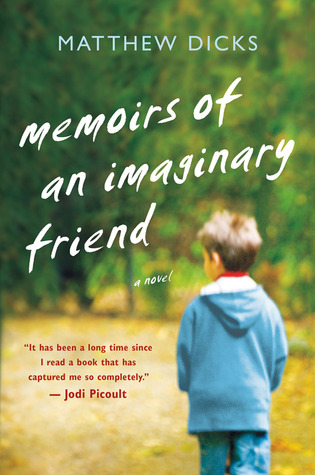
Memoirs of an Imaginary Friend by Matthew Dicks


Where imaginary is better than real.

Synopsis of Memoirs of an Imaginary Friend by Matthew Dicks: Imaginary friend Budo narrates this heartwarming story of love, loyalty, and the power of the imagination—the perfect read for anyone who has ever had a friend . . . real or otherwise.  

Budo is lucky as imaginary friends go. He's been alive for more than five years, which is positively ancient in the world of imaginary friends. But Budo feels his age, and thinks constantly of the day when eight-year-old Max Delaney will stop believing in him. When that happens, Budo will disappear.

Max is different from other children. Some people say that he has Asperger’s Syndrome, but most just say he’s “on the spectrum.” None of this matters to Budo, who loves Max and is charged with protecting him from the class bully, from awkward situations in the cafeteria, and even in the bathroom stalls. But he can’t protect Max from Mrs. Patterson, the woman who works with Max in the Learning Center and who believes that she alone is qualified to care for this young boy. 

When Mrs. Patterson does the unthinkable and kidnaps Max, it is up to Budo and a team of imaginary friends to save him—and Budo must ultimately decide which is more important: Max’s happiness or Budo's very existence.  

Narrated by Budo, a character with a unique ability to have a foot in many worlds—imaginary, real, child, and adult— Memoirs of an Imaginary Friend touches on the truths of life, love, and friendship as it races to a heartwarming . . . and heartbreaking conclusion.

My two cents

The book in one sentence: A heartwarming story of friendship, as experienced by Budo, Max's imaginary friend.

***
My heart just melted with this story. It is sweet and heartwarming, and it has an honest voice. I was initially intrigued by the title and the premise ... whoever would've thought that an imaginary friend would write a story?

The synopsis above is a bit more than I would've liked to reveal in terms of the plot. But I found this book quite special, and not just because of the story. Here's why:

1. The world building. Dicks does a wonderful job of creating the world and the psychology of imaginary friends. What is an imaginary friend? Why do they exist? What are imaginary friends like -- what do they look like, do they have superpowers, do they sleep? If they're imaginary, do they exist? From the big questions to the mundane, the author not only lets us into this other-world, he pulls us into it and ... 

2. Makes us care about imaginary friends! Especially Budo, who was imagined by Max Delaney, a young boy (who has some form of autism) needed a way to cope with the difficulties in life. Budo is just one among them. Throughout the book, we are introduced to a wide assortment of imaginary friends -- from the very human-looking Budo, to Puppy (who is in fact in the shape of a puppy), to a Pink Girl (who is like a balloon), to Oswald the Giant (who plays a special role in the story). While imaginary, they have their own personalities and back stories which can't help but make you care about them and their creators.  

3. It's about the time-honoured themes of friendship and sacrifice but it puts such an unusual twist on it that it sets this book apart. This tension -- both from Max's perspective with his deep-seated struggle to cope, and from Budo's viewpoint -- is drawn out and built up. The friendship between the imaginary and the real only highlights the paradox of what Budo has to accept as inevitable -- that when he ceases to exist, that Max has made the big step towards independence.

    If Max stays here, I could live for as long as Ma lives. I could live longer than any imaginary friend ever. Maybe if Max stays here in this room, we could both be happily ever after. (p. 183)

    I don't know how much of Max I am allowed to lose to save myself. (p. 187)
Verdict: Such a sweet and unusual story of friendship between the real and the imaginary. A must-read that will give you warm fuzzies and remind you of the beauty and innocence of childhood friendships.


The Opening:

Here is what I know:
My name is Budo.
I have been alive for five years. 
Five years is a very long time for someone like me to be alive. 
Max gave me my name. 
Max is the only human person who can see me.
Max's parents call me an imaginary friend.
I love Max's teacher, Mrs. Gosk.
I do not like Max's other teacher, Mrs. Patterson.
I am not imaginary.


Memoirs of an Imaginary Friend by Matthew Dicks


·
OLDER


© guiltless readingMaira Gall